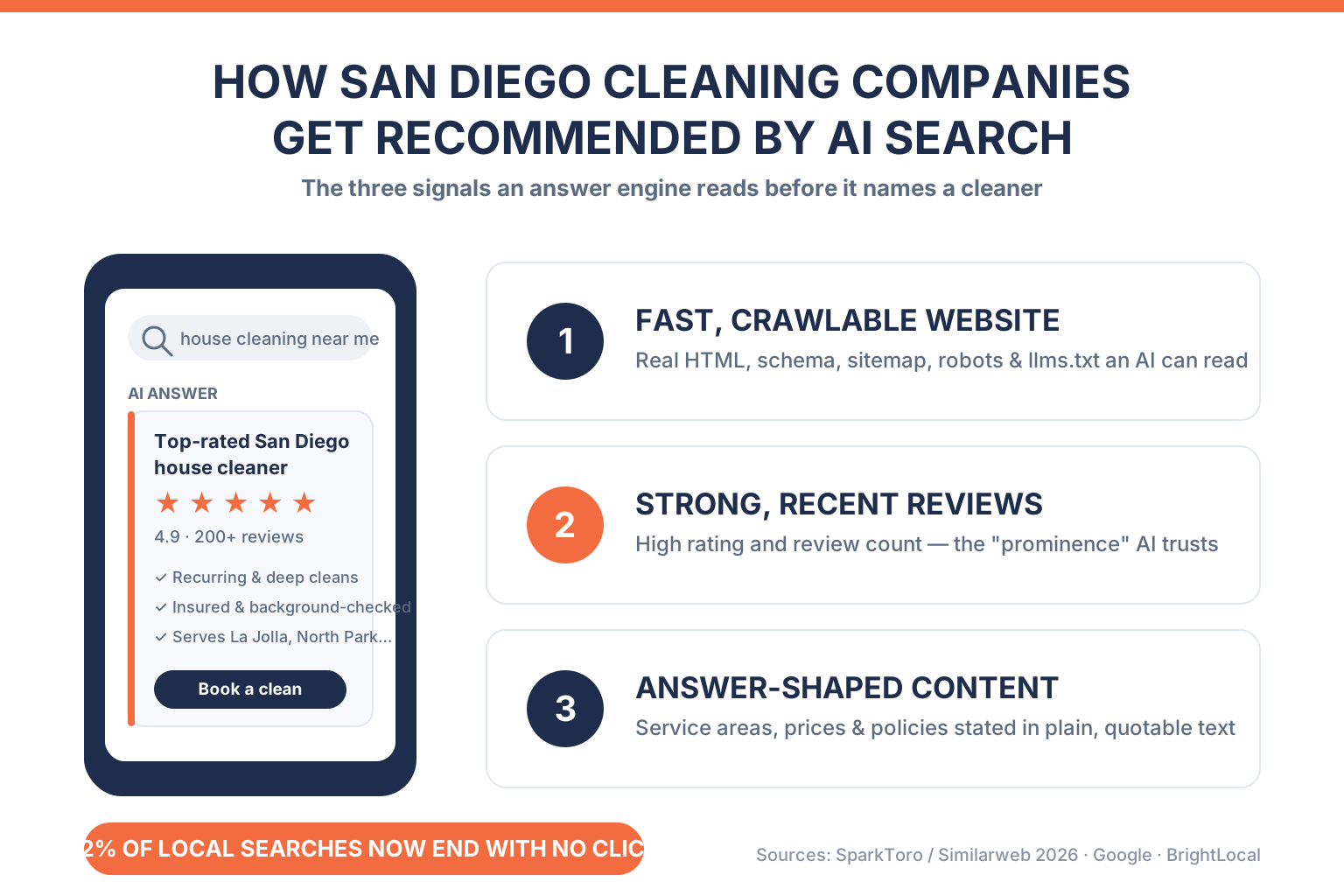
A San Diego cleaning company gets recommended by ChatGPT, Google AI Overviews, and Perplexity the same way it earns a spot in Google’s local pack — but the machine reading your business now is a language model, not just a ranking algorithm. To be the cleaner an AI names, you need three things it can actually read: a fast, crawlable website with clean structured data (schema, sitemap, and an llms.txt file), a strong and recent review profile, and answer-shaped content that states your service areas, prices, and policies in plain language. Miss those, and the AI recommends the three cleaners who have them — even if your work is better.
This matters more every quarter because search is going answer-first. In early 2026, 68% of U.S. Google searches ended without a single click to the open web (SparkToro / Similarweb), and local queries specifically were zero-click 72% of the time (Search Engine Land). When a San Diego homeowner types “house cleaning near me,” most of them never see a list of ten blue links anymore. They see one answer — and you’re either in it or you’re invisible.
This guide is for cleaning-business owners and the agencies serving them in San Diego — from Chula Vista to Carmel Valley. It explains, in plain English and with current sourced numbers, how AI answer engines pick which cleaner to recommend, why a slow or thinly-structured website quietly loses you those recommendations, and the specific, checkable things that make your business the answer. No invented figures — every stat links to its source.
Key Takeaways
- Search now answers instead of listing. In early 2026, 68% of U.S. Google searches ended without a click, and local queries were 72% zero-click (SparkToro, Search Engine Land). The homeowner reads one answer — being in that answer is the whole game.
- The audience is already enormous. Google AI Overviews reached over 2 billion monthly users by mid-2025 (Digiday) and roughly 2.5 billion by May 2026 (CNBC); ChatGPT hit 900 million weekly users (OpenAI, via TechCrunch) and Perplexity handled 780 million queries in a single month (TechCrunch).
- AI is now a real traffic source. Generative-AI referrals to U.S. retail sites jumped 1,200% between mid-2024 and early 2025 (Adobe Analytics) and 4,700% year over year by July 2025 (Forbes / Adobe).
- The signals AI weights are the ones you can control. Google ranks local results on relevance, distance, and prominence — and says more reviews and higher ratings help (Google Business Profile Help). AI engines read the same signals plus your site’s structure.
- A fast, structured site is the foundation. If an AI crawler can’t read your pages — no schema, no clean sitemap, no
llms.txt, slow load — you don’t get cited. A done-for-you Astro cleaning site ships all of that by default.
Table of contents
- What “AI search” actually means for a San Diego cleaner
- The numbers: local search is now answer-first
- How AI engines decide which cleaner to recommend
- The San Diego angle: winning “near me” when nobody clicks
- The checklist: make your cleaning site AI-visible
- Where a done-for-you fast site fits
- Frequently asked questions
What “AI search” actually means for a San Diego cleaner
“AI search” is the shorthand for how people now find answers through large language models instead of a page of links. It shows up in four places that matter to a cleaning company:
- Google AI Overviews — the AI-written summary at the top of Google results that answers the query directly, often naming specific businesses.
- Google AI Mode — a full conversational search experience that Google said surpassed 1 billion monthly users at its 2026 I/O event (Search Engine Land).
- ChatGPT and Perplexity — standalone assistants people ask “who’s a good house cleaner in San Diego?” the way they used to ask a neighbor.
- Voice assistants and Gemini — the same models, answering out loud or inside Android.
Optimizing to be named by these engines is called AEO (Answer Engine Optimization) and GEO (Generative Engine Optimization). It’s not a replacement for local SEO — it’s the next layer on top of it. The good news for an operator: the work overlaps heavily with what already wins the Google map pack. The bad news: if your website is slow, thin, or unreadable to a crawler, you fail both at once.
The numbers: local search is now answer-first
For a decade, the goal was to rank in the top three links. That goal is eroding fast, because fewer searches produce a click at all. SparkToro’s 2026 study, built on Similarweb clickstream data, found that 68.01% of U.S. Google searches ended without a click in the first four months of 2026 — up from 60.45% in 2024 — so only about 276 of every 1,000 searches now reach the open web (SparkToro).
The effect is uneven, and it’s worst exactly where a cleaning company lives. Broken out by query type, local searches were zero-click 72% of the time and informational searches 74%, while transactional queries (31%) and commercial-investigation queries (46%) still sent meaningful clicks (Search Engine Land). Translation: when someone is researching who cleans homes in their part of San Diego, they usually get their answer without visiting anyone’s site — so you need to be the business the answer names.
Zero-click rate by query type, U.S. Google searches, early 2026 (percent of searches ending with no click). Local and informational queries — exactly the ones that decide who a homeowner considers — are the most likely to end in an AI answer instead of a visit. Source: SparkToro / Similarweb via Search Engine Land, 2026.
Why is this happening? AI Overviews now appear on more than 20% of Google searches, and when one shows up, click-through to the results below drops by nearly 60% (Search Engine Land). The audience for those answers is staggering: AI Overviews reached over 2 billion monthly users by mid-2025 (Digiday) and about 2.5 billion by May 2026 (CNBC). Meanwhile the standalone assistants keep growing — ChatGPT crossed 900 million weekly active users in February 2026 (TechCrunch), and Perplexity processed 780 million queries in a single month in 2025 (TechCrunch).
And these engines send real customers, not just curiosity. Adobe Analytics measured a 1,200% surge in traffic to U.S. retail sites from generative-AI sources between mid-2024 and early 2025 (Adobe), rising to 4,700% year over year by July 2025 (Forbes / Adobe) — and those AI-referred visitors browsed more pages and bounced less than the average visitor.
Scale of the major AI answer surfaces, 2025–2026, in millions. Metrics differ by platform (monthly users, weekly users, and monthly queries — labeled per bar), so read this as relative reach, not a like-for-like ranking. Sources: CNBC, Search Engine Land, TechCrunch (ChatGPT), TechCrunch (Perplexity).
How AI engines decide which cleaner to recommend
An AI answer isn’t magic — it’s a model summarizing the most trustworthy, machine-readable information it can find about businesses that match the query and the location. For a local service like cleaning, the inputs it leans on are the ones you can influence:
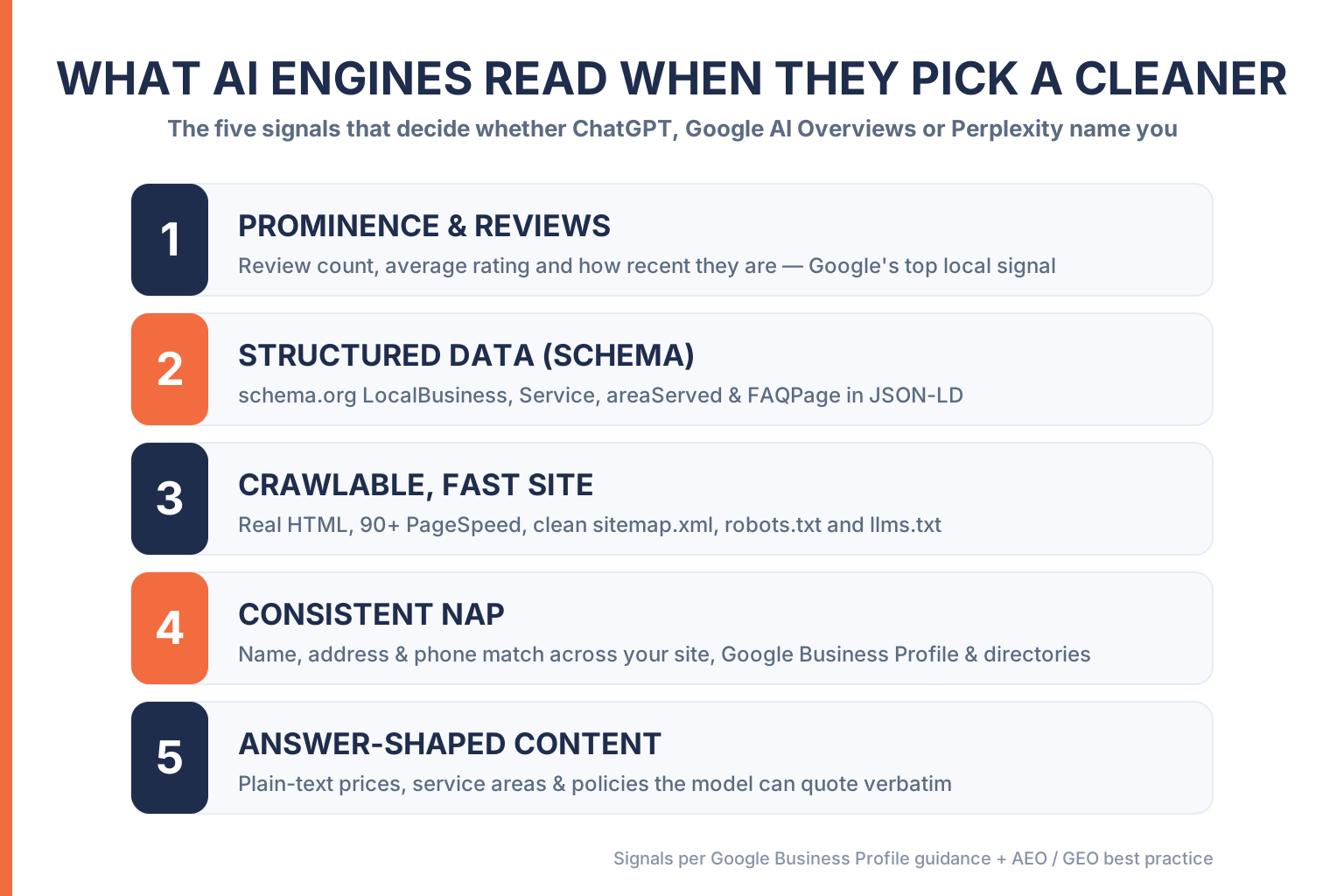
1. Prominence and reviews. Google is explicit that local ranking comes down to relevance, distance, and prominence, and that “more reviews and positive ratings can improve your business’s local ranking” (Google Business Profile Help). AI answer engines lean on the same public reputation signals — review count, average rating, and how recent those reviews are — because that’s the strongest proxy they have for “is this a real, well-regarded business.” This is why a steady, automated flow of fresh Google reviews is now an AI-visibility tactic, not just a reputation one. (We break the mechanics down in how one cleaner went from 47 to 218 Google reviews.)
2. Structured data the model can parse. When your website marks up your business, services, service area, and FAQs with schema.org JSON-LD, you’re handing the model clean, unambiguous facts instead of making it guess from prose. A cleaning page that declares its LocalBusiness/Service type, areaServed: San Diego, price ranges, and hours is far easier to quote correctly than one that buries the same details in a hero image.
3. A crawlable, fast website. If the crawler can’t load or read your pages, none of the above helps. That means real HTML (not text trapped in JavaScript that never renders), a valid sitemap.xml, a robots.txt that welcomes AI crawlers, and — increasingly — an llms.txt file that gives language models a clean map of your key pages. Speed is part of readability: Google and Deloitte’s long-cited research found that a mere 0.1-second improvement in load time lifted retail conversions 8.4% (web.dev / Deloitte), and a slow site is both harder to crawl and worse at converting the visitor once the AI does send them.
4. Consistent NAP and citations. Your Name, Address, and Phone number need to match everywhere — your site, Google Business Profile, Yelp, and directories. Contradictory listings make a model less confident naming you, and confidence is what gets you into a one-business answer.
5. Answer-shaped content. Models quote passages that directly answer a question. A page that says, in plain sentences, “We offer recurring house cleaning in San Diego, including Chula Vista, La Jolla, and North Park. A standard 2-bed/2-bath clean starts around $150,” is quotable. A page of adjectives is not.
The San Diego angle: winning “near me” when nobody clicks
San Diego is a strong market to fight for and a competitive one. The county has roughly 522,000 households with a median household income around $108,000 — well above the national average (Data USA / U.S. Census) — and a typical standard clean for a 2-bed/2-bath home runs about $150–$230 (Sparkly Maid San Diego, 2025). That’s a large, high-value pool of homeowners who increasingly ask rather than scroll.
Because 72% of local searches now end without a click (Search Engine Land), the practical target changes. Ranking #4 on a links page that nobody scrolls to is worth little. Being one of the two or three businesses named when a Carmel Valley parent asks “recommend a reliable house cleaner near me” is worth a booked recurring client.
To be that named business in San Diego specifically, your site needs local specificity the model can lift verbatim:
- Name your neighborhoods and suburbs. “San Diego” is a start; “La Jolla, Pacific Beach, North Park, Chula Vista, and Carmel Valley” is what gets you matched to a hyper-local question.
- Publish service-area pages, not one generic page. A page per area with genuinely local detail (parking, HOA norms, typical home sizes) gives the model distinct, quotable facts for each query.
- Put real prices and policies in text. Answer the exact questions homeowners ask an AI: what it costs, what’s included, whether you’re insured, how to book.
- Mark it up with
areaServedschema. Declare San Diego and its sub-areas in structured data so distance/relevance matching is unambiguous.
The checklist: make your cleaning site AI-visible
Here’s the concrete, checkable list. If your current website can’t tick these, that’s exactly where recommendations are leaking:
- 90+ PageSpeed on mobile. Fast pages crawl cleanly and convert the traffic AI sends. (Slow, plugin-heavy sites fail here — see Astro vs WordPress for cleaning sites.)
- Schema on every page —
LocalBusiness/Service,areaServed,FAQPage, andBreadcrumbListin JSON-LD. - A clean
sitemap.xmlandrobots.txtthat let search and AI crawlers index everything. - An
llms.txtfile that maps your key pages for language models. - Per-neighborhood service pages with real local detail and prices in text.
- A live, automated Google-review engine so your rating count is high and recent.
- Consistent NAP across your site, Google Business Profile, and directories.
- Answer-first copy — every page opens by directly answering the question it targets.
- An always-on booking path (a fast form, calculator, or AI chat widget) so an AI-referred visitor can book in seconds.
None of these are exotic. They’re just rarely all present on a small cleaning company’s website at once — which is precisely why the businesses that do have them get named.
Where a done-for-you fast site fits
You can build every item on that checklist yourself if you have the time and the technical comfort. Most cleaning operators don’t — they’re running crews, not editing schema. That’s the gap our Get-a-Website service closes: we build cleaning-company sites on the Astro framework with a guaranteed 90+ Google PageSpeed score (often a perfect 100), schema and meta structured for AEO/GEO, and correct sitemap, robots, and llms.txt files shipped by default — the exact foundation AI answer engines need to read and recommend you.
It’s a flat $497 one-time + $97/month (you pay only the monthly up front; the build fee is due after the site is live and you’re happy), which covers managed hosting, your domain, SSL, per-neighborhood location pages, an instant-quote calculator, and an AI chat widget — no per-edit agency fees (Get a Website). For agencies and multi-location operators, five sites are $1,200 one-time + $297/month. Pair it with an automated review flow and you’ve built the whole AI-visibility foundation in one move.
The shift underneath all of this is simple: search used to send you a visitor to persuade, and now it increasingly sends the homeowner an answer to trust. The cleaning companies that win the next few years in San Diego will be the ones whose website makes them the easiest business for a machine to read, verify, and recommend. Build that foundation now, while most of your competitors still think “AI search” is something that happens to someone else.
Frequently asked questions
How do I get my cleaning business recommended by ChatGPT or Google AI Overviews?
Give the AI clean, trustworthy, machine-readable signals about your business: a fast, crawlable website with schema.org structured data (LocalBusiness/Service, areaServed, FAQPage), a valid sitemap, robots.txt, and an llms.txt file; a strong and recent Google review profile; consistent Name/Address/Phone across the web; and answer-first pages that state your San Diego service areas, prices, and policies in plain text. AI engines lean on the same prominence and relevance signals Google uses for local ranking (Google Business Profile Help), plus your site's structure. A done-for-you Astro site ships that foundation by default.
What is AEO and GEO, and how are they different from SEO?
SEO (Search Engine Optimization) gets your page into the list of links. AEO (Answer Engine Optimization) gets your business quoted in the AI-written answer above the links. GEO (Generative Engine Optimization) gets you named when someone asks a standalone assistant like ChatGPT or Perplexity to recommend a cleaner. All three read the same foundation — a fast, well-structured, well-reviewed web presence — so you build one site that wins all three, not three separate strategies.
Do AI answer engines really affect a local San Diego cleaning business?
Yes. In early 2026, 68% of U.S. Google searches ended without a click, and local searches specifically were zero-click 72% of the time (Search Engine Land). Google AI Overviews reached roughly 2.5 billion monthly users by May 2026 (CNBC). When most local searchers get an answer without visiting anyone's site, being the business that answer names is how you get the booking.
Does website speed affect whether AI engines cite my cleaning site?
It helps in two ways. A fast site is easier and more reliable for crawlers to load and read, and it converts the visitor better once an AI sends them — Google and Deloitte found a 0.1-second faster load lifted conversions 8.4% (web.dev / Deloitte). Slow, plugin-heavy sites tend to fail both. We build on Astro with a guaranteed 90+ PageSpeed score; see Astro vs WordPress for cleaning websites.
What is an llms.txt file and do I need one for my cleaning website?
llms.txt is a simple text file at the root of your site that gives large language models a clean map of your most important pages, so AI crawlers can find and understand your services and location pages without wading through clutter. It's a low-cost, forward-looking AEO/GEO signal. Our Get-a-Website build ships a correct llms.txt (alongside sitemap.xml and robots.txt) automatically.
How long does it take to become visible in AI search?
There's no day-one switch — AI engines cite businesses with an established, trustworthy footprint. With a fast, properly structured site, per-neighborhood pages, clean schema/sitemap/llms.txt, and a growing recent-review profile, most local cleaning sites start gaining local search and AI visibility within about 3–5 months. Anyone promising instant AI rankings isn't being straight with you. State and municipal licensing, insurance, and bonding remain the operator's responsibility.
Nadia Sarin leads customer retention and reviews content for Cleaning Services GHL Snapshot and is based in San Diego, CA. She writes about the parts of a cleaning business that compound quietly — review flywheels, recurring revenue, and now the structured, well-reviewed web presence that decides whether an AI names your company or a competitor’s. Statistics cited here are from the linked third-party sources; San Diego household and income figures are from the U.S. Census Bureau via Data USA, and pricing is illustrative.
Related reading: Local SEO for cleaning businesses: the map-pack playbook · From 47 to 218 Google reviews without begging · Astro vs WordPress for cleaning websites · AI chat widget for cleaning companies · Online booking for cleaning businesses