
It is the third Monday in a row you are a cleaner short. Someone texted at 6:40am that they are “not feeling it anymore,” or they just did not show and will not answer. Now you are repacking routes in the parking lot, pushing clients, and doing a two-hour house yourself. You hired that person eleven weeks ago, and now you start over.
Here is the honest answer most owners do not want to hear: if good cleaners keep leaving, it is almost never because cleaners are flaky by nature. It is because the job you hand them, the schedule, the pay, the first two weeks, the way they hear from you, has holes in it, and quitting is where those holes leak out. Fix the system around the person and most of the churn disappears. This guide covers why cleaners quit, what each lost person costs you, the six-stage system that keeps a crew together, the texts you can steal, and how it changes at three sizes.
Key Takeaways
- Turnover is a system problem, not a character flaw. Among people who quit in 2021, 63% cited low pay, 63% no path to advance, and 57% feeling disrespected (Pew Research Center). None of that is “lazy.”
- It is expensive. Replacing one worker costs one-half to two times their annual pay, and voluntary turnover costs US businesses about $1 trillion a year (Gallup). Cleaning runs 100–200% turnover at many shops (CleanLink).
- Most of it is preventable. Gallup found 52% of voluntary leavers say their employer could have kept them. The cheapest levers are the ones owners skip: a real first two weeks, a predictable schedule, and communication that is not a chaotic group chat.
Table of contents
- Why cleaners actually quit
- What turnover really costs a cleaning business
- The system that keeps a cleaning crew
- The crew texts you can steal today
- The 1099 trap that makes turnover worse
- The same problem at three sizes
- The objections I hear from owners
- Frequently asked questions
- The bottom line
Why cleaners actually quit
When a cleaner leaves, the owner’s story is about the cleaner: unreliable, did not want to work. Sometimes true, mostly not. The research on why people quit points back at the job.
Pew Research Center asked Americans who left a job in 2021 why they went. The top answers were low pay (63%), no opportunities for advancement (63%), and feeling disrespected (57%), followed by a lack of flexibility to choose their hours (45%) (Pew). Read those with a cleaning crew in mind: pay too low to live on, no sense that showing up well leads anywhere, feeling like a disposable pair of hands, a schedule that changes with no notice. That is the daily experience of a lot of cleaners, and it is fixable.
Share of workers who quit a job in 2021 citing each as a reason. Source: Pew Research Center, 2022.
The useful part is one more Gallup finding: 52% of people who quit voluntarily say their employer could have kept them (Gallup). Half your churn walked out a door you could have closed.
What turnover really costs a cleaning business
Owners treat a quit as a weekend of re-hiring. The real bill hits in four places.
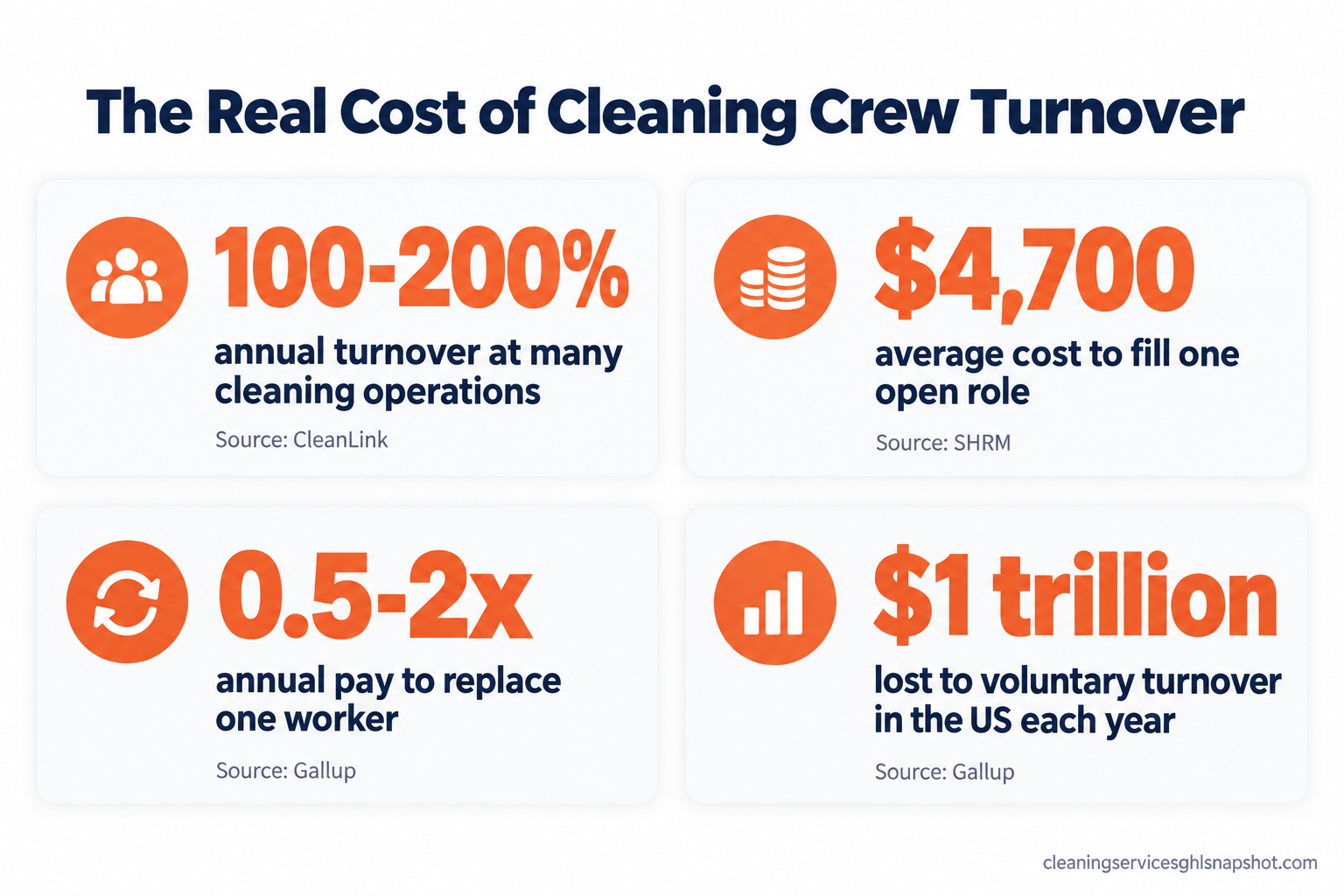
The hard cost of replacing them. SHRM pegs the average cost to fill a role at about $4,700 (SHRM). Gallup frames it bigger: replacing one person costs one-half to two times their annual pay with lost productivity added (Gallup). For a cleaner near the median of $17.07 an hour, about $37,080 a year (BLS), even the low figure is real money you pay every time the door spins.
The revenue you drop while short-staffed. A missing cleaner means pushed appointments, a route you could not run, a deep clean you turned away. Where labor is the product, an empty seat is lost sales, not just lost wages.
The quality tax on clients. New hires are slower and miss things for weeks. Churn constantly and your clients are perpetually cleaned by someone on week two, exactly when a recurring customer starts shopping around. Crew turnover becomes client turnover.
The owner’s own time. Every quit pulls you back into recruiting, trial cleans, and training. At 100–200% annual turnover (CleanLink), a ten-person shop runs fifteen to twenty hires a year.
The system that keeps a cleaning crew
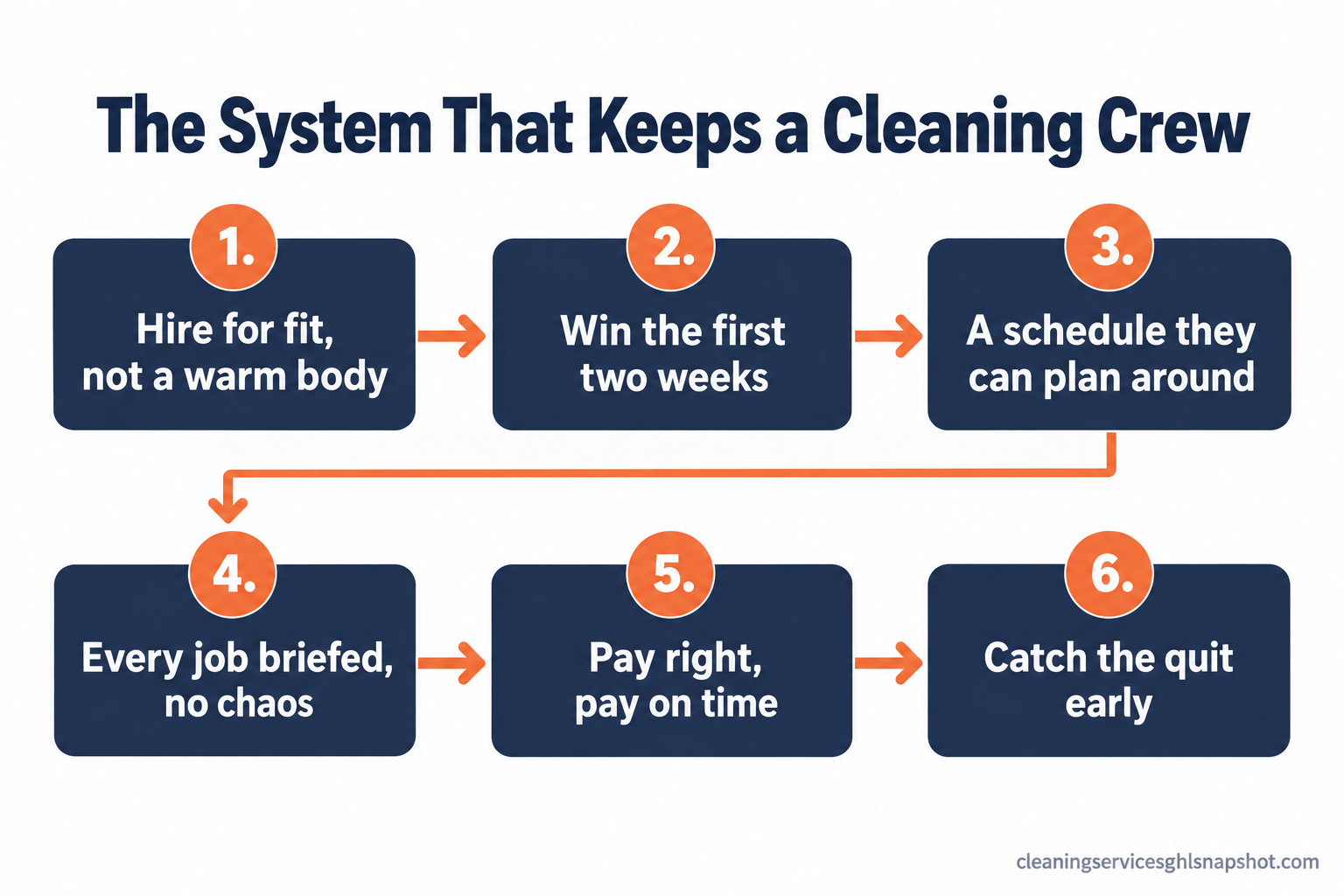
You cannot personality-test your way out of churn, and you cannot pay your way out alone. What works is a system: the same six stages for every hire, so a good cleaner has a reason to stay and a bad fit shows early.
1. Hire for fit, not just a warm body
Desperate hiring is the root of most early quits. Short on people, you say yes to anyone with a car, and three weeks later they ghost. Break the loop by always recruiting: keep an application link live, run a short phone screen, and do a paid trial clean before anyone is “hired.” How it breaks: you skip the trial because you need them Tuesday, and learn on a client’s floor that they cannot clean. The fix: a standing intake, so you choose from a bench instead of begging.
2. Win the first two weeks
Most turnover happens early. A cleaner who feels lost in week one is already half gone. Give them a named buddy to ride with, a checklist for each room, the gear in their hands on day one, and a real check-in at week’s end. How it breaks: you hand a new person a key and assume they will “figure it out,” and they decide the place is a mess. The fix: a written onboarding path, the same muscle as your client onboarding system, pointed at the crew.
3. Give a schedule they can plan a life around
Unpredictable scheduling is a loud quit signal, and it showed up in the Pew data as a lack of flexibility. Cleaners have kids, second jobs, and lives. If they learn Sunday night what Monday looks like, they will take a warehouse job that posts two weeks out. Publish the week ahead, keep each person’s days consistent, and give an easy way to request time off. How it breaks: you shuffle people daily to patch holes, and your most reliable cleaners burn out first. The fix: stable, published routes, which also make you run on time, per route optimization for cleaning businesses.
4. Communicate every job without the chaos
A lot of crew frustration is information friction: nobody knew the gate code, the scope changed and no one said, the group chat has 200 unread messages. Every clean should reach the crew the night before with the address, access, scope, and client notes, automatically. How it breaks: you run the operation out of a group text and your memory, so things get missed and “this place is disorganized” becomes a reason to leave. The fix: push each job to the assigned cleaner as a structured message, which our SMS automation and CRM and workflows do.
5. Pay right, pay on time, and show the path
Pay is real; you will not out-communicate a wage nobody can live on. You do not have to be the highest payer in town, but you must be in the honest range, pay exactly when you said, and make the math clear: what they earn now, what a lead earns, and how to get there. The median for maids and housekeeping cleaners is about $17 an hour (BLS). How it breaks: one late or wrong paycheck erases months of goodwill. The fix: reliable payroll and a one-page “here is how you earn more here.”
6. Catch the quit before it happens
People rarely quit out of nowhere. The signs come first: fewer shifts, going quiet, small quality slips, a run of “running late.” Build a monthly 30-second stay-check with each person, “how is it going, what would make this better,” and act on what you hear. How it breaks: you only talk to a cleaner when something is wrong, so they stop telling you anything. The fix: make the normal state of the relationship a short, two-way check-in, so you hear “I need Fridays off” before “I quit.”
The year I stopped blaming cleaners and started fixing the job around them, my turnover roughly halved. It was not a raise that did it. It was a real first two weeks, a schedule people could plan around, and ending the group-chat chaos. Pay gets them in the door; the system keeps them.
The crew texts you can steal today
Half of retention is just communicating like a company instead of a chaotic group chat. Steal these and automate the ones that repeat. For more, see our cleaning business text message templates.
Day-one welcome (send the night before the first shift):
Hi [Name], welcome to [Company]! Tomorrow you are riding with [Buddy], meet at [place/time]. Wear [dress code], we supply the rest. Text me here any time. Glad to have you.
Night-before job brief (every cleaner, every day):
Tomorrow: [Client], [address], arrive [time]. Access: gate 1234, key in lockbox. Scope: 3 bed / 2 bath recurring, focus kitchen + master bath. Pet home. Reply 👍 to confirm.
Shift confirmation (cuts morning no-shows):
Morning [Name]! You are on for [#] stops today starting [time] at [first address]. Reply C to confirm you are rolling, or call me if anything came up.
Payday confirmation (builds trust every cycle):
Payday 💸 Your pay for [dates] just went out, [amount] for [hours] hours. Questions on the numbers? Reply here. Thanks for the solid work this week.
Monthly stay-check (catches the quit early):
Checking in, [Name], you have been with us [time] now. How is it going, honestly? One thing that would make the job better?
Recognition (free, and almost nobody does it):
Saw the before/after on the [Client] deep clean, excellent work. Passing it to the team. Thank you.
These work because they replace silence and guesswork with a company that has its act together. A cleaner who knows where to be, gets paid on time, and hears “nice work” occasionally does not go job-hunting.
The 1099 trap that makes turnover worse
A lot of owners try to dodge the staffing headache by calling everyone a 1099 contractor. It feels cheaper, but it usually makes retention and your risk worse at once.
To legally treat a cleaner as a 1099 contractor, you generally cannot control how, when, and where they work, which is the opposite of running a tight, consistent operation. The more you do the retention things in this guide, set the schedule, assign routes, require your process, the more those workers look like employees to a labor agency. In states using the strict ABC test, cleaning companies almost always fail, and the penalties are not small. We walk through the tests and numbers in 1099 vs W-2 for cleaning businesses.
The retention angle is simpler: contractors have no reason to be loyal and every reason to take the next better gig, so a 1099-only model often bakes in the churn you are trying to escape. This is not legal advice, but 1099 is not a turnover fix.
The same problem at three sizes
The six stages are universal. Which one matters most changes with the shape of your business.
Rough annual replacement cost at ~150% turnover, using SHRM’s ~$4,700 average cost to fill one role. Source: SHRM and Gallup.
Solo operator or two-person team. You are the recruiter, trainer, and the one covering the shift when someone quits, so you cannot afford a 100% turnover year. Your biggest moves are stage 2 (a real first two weeks, even if the “buddy” is you) and stage 4 (automated job briefs), so a new person ramps fast. One retained cleaner is the difference between taking on recurring clients and turning them down.
Mid-size residential team (roughly 3 to 15 cleaners). Your pain is consistency across crews, so the schedule (stage 3) and communication (stage 4) carry the most weight. This is where an owner’s memory stops being a system and you need published routes, structured job briefs, and a real onboarding path.
Large or commercial and janitorial (15 to 50+). Bid-based contracts, night crews, and the industry’s brutal 100–200% turnover (CleanLink) mean you onboard constantly, and a gap on a night shift can be a contract-compliance problem. Your priorities are stage 1 (an always-on hiring pipeline) and stage 5 (competitive, dead-on-time pay).
The chart is the point: a ten-person shop at 150% churn spends roughly $70,000 a year replacing people. Halving that pays for a lot of system.
The objections I hear from owners
“Pay is the real problem, and I can’t just raise wages.” If you are well under market, fix that first. But pay was one of several top reasons people quit, alongside no advancement, feeling disrespected, and no flexibility (Pew). The cheapest wins, a real first two weeks, a predictable schedule, ending the group-chat chaos, cost almost nothing.
“I use 1099 contractors, so retention isn’t my job.” It is, because churn still costs you re-hiring time and client quality, and leaning on 1099 to avoid managing people is the misclassification risk in the 1099 vs W-2 guide. Contractor or employee, the stages that make people come back still apply.
“I’m too small to have an HR system.” You do not need an HR department, just a one-page onboarding checklist, a published schedule, and a few texts that fire automatically, which a solo operator runs from a phone. Small is when one quit hurts most, so small is when a light system pays off fastest.
“They’ll just leave for fifty cents more anyway.” Some will, and you cannot keep everyone. But people rarely leave a job where they feel set up to succeed, paid on time, and occasionally appreciated. They leave chaos over fifty cents. Fix the chaos and the fifty cents stops mattering.
Frequently asked questions
Why do my cleaners keep quitting?
Usually because of the job, not the person. The most-cited reasons people quit are low pay, no path to advance, feeling disrespected, and unpredictable scheduling (Pew Research Center, 2022). In cleaning that shows up as a rough first two weeks, a schedule that changes with no notice, and chaotic communication. Gallup found 52% of voluntary leavers say their employer could have kept them, so much of your churn is preventable.
What is a normal turnover rate for a cleaning business?
High. Contract cleaning and janitorial operations often run 100% to 200% annual turnover (CleanLink), so a 10-person shop can churn through 15 to 20 hires a year. That is common but not fixed. Operators who onboard well, schedule predictably, and communicate clearly cut turnover well below the industry norm.
How much does it cost to replace a cleaner?
More than owners expect. SHRM puts the average cost to fill a role at about $4,700, and Gallup estimates total replacement cost at one-half to two times the person's annual pay once lost productivity is counted. For a cleaner earning around $37,000 a year, even the low end is real money you pay every time someone leaves.
Can software really reduce cleaning staff turnover?
It will not fix a bad wage or bad management, but a lot of churn is pure information friction: missed job details, no schedule visibility, a buried group chat. Automating night-before job briefs, shift confirmations, published schedules, and payday texts removes the daily chaos that makes cleaners feel set up to fail.
Should I use 1099 contractors to avoid turnover headaches?
Be careful. To legally treat cleaners as 1099 contractors you generally cannot control their schedule, routes, and process, which conflicts with running a consistent operation, and in ABC-test states cleaning companies usually fail with real penalties. Contractors also have little reason to stay. Talk to your accountant, and do not treat 1099 as a retention fix.
The bottom line
Your cleaners are probably not quitting because cleaners are flaky. They are quitting because the first two weeks were a mess, the schedule changed every Sunday, the pay was late or below the warehouse down the road, or nobody said the job was going well. Every one of those is a system you can build.
Start this week with the two stages that pay off fastest: write a one-page onboarding path so your next hire’s first two weeks are not chaos, and turn on automatic night-before job briefs and shift confirmations. From there, stabilize the schedule, tighten payday, and add the monthly stay-check. If you would rather not wire that by hand, the Cleaning Snapshot ships the scheduling, job-brief, and confirmation automations pre-built, or book a walkthrough first. A crew that stays is a system you install, not a personality you get lucky with.
About the author
Marisol Vega is a Cleaning Operations Strategist in Austin, TX. She spent nine years scaling a residential maid service from two vans to a fourteen-crew operation before moving full-time into systems work, and writes about the unglamorous mechanics of a profitable cleaning business: route density, recurring-attach rate, and the texts that keep a Tuesday schedule full.
Related posts
- Why Is My Cleaning Crew Always Late? The Real Causes and the Fix
- Cleaning Business Client Onboarding: From Booked to a First Clean They Rebook
- 1099 vs W-2 for Cleaning Businesses: What It Really Costs to Get It Wrong
- Cleaning Business Text Message Templates: 28 SMS Scripts That Book, Confirm & Retain
Sources
- Pew Research Center: Majority of workers who quit a job in 2021 cite low pay, no opportunities for advancement, feeling disrespected
- Gallup: This Fixable Problem Costs U.S. Businesses $1 Trillion
- SHRM: The Real Costs of Recruitment
- CleanLink / Contracting Profits: Report Evaluates Industry Turnover
- BSCAI: Industry Reports (Building Service Contractor Frontline Labor Report)
- U.S. Bureau of Labor Statistics: Maids and Housekeeping Cleaners (OEWS)
- U.S. Bureau of Labor Statistics: Janitors and Building Cleaners (OEWS)