
It is a Tuesday morning and the envelope on your desk is from your state labor department. One of your cleaners, the one who quit in March, filed for unemployment and listed your company as her employer. You paid her on a 1099. Now the state wants to know why a person who worked your routes, on your schedule, for eleven months was never on payroll. That one letter can turn into back taxes, penalties, and a bill that dwarfs the wages you were trying to save on.
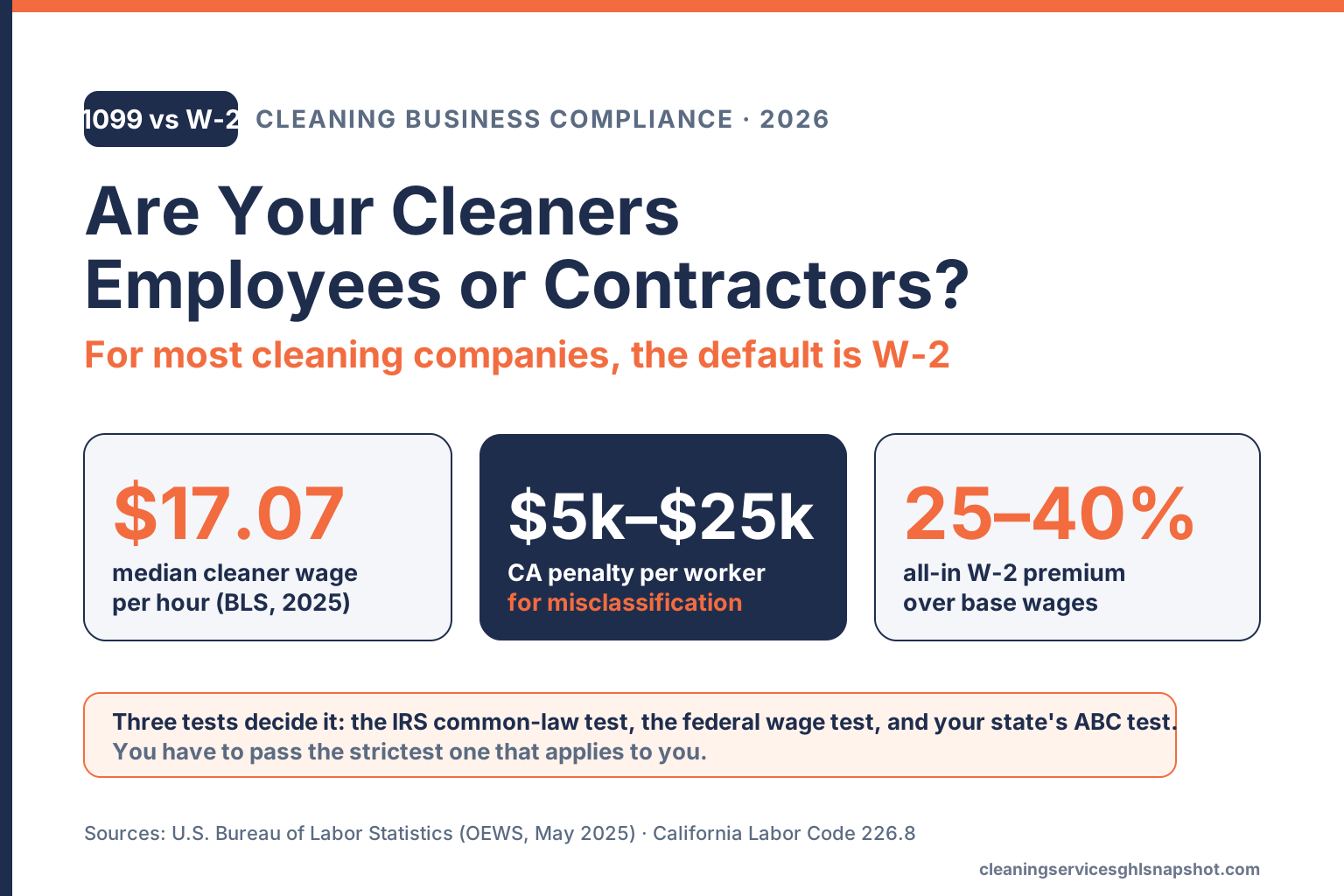
Here is the short answer. For most cleaning companies, the people who clean are employees, not independent contractors, under at least one of the tests that apply to you. You can still use 1099 contractors in narrow cases, but the default is W-2, and guessing wrong is one of the most expensive mistakes an owner can make. This guide walks the three tests, the real cost math, and how to fix a bad setup before a letter arrives.
Key takeaways
- The default answer is W-2. Three tests (IRS, federal wage law, your state) can each reclassify your cleaners, and they do not agree. You have to pass the strictest one that applies.
- A signed “independent contractor” agreement does not settle it. Regulators look at how the work actually happens, not what the paper says.
- The real W-2 premium is smaller than owners think. Payroll taxes add roughly 10% over wages; all-in with workers’ comp and paid time, usually 25% to 40% over base pay.
- The penalty for getting it wrong is larger than owners think. In California, willful misclassification runs $5,000 to $25,000 per worker on top of back taxes and interest.
- The federal rules loosened in 2025, but that does not save you. The IRS test and strict state tests like California’s did not change.
Table of contents
- Why this question decides your margins
- The three tests that do not agree
- Test 1: the IRS common-law test
- Test 2: the federal wage-law test (and what changed in 2025)
- Test 3: the state ABC test, where most cleaners fail
- The real cost of 1099 vs W-2
- Three operators, three answers
- How to fix a bad setup
- Objections I hear every week
- FAQ
Why this question decides your margins
Labor is the biggest line in a cleaning P&L, so how you classify your workers changes the economics, not just the paperwork. The Bureau of Labor Statistics counted 860,670 maids and housekeeping cleaners in its May 2025 survey, median $17.07 an hour (about $35,510 a year). Janitors and building cleaners number over 2.2 million, median $17.71 an hour. When crews earn $17 and change, every point of added labor cost stings, which is why owners reach for 1099 status: it looks like it shaves 10% to 30% off each worker.
The catch is that the savings are a loan, not a gift. If the classification is wrong, the state and the IRS can claw back the employer taxes you skipped, add interest, and stack penalties on top, and the longer it ran and the more workers it covered, the bigger the bill.
The three tests that do not agree
There is no single definition of “independent contractor.” At least three separate authorities each run their own test, and a worker can pass one and fail another.
| Test | Who runs it | What it controls | How hard it is to pass |
|---|---|---|---|
| Common-law test | IRS (federal taxes) | Payroll tax, W-2 vs 1099 filing | Moderate; weighs control |
| Economic reality test | US Dept. of Labor (wage/hour) | Minimum wage, overtime | Looser as of 2025 |
| ABC test | Many states (CA, MA, NJ, etc.) | State wage law, unemployment | Very hard for cleaners |
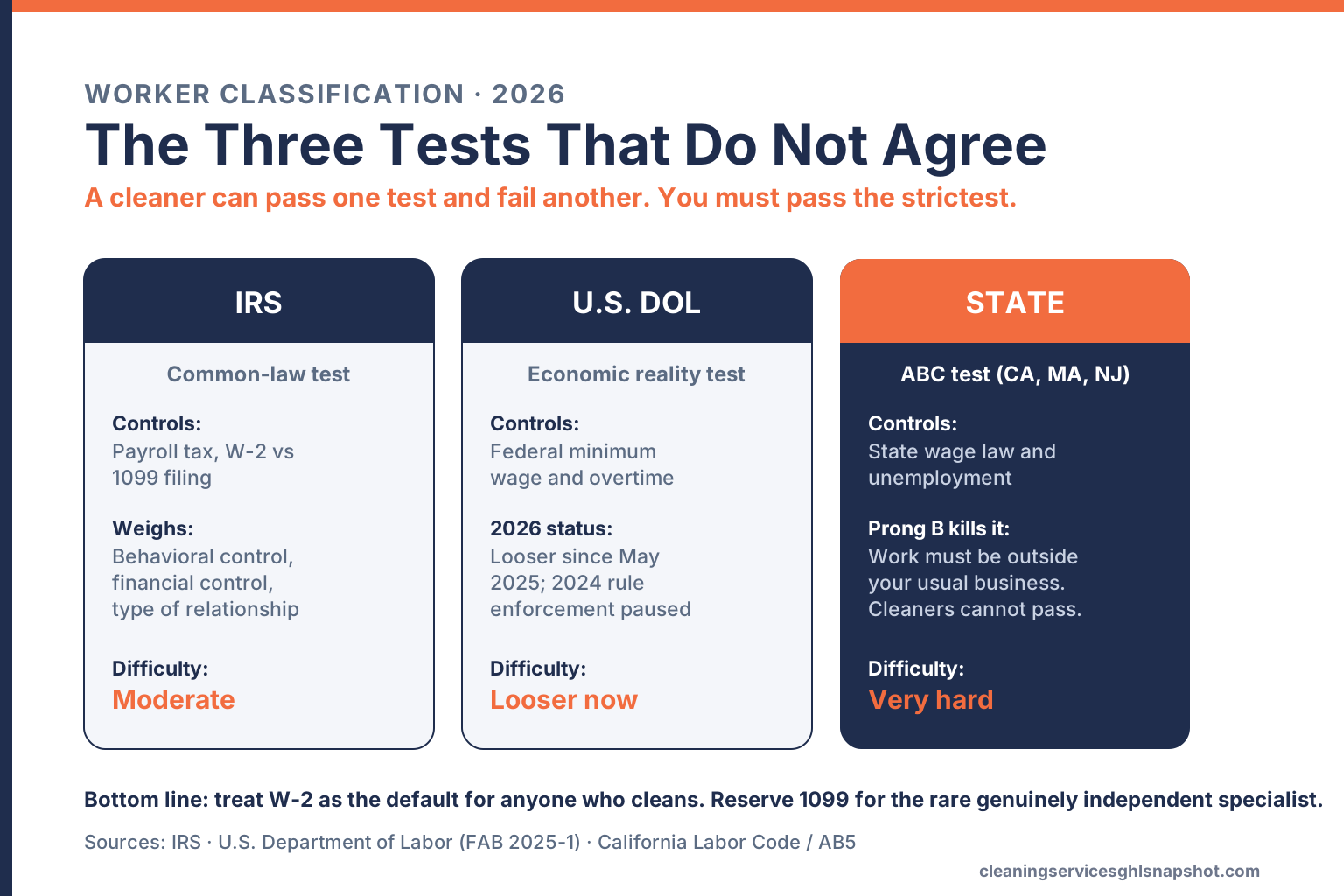
You do not get to pick the friendliest one. You have to satisfy every test that applies, which means passing the strictest. For a cleaning company in an ABC-test state, that is the state test, and it is brutal. Let’s take them one at a time.
Test 1: the IRS common-law test
The IRS decides federal tax status with its common-law test, built on three buckets of evidence:
- Behavioral control. Do you control what the worker does and how? Set their hours, assign the route, hand out the checklist, require your uniform? That points straight at employee.
- Financial control. Who provides the supplies, the vacuum, the car, the gas? Can the worker realize a profit or loss, or do they just earn an hourly or per-job rate? A true contractor has real financial skin in the game.
- Type of relationship. Is the work ongoing and central to your business, or a one-off specialty project? A cleaner cleaning for a cleaning company is the core product, which weighs heavily toward employee.
How it breaks for cleaners
This is where most owners trip. You think you have contractors because you pay on a 1099 and everyone signed a form. But look at the facts: you set the schedule, assign the homes, hand out the checklist, require before-and-after photos, and send the “crew is on the way” texts. Every one of those is control, and the IRS reads the facts on the ground, not what the contract calls it.
If you are unsure, either side can file IRS Form SS-8 and ask the IRS to decide. Most owners do not want to invite that, and a cleaner who gets hurt, fired, or angry can file it for you. The answer usually comes back “employee.”
Test 2: the federal wage-law test
Separate from taxes, federal wage and hour law (the FLSA, which sets minimum wage and overtime) uses an “economic reality” test. This is the one that actually changed recently, and the change is widely misunderstood. In 2024 the Department of Labor issued a strict six-factor rule. Then in May 2025 the DOL paused enforcement of that rule and reverted to an older, more business-friendly framework, and in 2026 it proposed rescinding the 2024 rule entirely. So at the federal wage level, the standard is looser than it was two years ago.
Federal wage law got friendlier, but it is the least of your three worries. The tax test and the state test generate the big assessments, and neither moved.
Test 3: the state ABC test
Many states, including California, Massachusetts, and New Jersey, use the ABC test for state wage law and unemployment. It is the hardest to pass and the one that sinks most cleaning companies. A worker is presumed an employee unless the business proves all three:
- A. The worker is free from the company’s control and direction.
- B. The worker performs work outside the usual course of the company’s business.
- C. The worker is engaged in an independently established trade of the same nature.
Prong B is the killer. The work must be outside the usual course of your business, and a house cleaner cleaning houses for a house-cleaning company is doing the exact thing the company sells. There is almost no honest way to argue cleaning is “outside the usual course” of a cleaning business. That is why California, which codified the ABC test in AB5, effectively presumes cleaning-company cleaners are employees.
The California spotlight
The stakes there are specific and large. Willful misclassification carries civil penalties under Labor Code 226.8 of $5,000 to $15,000 per violation, rising to $10,000 to $25,000 for a pattern or practice. Those are per worker, stacked on the back payroll taxes and interest the state and IRS also want. Janitorial has long been a named enforcement target there.
If you operate in an ABC-test state, treat W-2 as the starting assumption for anyone who cleans. The exceptions are narrow and worth a lawyer’s time, not an owner’s hunch. For the quoting side of that labor math, see how to build cleaning pricing tiers that still leave a margin once the crew is on payroll.
The real cost of 1099 vs W-2
The whole reason owners gamble on 1099 is cost, and the good news is the real W-2 premium is smaller than you fear. On W-2 you pay employer payroll taxes on top of wages: 7.65% for FICA (6.2% Social Security up to the 2026 base of $184,500, plus 1.45% Medicare), about 0.6% effective federal unemployment, and a state unemployment rate that commonly starts near 3% for a new employer. Add workers’ compensation, which for cleaning runs well above an office rate, plus paid time off. All in, a W-2 cleaner usually lands 25% to 40% over base wages, with the pure tax piece closer to 10%.
Illustrative hourly cost of a $20/hr cleaner. “W-2 + payroll tax” adds ~10% for FICA, FUTA and SUTA; “W-2 all-in” adds workers’ comp and paid time for a ~25-40% premium. Rates vary by state. Sources: SSA 2026 wage base, IRS employer tax guide.
So a $20 wage costs about $25 to $27 an hour all-in on W-2. Now the other side of the ledger: the cost of dodging it wrong.
Per-worker exposure for a misclassified $35k/yr cleaner: recovered employer taxes run a few thousand a year before interest; California adds $5,000-$25,000 per worker in willful-misclassification penalties. Multiply by every cleaner and every year.
One misclassified cleaner who triggers an audit can cost more than a year of the W-2 premium on your whole crew. That is the real trade: a budgetable 25% to 40% versus a lottery ticket that pays out in five- and six-figure assessments.
Three operators, three answers
The solo operator with two helpers
You clean yourself and bring two people on busy days, pay them 1099, and assume it is fine because they are “part-time” and “just helping.” It is not. Part-time does not mean contractor, and helping you do the core work is the textbook employee pattern. The fix is cheap: a payroll app runs a few dollars per worker a month, and two part-timers on W-2 add maybe a few hundred a month in taxes, set against one unemployment claim that unravels everything.
The mid-size residential shop with eight cleaners
Recurring homes, tight routes, turnover as your top headache. The 1099 temptation is strongest here because eight people’s payroll taxes feel like real money. But eight misclassified workers is also eight penalty multipliers and eight potential claims. The smarter lever is making W-2 crews pay for themselves through density: tighter routes, fewer no-shows, and higher recurring-attach recover far more than the tax savings ever did. Our guides to cutting crew no-shows and route planning are where that margin lives.
The large janitorial contractor with a 40-person night crew
You bid commercial contracts and run night crews across buildings, and you face the strictest scrutiny. Janitorial is a named enforcement target in several states, clients increasingly require proof that workers are W-2 and insured, and one large audit can end a contract. At this scale W-2 is not a choice, it is a requirement to keep winning commercial cleaning contracts. The edge goes to the contractor who can show clean classification, real workers’ comp, and documented crews.
How to fix a bad setup
Realized your 1099 crew should be W-2? Do not wait for a letter. A rough playbook:
- Stop the bleeding. Do not add new 1099 cleaners while you sort it out. Every one adds to the exposure.
- Get a professional read. A few hundred dollars on an employment attorney or payroll CPA to confirm status is the cheapest insurance around.
- Look at voluntary programs. The IRS’s Voluntary Classification Settlement Program lets eligible employers reclassify going forward with reduced back-tax liability. Ask your CPA if it applies.
- Reclassify forward. Put the crew on payroll, set up employer tax accounts, and get workers’ comp in place.
- Document from here on. Offer letters, time records, and a clean paper trail turn a future audit into a formality.
Steal this: the self-audit checklist
Run this control audit on each “contractor.” Every “yes” pushes toward employee:
- Do I set their work hours or schedule?
- Do I assign which jobs or route they take?
- Do I require my uniform, my checklist, or my branded materials?
- Do I provide the supplies, equipment, or vehicle?
- Do I forbid them from sending an unapproved substitute?
- Is cleaning the core service my company sells?
- Has this person worked for me on an ongoing basis, not a one-off project?
- Do they clean for other clients of their own, under their own business?
If you answered “yes” to the first seven and “no” to the last, you almost certainly have an employee.
Steal this: when a 1099 can actually hold up
True contractor relationships exist here, they are just narrow. A specialist you bring in for a one-time post-construction job who runs their own crew, sets their own price, carries their own insurance, and cleans for other companies can be a legitimate 1099. The test is independence: they run a real business, you are one of their clients, and you do not control how they work. If every prong fits, document it with a real scope-of-work agreement and keep proof of their separate business.
Objections I hear every week
“All my competitors pay 1099, so why can’t I?” “Everyone does it” is not a defense, it is a description of an industry full of exposure. When enforcement picks a target, being typical is what makes you easy to find.
“My cleaners want to be 1099 for the tax reasons.” Neither the worker nor you gets to choose; the facts of the work decide it. A worker’s preference will not protect you when they later file for unemployment and the state reclassifies them anyway.
“They signed a contract that says independent contractor.” That paper helps far less than you think. Every test looks at how the work actually happens, not what the agreement calls it. A “contractor” contract while you control the schedule, route, uniform, and method is evidence of misclassification, not a shield.
“I genuinely cannot afford to put everyone on W-2.” Then you cannot afford the penalties either, and the real fix is on the revenue side. Most shops that “cannot afford” payroll are leaking far more than 10% to loose routing, no-shows, and one-off cleans that never convert. Close those leaks with better appointment automation and the premium stops standing between you and a profit.
“The rules loosened in 2025, so I am in the clear.” Only the federal wage test loosened, and it is the least of your three tests. The IRS tax test and state ABC tests did not change. In California or another ABC state, you are exactly as exposed as in 2024.
FAQ
Are house cleaners employees or independent contractors?
For most cleaning companies they are employees (W-2). Because the owner controls the schedule, routes, methods, and supplies, and because cleaning is the core service, cleaners fail the IRS control test and almost always fail Prong B of state ABC tests. True 1099 contractors exist only in narrow cases.
Does a signed independent-contractor agreement protect me?
Not much. Every test looks at how the work actually happens, not what the contract calls it. A signed agreement while you control hours, routes, and methods is evidence of misclassification, not a defense.
How much does misclassification actually cost?
Recovered employer payroll taxes plus interest for every year and worker, and in states like California, civil penalties of $5,000 to $25,000 per worker under Labor Code 226.8. One audit can exceed a year of the taxes you saved.
Did the 2025 federal changes make it safe to use 1099 cleaners?
No. The DOL loosened only the federal wage-and-hour test, which governs minimum wage and overtime. The IRS tax test and state ABC tests were unchanged, and those generate the large assessments.
What does it really cost to put a cleaner on W-2?
Employer payroll taxes add roughly 10% over wages (FICA, FUTA, SUTA). With workers' compensation and paid time off the all-in premium is usually 25% to 40% over base pay, about $25 to $27 an hour on a $20 wage.
I have paid 1099 for years. Can I fix it without getting crushed?
Often yes. Ask a payroll CPA about the IRS Voluntary Classification Settlement Program, which can reduce back-tax liability for eligible employers who self-correct going forward. Self-correcting beats getting caught. Rules and exemptions vary by state, so confirm your own state's test with a local employment attorney first.
The bottom line
Go back to that envelope on your desk. The owner who opens it with a clean W-2 setup, real workers’ comp, and a documented crew has a five-minute formality. The owner who bet on 1099 status has a problem that compounds by the worker and by the year. The W-2 premium is a known, budgetable 25% to 40%. The cost of getting classification wrong is a number you do not get to pick.
So treat W-2 as the default for anyone who cleans, reserve 1099 for the rare genuinely independent specialist, get one professional read for your state, then spend your energy on the lever that moves the margin: crews busy, routes dense, customers recurring. For customer texting, pair this with our TCPA and 10DLC guide; for the numbers behind the industry, see the 2026 cleaning business statistics.