
It is 7:52 on a Tuesday and a woman named Karen fills out your quote form while she is on hold with her pediatrician. She wants a biweekly clean for a three-bed, two-bath. You are elbow-deep in a move-out across town, so you see the notification, think “I’ll call her at lunch,” and get pulled into a fridge that runs an hour long. By 2pm you call. Voicemail. You text. Nothing. You never hear from Karen again, and you quietly decide she “wasn’t serious.”
Here is the part that stings: Karen was serious at 7:52. She filled out three other forms that morning, and the crew that texted her a price back at 7:56 got the job. She never ghosted you. You showed up to the conversation four hours after it ended. Most lost cleaning leads are not lost on price or quality. They are lost in the gap between “they asked” and “you answered,” then lost again in the follow-up that never happened. This guide is the fix: a six-stage quote follow-up sequence, the exact texts you can steal, the timing that works, and how it changes with the size of your shop.
Key Takeaways
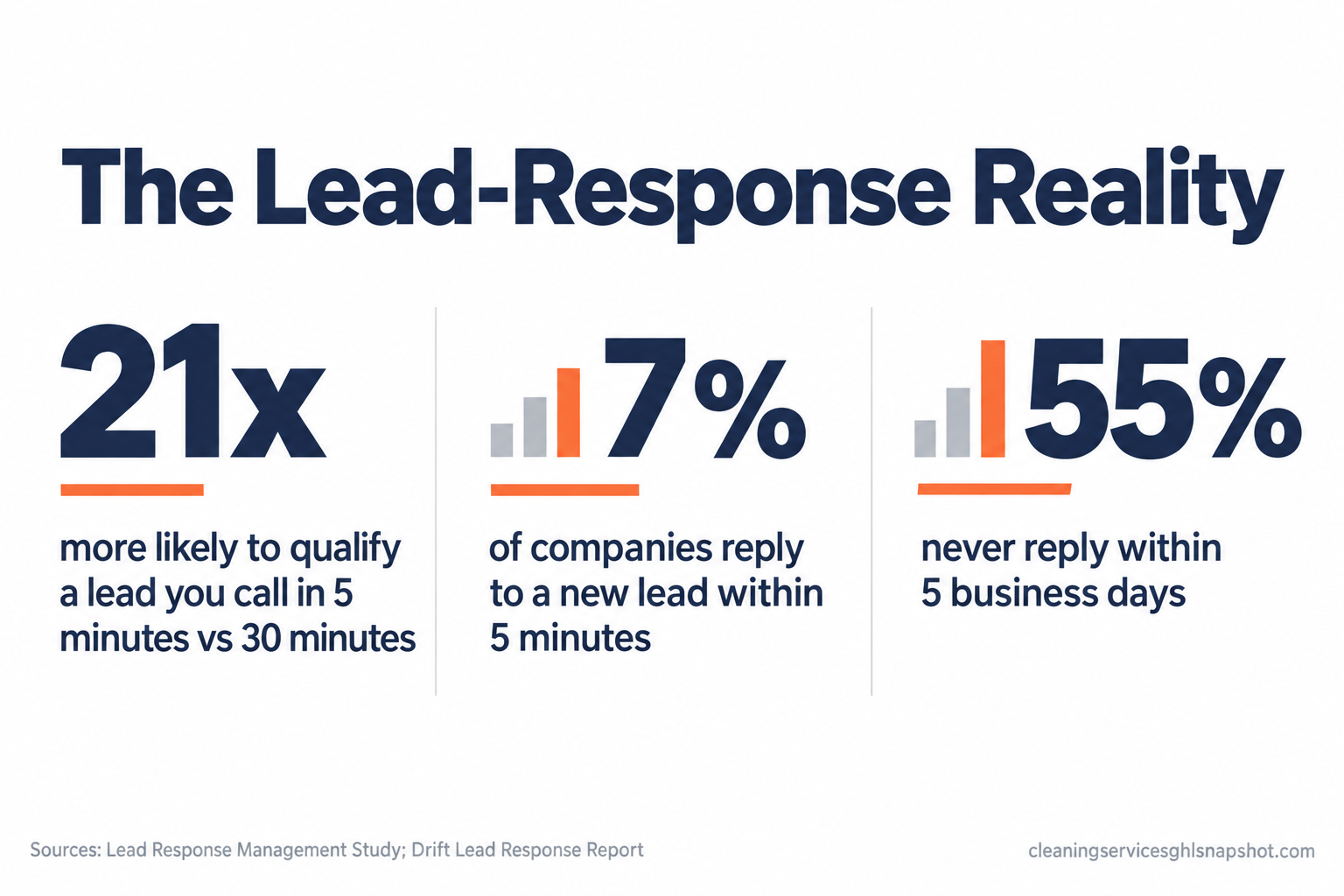
- Speed is the whole ballgame. Per the Lead Response Management Study, calling a web lead within 5 minutes instead of 30 makes you 21 times more likely to qualify it. The first crew to reply usually wins the job.
- Most shops are slow, which is your opening. A secret-shopper study of 433 companies found only 7% replied within 5 minutes and 55% never replied within 5 business days. Being fast is a near-free advantage.
- One reply is not follow-up. Analysis of 3.5 million leads found 93% of the ones that converted were reached inside the first 6 attempts. Quitting after one text leaves money on the table.
- Text beats call beats email for this. A quoted price in writing with a one-tap booking link gets read and acted on. Save the phone for the ones who want to talk it through.
- Build it as a system, not a habit. The sequence has to fire on its own, because on a packed Friday your memory is the first thing to break.
Table of contents
- What a slow quote follow-up actually costs you
- The 6-stage cleaning quote follow-up sequence
- The exact follow-up messages you can steal
- Does texting a quote really beat calling?
- The same sequence at three sizes of business
- Following up by text without breaking TCPA
- The objections I hear from owners
- Frequently asked questions
- The bottom line
What a slow quote follow-up actually costs you
Run the math on Karen. A biweekly three-bed at $150 a visit is 26 cleans a year, about $3,900. Keep her two years and she is worth close to $8,000, plus referrals. You did not lose a $150 clean when you called at 2pm. You lost a multi-thousand-dollar customer, after paying for the ad or referral that put her form in front of you.
Now stack that against how the rest of your market behaves. The Lead Response Management Study found the odds of qualifying a web lead drop 21 times when you wait 30 minutes instead of 5, and the odds of even reaching them drop 100 times. Harvard Business Review’s analysis of roughly 1.25 million leads across 2,241 companies found firms that reached out within an hour were about seven times more likely to have a real conversation than those who waited one more hour, and 60 times more likely than those who waited a day. Twenty-three percent never responded at all.
That last number is the good news for you: being fast is not hard, it is just rare. A secret-shopper study of 433 companies found only 7% replied within five minutes and 55% went dark for five business days. Your competitors are handing you leads. The labor math sharpens it: with about 860,670 maids and housekeeping cleaners employed at a median $17.07 an hour (BLS OEWS, May 2025), your crew cost per route is fixed whether the stop is a one-off or a lifer, so every quote you turn into a recurring client earns more per mile you already drive. In a $18.8 billion US residential cleaning market of roughly 357,000 businesses (IBISWorld, 2026), the winners are not the best cleaners. They are the fastest responders.
The 6-stage cleaning quote follow-up sequence
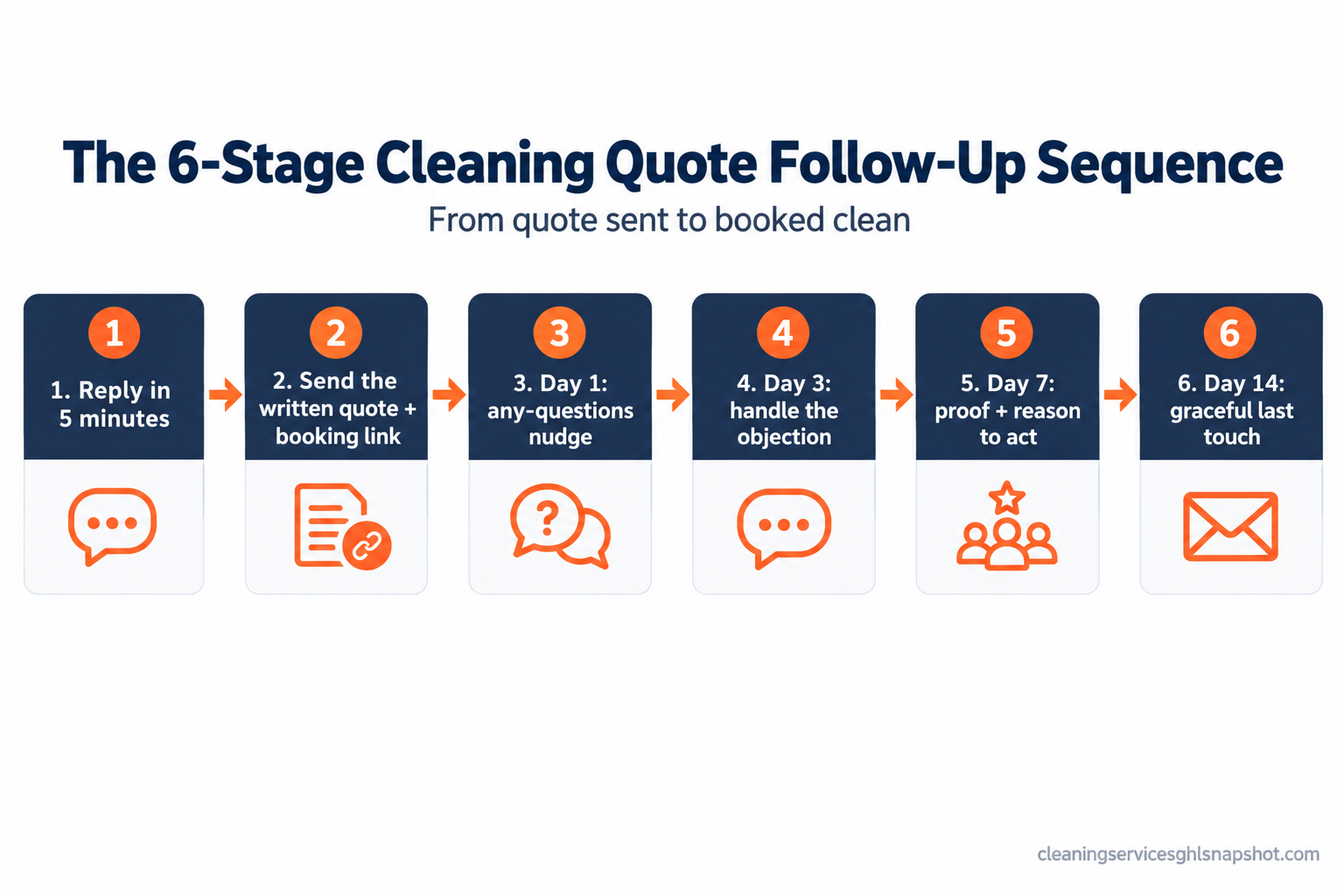
Every lost quote traces to the same root cause: the follow-up lives in your head instead of in a system, so it dies the second a job runs long. Build the system once and it works every Tuesday, including the ones where you are up a ladder. Here is the six-stage flow.
| Stage | Timing | Channel | Goal |
|---|---|---|---|
| 1. First reply | Within 5 minutes | Text (or call) | Beat the other crews to the conversation |
| 2. Written quote | Same hour | Text + email | Price in writing, one-tap booking link |
| 3. Any-questions nudge | Next morning, day 1 | Text | Restart a stalled thread, low pressure |
| 4. Objection handler | Day 3 | Text or call | Name the real hesitation and answer it |
| 5. Proof + reason to act | Day 7 | Text or email | Reviews, photos, an honest reason to book now |
| 6. Graceful last touch | Day 14 | Text | Close the loop, then move to slow nurture |
Stage 1, within 5 minutes: the first reply. The moment a form comes in or a call is missed, a reply goes out. Not a full quote, just a human answer that holds the lead and confirms the best number to text. That single message is what the missed-call text-back setup automates, and it is the difference between winning and losing most jobs. How it breaks: you are on a job and can’t type it, so automate the first touch to fire without you, then follow up personally when you are free.
Stage 2, same hour: the written quote. Send the actual price in writing with a booking link, so the client can say yes without a phone call. This is where an instant-quote flow beats a callback: a number she can act on at 8pm on her couch converts far better than “let’s schedule a time to talk.” How it breaks: the quote is vague or buried in a paragraph. Fix it with a clean format and a real online booking link so the next step is obvious.
Stage 3, next morning: the any-questions nudge. Most people who go quiet are not saying no. They got busy. A short, friendly bump the next morning restarts the thread and offers to tweak the scope or the date. How it breaks: the nudge sounds needy or salesy. Keep it short, helpful, and about her, not about closing you.
Stage 4, day 3: the objection handler. By now the silent ones have a reason, and it is almost always price, timing, or “checking with someone.” Name it out loud and make it easy: offer a smaller first clean, a different day, or a quick call. This is the message most owners skip, and it is where a big chunk of the winnable jobs hide. How it breaks: you guess the wrong objection, so ask directly rather than assume, and give one clear option, not five.
Stage 5, day 7: proof plus a reason to act. A week in, add trust and a gentle nudge to decide: a couple of before-and-after photos, a line about your reviews, and an honest reason to book now (your next open recurring slot, not fake scarcity). How it breaks: the “reason to act” is a fake countdown that reads as pressure. Use something true, or drop it and lead with proof.
Stage 6, day 14: the graceful last touch. If she still hasn’t booked, one warm, no-pressure close that offers to hold her quote for 30 days, then she moves to a slow monthly nurture list instead of a hard chase. How it breaks: you either give up at day 2 or keep hammering at day 30. Fourteen days of light, spaced touches is the sweet spot, then back off.
The exact follow-up messages you can steal
You do not need clever copy. You need clear, warm messages that make saying yes easy. Steal these, swap in your name, price, and city, and keep them short. (There are more in our text message templates for cleaners.)
Does texting a quote really beat calling?
For the first reply, whichever is faster wins, and text is almost always faster to send from a job site. For the quote itself, text plus email beats a call for one reason: it lets a busy person say yes on her own time. A voicemail asking for a callback adds a step; a price with a booking link removes one.
Relative odds of qualifying a web lead, where a 30-minute response equals 1x. Source: Lead Response Management Study (Oldroyd, MIT / InsideSales).
The sequence works because so few competitors run one. Here is what the market does with a fresh lead.
Share of companies, secret-shopper study of 433 firms. Source: Drift Lead Response Report.
Text also carries a channel edge: business texts get opened at rates as high as 98%, versus roughly 20% for email, and most are read within minutes. Use text for the time-sensitive touches and email for the backup copy, the same logic behind why missed-call text-back beats a voicemail nobody plays.
The same sequence at three sizes of business
The six stages are universal. What running them looks like depends entirely on the size of your shop.
The solo operator. You are the whole system, which is both your strength and your weakness. You can send a genuinely personal reply, but on a packed day, stages 1 through 3 evaporate. Your highest-impact move is to automate stage 1 (the 5-minute first reply) and stage 3 (the next-morning nudge) so they fire without you, then handle the rest by hand when you’re off the job. You do not need much, just a trigger that texts a new lead the instant a form comes in, and a reminder to follow up personally on day 3.
The mid-size residential shop (5 to 15 cleaners). You cannot personally answer every form, so the sequence has to be trained and tracked, not remembered. Decide who owns lead response (an office manager, a VA, or an automation that hands warm ones to a human), put the full six stages on autopilot, and measure one number above all: quote-to-book rate. Of the quotes you sent this month, what percentage turned into a booked clean? If you can’t answer that, you’re blind on the metric that funds growth. This is also where a faster follow-up compounds into a recurring-revenue engine, feeding more clients into the recurring book.
The commercial and janitorial operation (15 to 50-plus). Your sales cycle is longer, so the sequence stretches but the logic holds. A facilities manager still rewards the vendor who replies same-day with a clear next step, and still goes cold if you wait a week. Stage 1 becomes a same-day acknowledgment and a walkthrough booking; stages 3 through 6 become a paced cadence over two to four weeks. The deadliest failure here is the proposal you sent and never followed, because a busy manager reads silence as disinterest.
Following up by text without breaking TCPA
Automated follow-up texts are marketing under the Telephone Consumer Protection Act, so run them clean. Get clear consent on the form (a visible line that they agree to receive texts and calls about their quote), keep a record, honor STOP the instant it comes in, and text during reasonable hours. There’s a second trap: if you send from a US 10-digit number, carriers now require A2P 10DLC registration, and unregistered traffic gets silently filtered, which is why plenty of shops switch on texting and watch their delivery rates crater. None of this is legal advice, and your compliance is your responsibility, but the short version is get permission, register your number, and honor STOP. Our TCPA guide for cleaners walks through the details.
The objections I hear from owners
“Won’t all these texts annoy my leads?” Not if they’re useful and spaced out. Six light touches over 14 days, each easy to reply to or opt out of, is service, not spam. The businesses that annoy people go silent for a week and then blast a discount. And this only runs for people who asked you for a quote. They raised their hand.
“I already reply when I can, isn’t that enough?” “When you can” is the problem, because it usually means hours after the lead went to someone else. Stage 1 fires in five minutes whether or not you’re free, so you stop losing the fast-decision customers you never knew you were competing for.
“I don’t want to chase people who obviously aren’t interested.” Then let the sequence tell you who’s actually not interested. Most silent leads are busy, not uninterested, and the day-3 and day-7 touches convert a real slice of them. The ones who never respond by day 14 move to slow nurture on their own, so you’re not chasing, you’re giving genuine buyers a few chances to say yes.
“I already pay for Jobber or Housecall Pro, why do I need this?” Job-management tools are great at scheduling and invoicing the work you’ve already won. They’re weak at the front of the funnel, the fast, multi-touch follow-up that turns a quote into a booking, so plenty of owners run a lead-follow-up system alongside their field software. If you’re weighing platforms, our GoHighLevel vs Jobber breakdown covers where each one earns its keep.
Frequently asked questions
How fast should I respond to a cleaning quote request?
Within five minutes at the outside. The Lead Response Management Study found you are 21 times more likely to qualify a web lead you contact in five minutes versus thirty, and the first crew to reply usually wins. Automate the first text so it fires even when you are on a job.
How many times should I follow up on a cleaning quote?
Six light touches over about 14 days: a 5-minute first reply, the written quote, a next-morning nudge, a day-3 objection handler, a day-7 proof message, and a day-14 last touch. Analysis of 3.5 million leads found 93% of the ones that converted were reached inside the first six attempts, so quitting after one text leaves money behind.
Should I text or call a lead who asked for a quote?
Text for the first reply and the written quote, because it is faster from a job site and lets a busy person say yes on her own time. Save the call for the ones who want to talk it through, or for higher-value commercial bids.
Why do cleaning leads go quiet after asking for a price?
Almost always because they got busy or a competitor replied first, not because they lost interest. Only about 7% of companies reply within five minutes and more than half never reply within five business days, so a fast, multi-touch follow-up recovers many leads that look like they ghosted.
Are automated cleaning quote follow-up texts legal?
Yes, when you follow the rules. Follow-up texts are marketing under the TCPA, so collect clear consent on the form, keep a record, honor STOP immediately, and text during reasonable hours. From a US 10-digit number you also need A2P 10DLC registration or carriers filter your messages. This is not legal advice; your compliance is your responsibility.
What is a good quote-to-book rate for a cleaning business?
Measure your own before chasing a benchmark: of the quotes you sent this month, what percentage turned into a booked clean? Most shops that reply in five minutes and run a timed six-stage follow-up can move that number up within a quarter. Watching it climb matters more than any single target.
The bottom line
Karen was never a lost cause. She was a booked recurring client who filled out your form while you were up a ladder, and the only thing that beat you was a crew that answered faster and followed up on purpose. You do not need better cleaning to win her. You need a first reply that fires in five minutes and a sequence that stays warm for two weeks.
Build the six stages once, make them run on their own, and measure your quote-to-book rate every month. Do that and you stop competing on who cleans best, which is hard to prove up front, and start competing on who is easiest to hire, which you can win before lunch. The leads are already raising their hand. For more of the exact copy, our text message templates for cleaners and the instant-quote playbook pick up where this leaves off.