Custom software starts to pay off for a cleaning company the moment off-the-shelf tools stop fitting how you actually operate — usually somewhere between three and ten crews, when per-seat fees, disconnected apps, and double data entry quietly cost more than a purpose-built system would. Below that point, a good booking app or a GoHighLevel snapshot is the smart, cheap choice. Above it, the “cheap” monthly subscriptions turn into a tax: you pay for seats you don’t use, glue tools together by hand, and re-key the same job into three systems. This guide lays out — with sourced numbers, not vendor hype — exactly when a residential, commercial, or Airbnb-turnover operation outgrows its software, and what a custom CRM, a branded booking portal, or a custom AI agent actually replaces.
This is written for cleaning-business owners across the US — maid services, commercial janitorial crews, and short-term-rental turnover operators — who’ve hit the ceiling of their current tools and are wondering whether “custom” is a real option or an enterprise fantasy. It isn’t a fantasy anymore; AI-assisted development has collapsed the cost. But it’s also not for everyone. Let’s do the honest math.
Key Takeaways
- Off-the-shelf is right until it isn’t. Below ~3 crews, a booking app or a GHL snapshot beats custom on every axis. The cost of generic tools only turns negative once your operation’s edge cases don’t fit the software’s assumptions.
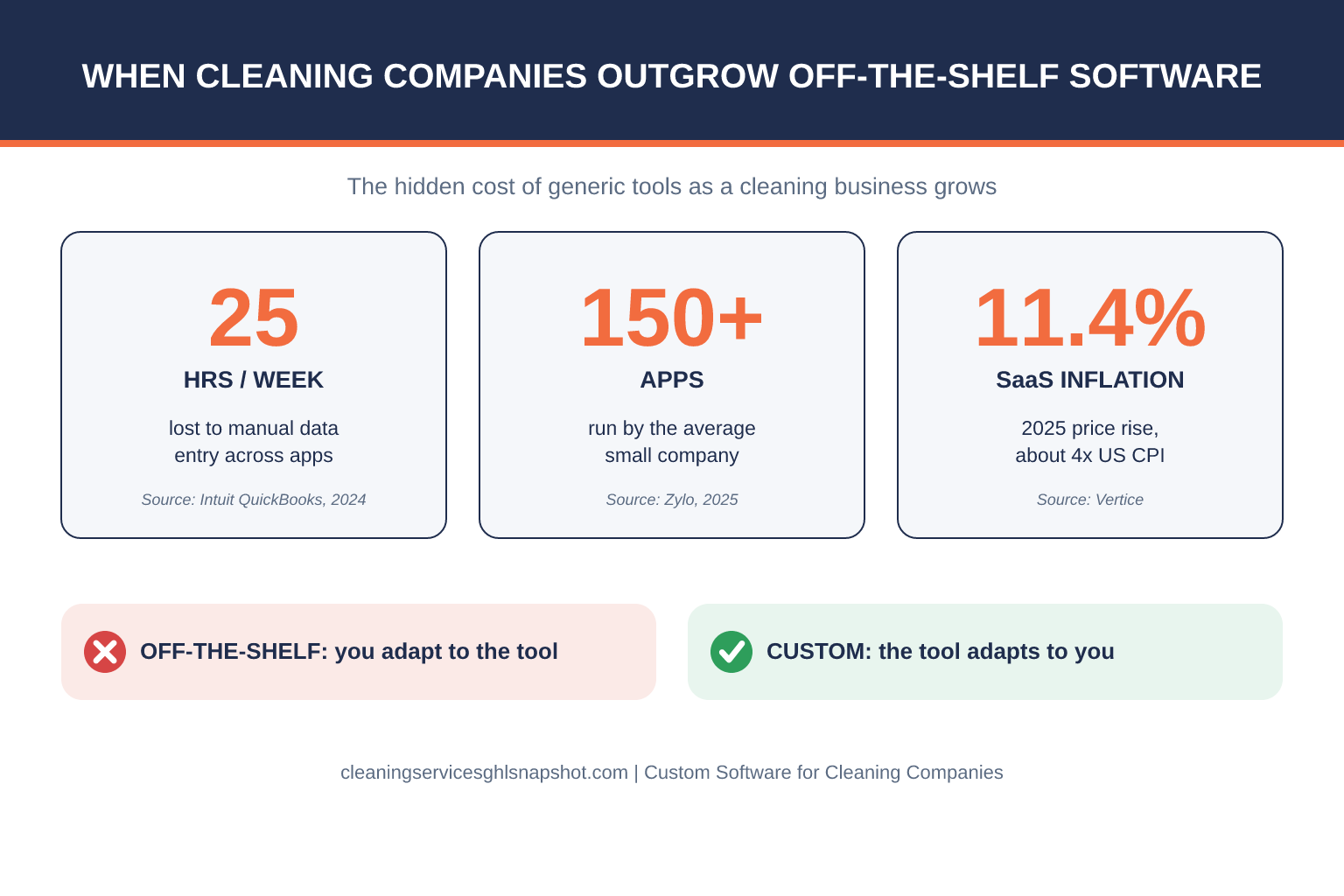
- Tool sprawl is a real, measured cost. Small businesses lose an average of 25 hours a week to manual data entry and reconciling apps, and overspend roughly $3,000/month on software they don’t fully use (Intuit QuickBooks 2024 Business Solutions Survey). The average small company now runs 150+ apps (Zylo 2025 SaaS Management Index).
- Switching between them taxes you again. Workers toggle between apps roughly 1,200 times a day — nearly 4 hours a week just reorienting (Harvard Business Review).
- A generic customer portal isn’t enough. 73% of customers use self-service, but only 14% of issues get fully resolved there (Gartner, 2024) — the gap is why a portal built for your recurring plans and property managers beats a bolt-on widget.
- The market is big enough to specialize in. US janitorial/cleaning is a $110B industry across 1.26M businesses (IBISWorld) — crowded enough that operational efficiency, not just clean floors, decides who wins the recurring accounts.
Table of contents
- What “custom software” actually means for a cleaning company
- The hidden costs of off-the-shelf tools as you grow
- 5 signs you’ve outgrown your booking app
- What custom software looks like for cleaners
- Build vs. buy: the honest math
- How custom software gets built fast (and what it costs)
- Frequently asked questions
What “custom software” actually means for a cleaning company
“Custom software” sounds like a six-figure, six-month enterprise project. For a cleaning business in 2026, it usually isn’t. It means one of three concrete things, each solving a problem your current stack can’t:
- A CRM and scheduling system built around how you actually operate — recurring maid plans, square-footage pricing, crew assignment, route grouping, and Airbnb turnover windows — instead of a generic template you fight against.
- A branded customer or commercial booking portal where homeowners and property managers self-book recurring cleans, see job status, download before/after photo reports, message dispatch, and pay invoices — without calling your office.
- A custom AI agent — a quote-and-booking agent, a voice receptionist, a review responder, or an outbound re-engagement caller — trained on your services and wired into your stack.
The line that matters: off-the-shelf software makes you adapt your business to the software. Custom software adapts to your business. For a small operation, adapting to the tool is a fair trade — the tool is cheap and you’re still figuring out your own process. For a scaled operation with a defined, differentiated way of working, that same adaptation becomes a daily friction cost that compounds.
The hidden costs of off-the-shelf tools as you grow
Generic tools are cheap on the invoice and expensive everywhere else. The costs don’t show up as a line item, which is exactly why owners miss them until they’re large. Here’s what the data says growing businesses actually lose.
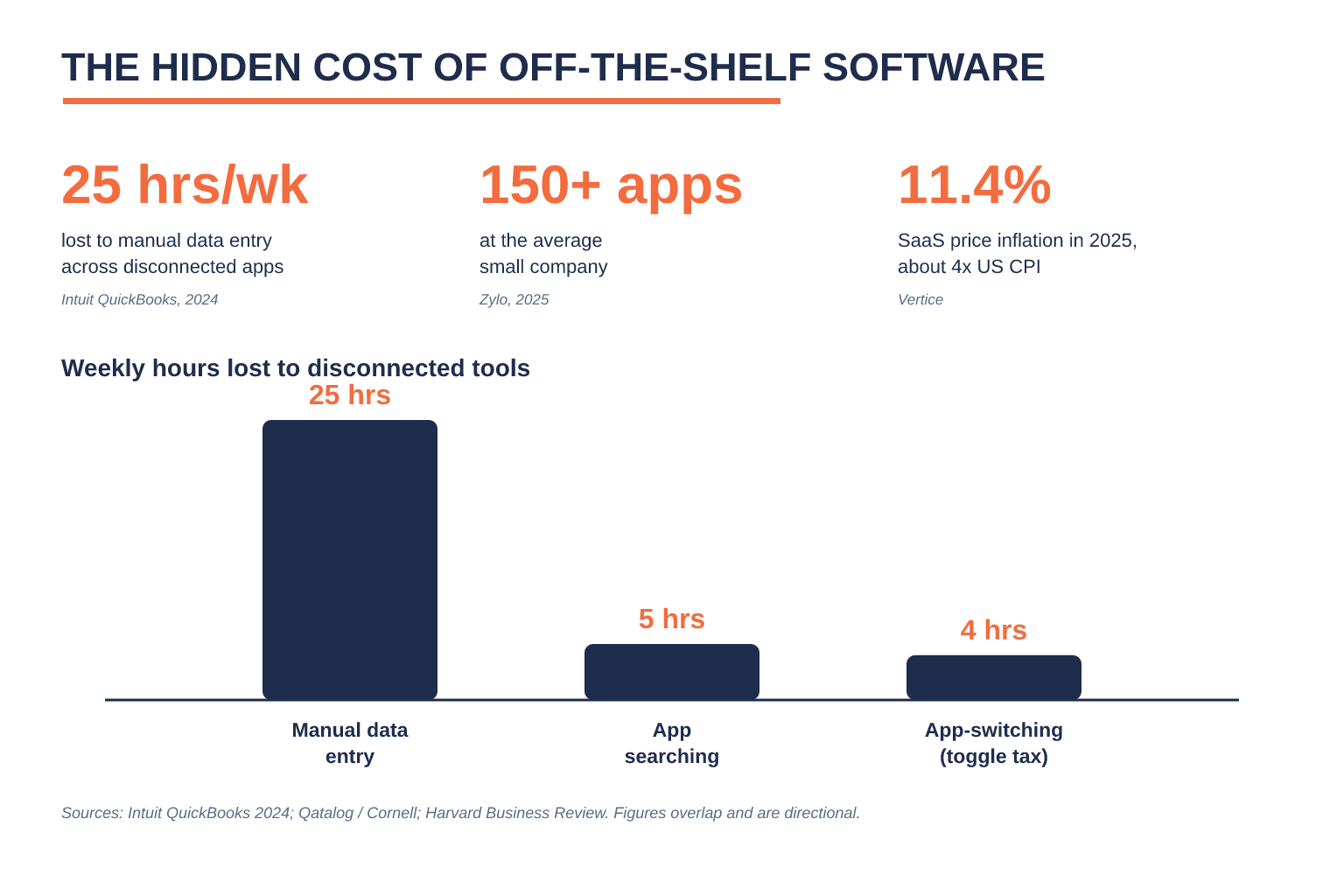
Tool sprawl and double data entry. The Intuit QuickBooks 2024 Business Solutions Survey of hundreds of US small businesses found companies lose an average of 25 hours a week to manual data entry and reconciling information across disconnected apps, and overspend about $3,000 a month on software they don’t fully use. 54% named manual, repetitive tasks as a top operational challenge — while paying for tools meant to eliminate them. For a cleaning company, that’s the office manager copying a booking from the web form into the scheduler, then into QuickBooks, then texting the crew — the same job entered four times.
The app count keeps climbing. The Zylo 2025 SaaS Management Index found that even small companies now run 150+ applications, with a large share of paid seats sitting unused. Every one of those tools is another login, another integration that can break, another place your customer data lives in a slightly different shape.
The “toggle tax.” Even when the tools work, moving between them costs you. Harvard Business Review’s study of app-switching found workers toggle between applications roughly 1,200 times a day, adding up to nearly 4 hours a week — about 9% of work time — just reorienting after each switch (HBR, 2022). A separate Qatalog/Cornell study clocked roughly 9.5 minutes to fully refocus after switching apps (via CIO Dive).
Per-seat pricing that scales against you. As you add crews and office staff, per-user SaaS fees compound — and the list prices themselves are rising fast. The Vertice SaaS Inflation Index reported SaaS list prices climbed about 11.4% in 2025, roughly four times the ~2.7% US consumer inflation rate. Off-the-shelf software you rent gets more expensive every renewal, whether or not you use more of it. Software you own doesn’t.
Estimated hours lost per week to disconnected tools at a typical small business. Sources: manual data entry — Intuit QuickBooks 2024 Business Solutions Survey; searching across apps — Qatalog/Cornell via CIO Dive; app-switching — Harvard Business Review. Figures overlap and are directional, not additive.
None of this means off-the-shelf software is bad. It means generic tools are priced and designed for the average business — and a cleaning company scaling past a few crews stops being average. The gap between “what the software assumes” and “how you actually run” is where the money leaks.
5 signs you’ve outgrown your booking app
You don’t need custom software because you’re big. You need it when specific, repeating friction starts costing real money. These are the five signals we see most often with cleaning operators:
- You’re paying humans to move data between systems. If someone on your team re-keys the same job into your scheduler, your accounting tool, and your CRM, you’re funding the integration your software should be doing. That’s the 25-hours-a-week problem in miniature.
- Your pricing or scheduling logic doesn’t fit the tool. Square-footage pricing, per-room add-ons, recurring-plan discounts, crew-skill matching, route-density scheduling — if you’re managing these in a spreadsheet beside your booking app, the app isn’t running your business; you are.
- Commercial clients want a portal you can’t give them. Property managers running 20 units don’t want to text you. They want to log in, see status, pull photo reports, and pay. A generic booking widget can’t do role-based, multi-unit access — and losing a commercial account over it is expensive.
- You’re hitting API walls. When you want your tools to talk to each other and the answer is “that integration doesn’t exist” or “you need the $500/month tier,” you’ve reached the edge of what rented software will let you do.
- The per-seat bill is now a real number. When software is a rounding error, custom makes no sense. When you’re paying for 15 seats across four tools and SaaS prices rise ~11% a year, owning the software starts to pencil out.
What custom software looks like for cleaners
When it is the right call, here’s what actually gets built — and the specific cleaning-business problem each one solves.
- A cleaning-specific CRM and scheduling platform designed around recurring plans, square-footage pricing, crew assignment, and route grouping. It can run standalone or on top of GoHighLevel and sync with Jobber, Housecall Pro, ZenMaid, QuickBooks, or Stripe — so it extends your stack instead of forcing a migration.
- A branded customer & commercial booking portal. Homeowners self-book recurring cleans; property managers manage multiple units with role-based access, download before/after photo reports, and pay invoices. This is where the self-service data matters: 73% of customers use self-service, but only 14% of issues get fully resolved in generic portals. A portal built for your workflow closes that gap — and cuts the inbound calls your office fields all day.
- Custom AI agents. An AI voice receptionist that answers 24/7 and books straight to your calendar; an AI quote-and-booking agent that qualifies jobs by service type and square footage; an outbound re-engagement caller that wins back customers who haven’t rebooked in 60–90 days.
- A crew/route dashboard and analytics layer that pulls jobs, revenue, crew utilization, review score, and rebooking rate from GHL + Stripe into one view — and sends a weekly P&L to Slack so you always know if the business is growing.
The through-line: each of these replaces a manual process or a missing capability, not a tool that already works. That’s the discipline that keeps a custom build from becoming its own kind of sprawl.
The self-service gap: most customers try self-service, but few generic portals actually resolve their need (%). A portal built around your recurring plans and property-manager workflow is what closes it. Source: Gartner, August 2024.
Build vs. buy: the honest math
There’s no trustworthy single stat that says “custom software pays off at $X in revenue” — the numbers that exist come from dev shops selling the build. So instead of a fake benchmark, here’s the honest framework, and an illustrative example clearly labeled as such.
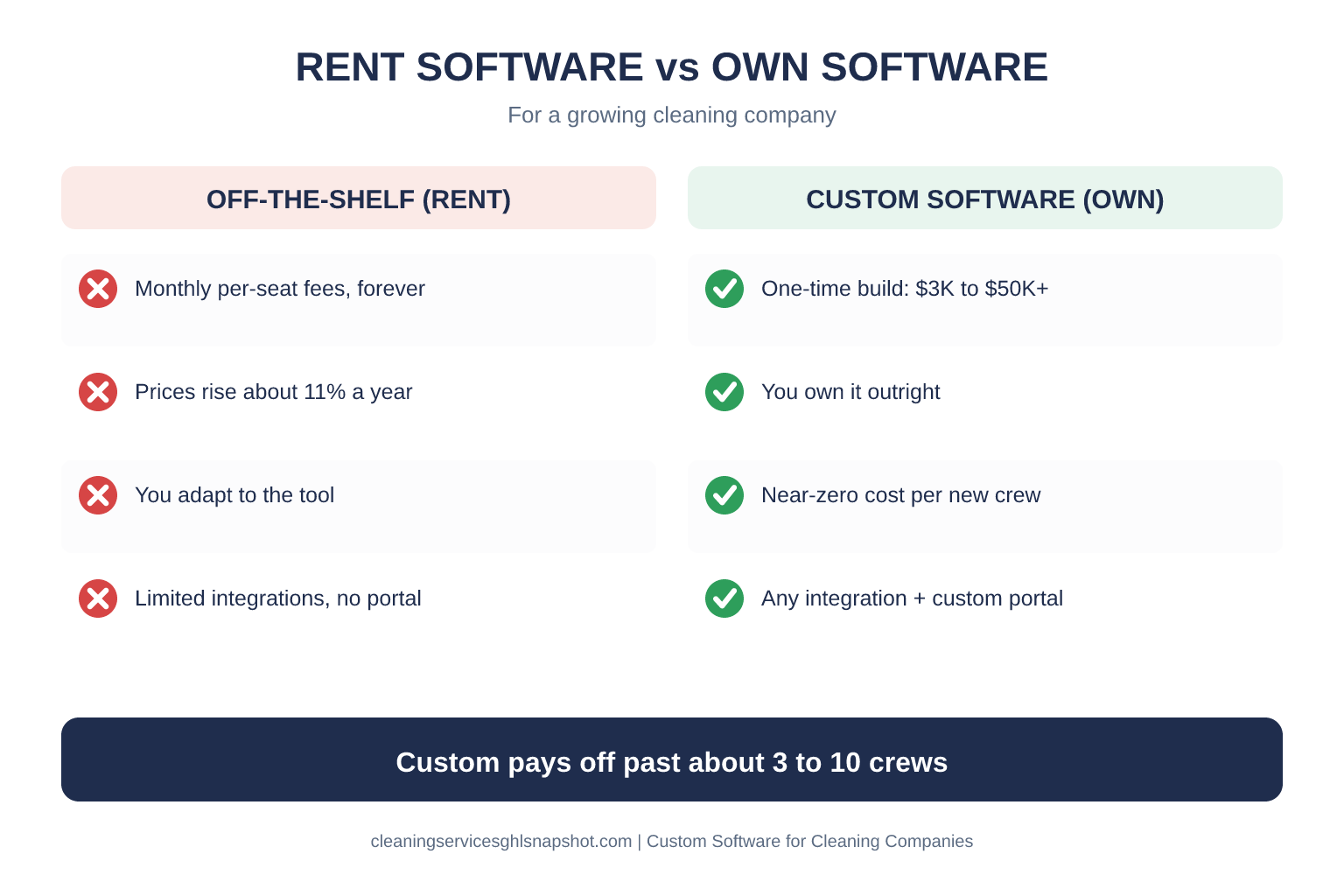
Off-the-shelf software is a rental. You pay monthly, forever, and the price rises with your headcount and with industry-wide SaaS inflation. Custom software is an asset. You pay more up front, own it outright, and your marginal cost per new crew or client is near zero. The crossover point is where the growing rental bill plus the hidden cost of manual glue work exceeds the one-time build plus light maintenance.
Off-the-shelf app vs. GHL snapshot vs. custom software
| Plan | Off-the-shelf app | GHL snapshot recommended | Custom software |
|---|---|---|---|
| Price | Per seat / mo | One-time + GHL plan | $3K–$50K+ project |
| Feature 1 | Fast to start, low upfront cost | Pre-built for cleaning, installed in 24h | Built exactly to your operation |
| Feature 2 | You adapt to the software | Booking, AI caller, reviews, CRM included | You own it — near-zero marginal cost |
| Feature 3 | Per-user fees rise as you grow | Best value for most operators | Portals, custom pricing, any integration |
| Feature 4 | Integrations limited to what's offered | Configurable, not fully bespoke | Best past ~3–10 crews / commercial clients |
| Feature 5 | No custom portal or pricing logic | Great until edge cases don't fit | Higher upfront, lower cost at scale |
An illustrative example (your numbers will differ): say you run four tools at a blended $180/month in seats, and SaaS prices rise ~11%/year. That’s ~$2,160 in year one, ~$2,400 in year two, ~$2,660 in year three — plus the office hours lost re-keying data between them. A focused custom build — say a booking portal that unifies the intake and kills the double entry — might run $8,000–$15,000 once. If it removes even 6–8 office hours a week and lets you cancel two overlapping subscriptions, the payback window is typically one to two years, and everything after that is upside you own. Below that scale, the same build never pays back — which is exactly why most cleaning companies should not build yet.
How custom software gets built fast (and what it costs)
The reason custom is even on the table for a cleaning business in 2026 is that AI-assisted development has cut build time roughly in half. Instead of a dev shop billing hourly while engineers hand-type every line, a small team using Claude Code — Anthropic’s AI-assisted development CLI — ships the same quality software far faster, and the output is yours, fully owned and deployable to your own infrastructure.
Typical scope and timelines look like this: a focused AI agent lands in about 2–3 weeks; a voice receptionist in 2–4 weeks; a booking portal or document processor in 3–6 weeks; and a full cleaning CRM + scheduling system in 6–12 weeks. Pricing runs $3K–$50K+ as a fixed-price project (scoped and quoted before anything is built), or $75/hour with no minimums, and every build ships with a 30-day bug-fix warranty. After launch, you can hire a dedicated engineer/VA from $700/month for maintenance, or stay on hourly for feature additions. You can see the full menu and example builds on our custom software page.
The process is deliberately un-scary: a discovery call, a written scope document with milestones and a fixed quote, the build in reviewable stages, then delivery. You approve the plan before a dollar is committed — which is the opposite of the open-ended, budget-eating custom projects that gave “custom software” its reputation.
The best-run cleaning companies I work with aren’t the ones with the most software — they’re the ones with the least friction. Sometimes that means one clean off-the-shelf setup. Sometimes it means building the one piece nobody sells. The skill is knowing which problem you actually have before you spend a dollar solving it.
If you’re not sure which side of the line you’re on, that’s the right question to bring to a scoping call — and often the honest answer is “stay off-the-shelf for now,” which is fine. The point of custom software isn’t to be impressive. It’s to remove a cost you can measure.
Frequently asked questions
Custom software for cleaning companies — common questions
When does a cleaning company actually need custom software?
When specific, repeating friction starts costing real money — usually somewhere between three and ten crews. The clearest signals: you pay staff to re-key data between apps, your pricing or scheduling logic lives in a spreadsheet beside your booking app, commercial clients want a portal you can't provide, or your per-seat SaaS bill has become a real number. Small businesses lose an average of 25 hours a week to manual data entry across apps; when that's your reality, custom starts to pay off. Below that, off-the-shelf is the smarter, cheaper choice.
How much does custom software cost for a cleaning business?
Fixed-price projects run $3,000 to $50,000+ depending on scope, or $75/hour with no minimums. A focused AI agent or booking portal sits at the lower end; a full CRM and scheduling platform at the higher end. Every build includes a 30-day bug-fix warranty, and you can hire a dedicated engineer from $700/month for ongoing maintenance. See current details on our custom software page.
Is custom software better than a GoHighLevel snapshot?
Not usually — and that's the honest answer. For most cleaning operators, a GHL snapshot installs in 24 hours and covers booking, AI calling, reviews, and CRM at a fraction of a custom build. Custom software wins only when your operation has edge cases the snapshot can't fit — bespoke pricing logic, a multi-unit commercial portal, or an integration that doesn't exist. Many operators run the snapshot for the core and build one custom piece on top.
Can custom software work with the tools I already use?
Yes — that's the most common build. Rather than replace your stack, we build a thin custom layer on top: a booking portal that reads from GoHighLevel, a dashboard that merges GHL and Stripe, or an AI agent that books into your existing calendar. It integrates with Jobber, Housecall Pro, ZenMaid, QuickBooks, and Stripe, so you keep what works and build only what's missing.
How long does it take to build?
Because builds use AI-assisted development, timelines are roughly half a traditional dev shop's: about 2–3 weeks for a focused AI agent, 2–4 weeks for a voice receptionist, 3–6 weeks for a booking portal, and 6–12 weeks for a full CRM and scheduling system. You get a written scope with milestones and a fixed quote before the build starts.
Do I own the software, or am I renting it like a SaaS tool?
You own it outright. Unlike a subscription — where prices rose about 11.4% in 2025 and keep climbing with your headcount — a custom build is an asset you own and can deploy to your own infrastructure. Your marginal cost per new crew or client is near zero, which is what makes it pencil out at scale.
About the author
Darnell Pierce is a GHL Automation Consultant based in Atlanta, GA. He runs a small GoHighLevel agency serving home-service operators, with cleaning companies making up the bulk of his book. He’s allergic to half-built funnels and over-engineered software alike, and he’d rather ship one bulletproof system than ten clever-but-fragile ones. He writes about the agency side of the business: what to build, what to buy, what to white-label, and how to onboard a cleaning client without breaking their existing calendar.
Related posts
- The Cleaning Business CRM That Actually Gets Used
- Online Booking for Cleaning Businesses: The 24/7 Self-Scheduling Setup
- How to Migrate Your Cleaning Business to GoHighLevel
- The Hidden Cost of Running GoHighLevel Yourself: Why Cleaning Businesses Hire a GHL VA
- Cleaning Business Statistics 2026: Market Size, Margins & Growth Benchmarks