A Seattle cleaning company gets stuck at 40 Google reviews for one reason, and it usually isn’t the quality of the work — it’s that asking for the review is a manual step nobody remembers to do once the crew is packing up the van. The fix isn’t nagging your customers harder. It’s an automated review-harvesting sequence that fires a one-tap Google review request by text the moment a clean is marked complete, routes happy customers straight to your profile, and quietly catches unhappy ones before they post. Do that after every job and a stalled 40 becomes a compounding, recent, high-star profile — the exact signal Google, and now AI, use to decide which cleaner to recommend.
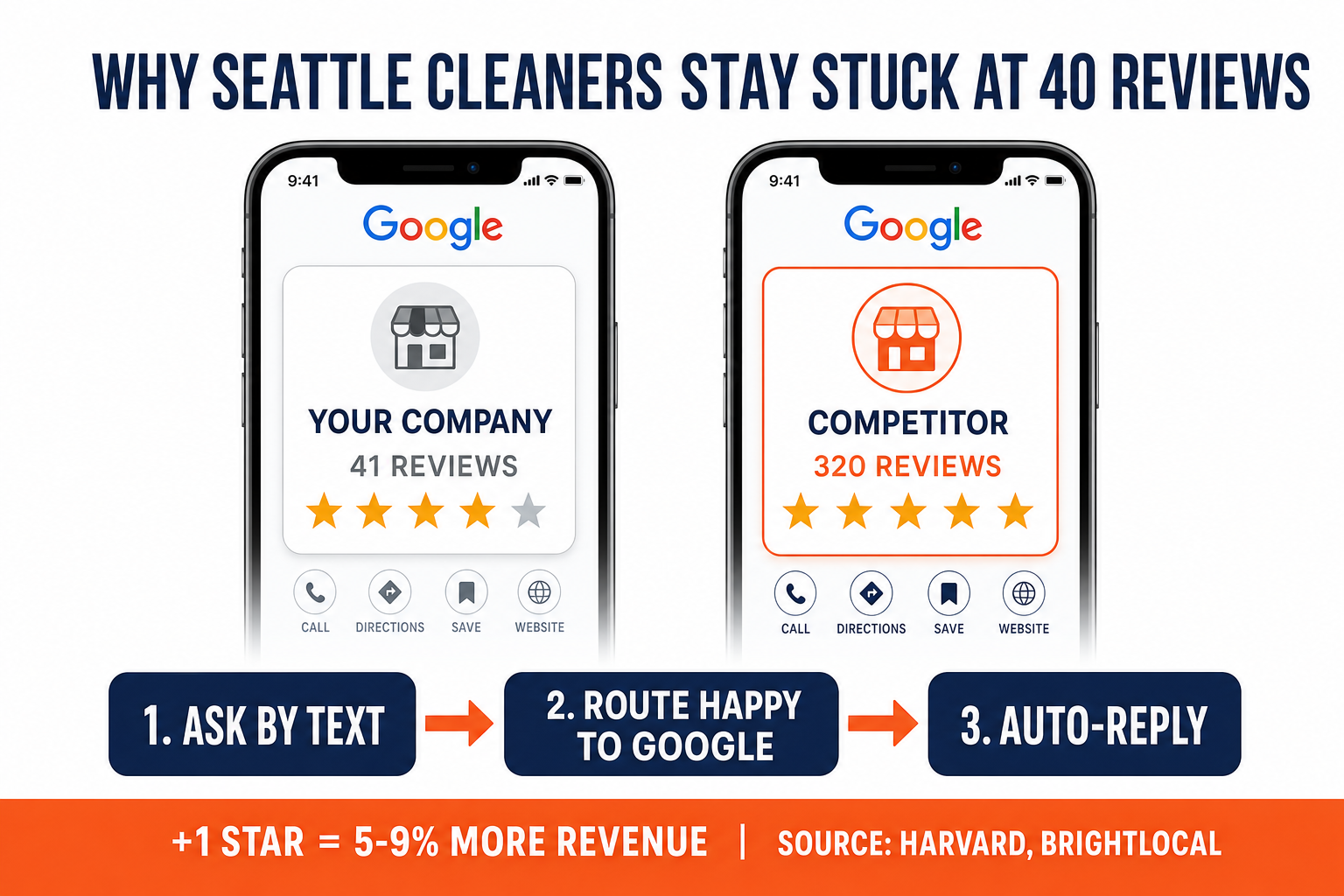
This matters more in 2026 than it did even two years ago, because the review profile is the storefront now. In 2024, 58.5% of U.S. Google searches ended without a single click to the open web (SparkToro) — most Seattle homeowners searching “house cleaning near me” never leave the results page. What they see is a map pack of three businesses and their star ratings. If yours is the one with 41 reviews sitting next to a competitor with 320, you lose the click before your website ever loads.
This guide is written for cleaning-business owners and the agencies serving them across the Seattle metro — from Ballard and Fremont to Bellevue, Kirkland, and Renton. It explains, in plain English and with current sourced numbers, exactly why your review count stalls, what that stall costs you in bookings and price, and the specific automated system that fixes it — the same one built into our review harvesting workflow. No invented figures: every stat links to its source.
Key Takeaways
- Your review count stalls because asking is manual. Great cleans don’t become reviews on their own — someone has to ask, at the right moment, every time. 69% of consumers say they left a review after being prompted in the last year (BrightLocal, 2024). Automating the ask is the whole unlock.
- A thin, stale profile costs real money. A Harvard Business School study using Washington State revenue data found a one-star increase in rating raised revenue 5–9% for independent businesses (Michael Luca, HBS), and 71% of consumers won’t even consider a business below 3 stars (BrightLocal).
- Reviews decide the zero-click search. With 58.5% of U.S. searches ending click-free (SparkToro), the map-pack rating is the decision. Google says more reviews and higher ratings improve local ranking (Google Business Profile Help).
- Reviews now feed AI recommendations too. 45% of consumers have used AI to find a local business — up from 6% a year earlier — yet ChatGPT recommends only 1.2% of local business locations (BrightLocal, 2026). A strong, recent review profile is how you get into that 1.2%.
- The fix is a post-clean automation, not more effort. A sequence that texts a one-tap Google link the moment a job is marked complete, routes by sentiment, and auto-replies to every review turns a flat 40 into a compounding stream. That’s exactly what review harvesting does.
Table of contents
- Why your Seattle cleaning company is stuck at 40 reviews
- What a stalled review profile actually costs you
- What Seattle homeowners do before they book a cleaner
- Reviews are now an AI-search signal too
- The fix: an automated review-harvesting system
- The Seattle angle: a high-value market worth the reviews
- Frequently asked questions
Why your Seattle cleaning company is stuck at 40 reviews
If your Google Business Profile has been parked in the low double digits for a year, it’s almost never a quality problem. Your customers are happy — they just never got asked at the one moment they’d have said yes. Here are the five reasons a good cleaning company stalls out, and every one of them is a process gap, not a work gap:
- Asking is manual, so it’s inconsistent. The clean finishes, the crew loads up, the owner is already thinking about the next job. “Ask for a review” lives on a mental to-do list that gets cleared maybe one time in ten. Ten five-star jobs produce one review.
- You ask too late — or by email only. A review request that lands two days later, buried in an email inbox, competes with everything else. The moment of peak delight is the hour right after a sparkling-clean house, and most owners miss it entirely.
- There’s no direct link. “Can you leave us a Google review?” asks the customer to open Google, search your name, scroll to the reviews, and tap the stars. Every extra step sheds people. Without a one-tap deep link, even willing customers drop off.
- It’s one-and-done. You ask once, at the end of the first clean, and never again — even though a recurring customer has a dozen more happy moments over the following year that could each become a review.
- Fear of a bad review freezes the ask. Owners who’ve been burned once stop asking everyone, which guarantees a thin profile. The answer isn’t to stop asking — it’s to route unhappy customers to a private channel before they reach the public review box.
What a stalled review profile actually costs you
A thin, aging review profile isn’t a vanity problem — it’s a revenue leak with three separate drains.
It costs you the click. Google is explicit that local ranking comes down to relevance, distance, and prominence, and that “more reviews and positive ratings can improve your business’s local ranking” (Google Business Profile Help). When a Queen Anne homeowner searches “house cleaning near me,” the three businesses in the map pack are sorted partly by that prominence signal. Forty reviews rarely wins the pack in a metro this competitive.
It costs you the booking once you’re seen. Even when you show up, a low count and rating filter you out before contact. 71% of consumers say they won’t consider a business with an average rating below three stars (BrightLocal), and consumers overwhelmingly expect to see recent reviews, not a wall of two-year-old ones. A stale profile reads as “maybe out of business.”
It costs you price. This is the one owners underrate. A Harvard Business School study by Michael Luca — built on Washington State Department of Revenue data, so it’s literally about businesses in your state — found that a one-star increase in online rating led to a 5–9% increase in revenue for independent (non-chain) businesses (HBS). A better rating doesn’t just win more jobs; it lets you hold a higher price without losing them.
There’s also a trust multiplier in how you handle reviews. BrightLocal found 88% of consumers would use a business that responds to all of its reviews, versus just 47% for a business that responds to none (BrightLocal, 2024). Replying isn’t optional politeness — it nearly doubles your consideration rate.
Percentage of consumers who would use a local business based on how it handles reviews. Replying to every review nearly doubles consideration versus ignoring them — and it’s fully automatable. Source: BrightLocal Local Consumer Review Survey, 2024.
What Seattle homeowners do before they book a cleaner
Before a homeowner in Wallingford or West Seattle lets a stranger into their house, they check your reputation — and they do it on Google. BrightLocal’s 2025 survey found 83% of consumers use Google to find and read reviews of local businesses, more than any other platform, and 71% regularly read reviews while browsing local businesses (BrightLocal, 2025).
That’s the whole ballgame for a home-service business. Letting a cleaner in is a trust decision, and reviews are the trust proxy people reach for. Two things drive that decision:
- Volume relative to competitors. Not an absolute number — a relative one. Forty reviews looks strong next to a competitor with 25 and weak next to one with 300. In a big metro like Seattle, the established players have hundreds, so the bar to look credible is higher.
- Recency. A profile whose newest review is eight months old signals a business that’s coasting. A steady drip of fresh reviews signals one that’s busy, current, and worth trusting this week.
Both of those are exactly what a manual, remember-to-ask process can’t produce — and exactly what an automated one does by default.
Reviews are now an AI-search signal too
Here’s the shift that makes 2026 different: homeowners increasingly skip the search box entirely and just ask an AI. BrightLocal found the share of consumers using AI to find local businesses jumped to 45% — up from 6% a year earlier — making AI the third-most-popular discovery channel, behind only Google and Facebook. ChatGPT specifically was used by 31% of consumers for recommendations, and Google AI Mode by 23% (BrightLocal, 2026).
But visibility hasn’t caught up with behavior. The same research found ChatGPT currently recommends just 1.2% of all local business locations (BrightLocal, 2026). Almost every cleaning company is invisible to AI — which means the handful that are legible to it win an outsized share of these new AI-driven referrals.
Percentage of consumers who have used AI (ChatGPT, Google AI Mode, etc.) to find a local business. Adoption is climbing fast while most local businesses remain invisible in AI answers — a strong, recent review profile is one of the clearest signals that gets you named. Source: BrightLocal, 2026.
How do you become one of the 1.2%? The same public reputation signals that win the map pack — a high review count, a strong average rating, and recent reviews — are the strongest, most machine-readable proxies an AI has for “this is a real, well-regarded cleaner in Seattle.” An automated review engine isn’t just a reputation tactic anymore; it’s an AI-visibility tactic. (We go deep on the site-structure side of this in AI search optimization for cleaning companies.)
The fix: an automated review-harvesting system
The solution to a manual problem is to remove the manual step. A review-harvesting automation does the asking, the timing, the routing, and the replying — every job, forever, without anyone remembering. Here’s the flow that turns a finished clean into a fresh five-star review:
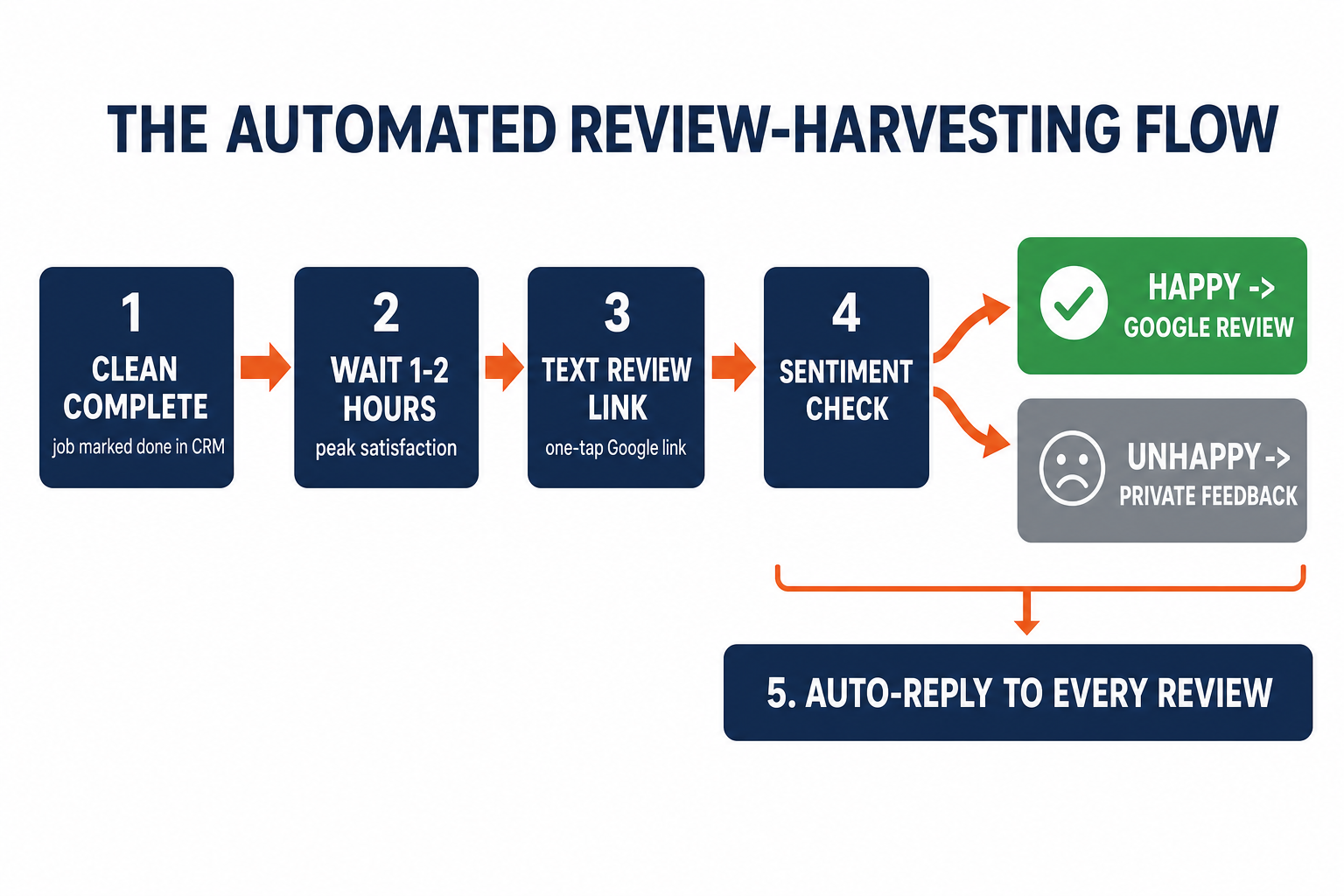
- The clean is marked complete. The crew closes out the job in the CRM (or the appointment auto-completes). That status change is the trigger — no human has to decide to ask.
- A short, smart delay. The system waits an hour or two, so the request lands while the client is still walking through a spotless house at peak satisfaction — far more effective than a next-day email.
- A one-tap SMS request. The ask goes out by text, because texts get read, with a direct deep link to your Google review form. No searching, no scrolling — the customer taps, picks five stars, and they’re done. (This runs on TCPA-compliant, opted-in messaging — see our TCPA guide.)
- Sentiment routing — the part that protects your rating. A quick check asks how the clean went. Customers who are happy get routed straight to the public Google link. Anyone who signals a problem is sent to a private feedback path that alerts you to fix it — so a recoverable issue becomes a phone call, not a one-star review. This is what lets you ask everyone without fear.
- Automatic replies. Every review that posts gets an on-brand reply automatically, capturing that 88%-vs-47% trust bump (BrightLocal) without you writing a word.
Three consumer behaviors that make automated review harvesting pay off: people leave reviews when asked, avoid low-rated businesses, and reward those that reply. Source: BrightLocal Local Consumer Review Survey, 2024.
The difference between manual and automated isn’t effort — it’s coverage. A manual process captures the handful of jobs you remember to follow up on. An automated one captures 100% of completed cleans, at the best possible moment, with a one-tap link and a safety net. That’s how the same volume of happy customers goes from producing one review a month to producing a steady, recent stream.
The Seattle angle: a high-value market worth the reviews
Seattle is exactly the kind of market where a strong review profile pays for itself fast. The city has roughly 363,000 households with a median household income of about $123,860 in 2024 — up from $121,984 the year before, and 53% above the national median (Data USA / U.S. Census). That’s a deep pool of high-value homeowners who can afford recurring service and who research carefully before letting anyone into their home.
They’re also paying real money for it. A recurring 2-bedroom clean in Seattle runs about $190–$280, with regular maintenance cleans commonly $250–$300 per visit and one-time deep, move-in, or move-out cleans running $600–$800+ (24|25 Cleaners, 2025; Angi). At those tickets, remember the Luca finding: a one-star rating bump is worth 5–9% more revenue (HBS). On a book of recurring $250 cleans, that’s not a rounding error — it’s a raise you unlock by asking every customer for a review.
The competitive reality cuts the same way. Established Seattle cleaners have hundreds of reviews, so a thin profile doesn’t just look average — it looks risky next to them. The operators who install an automated review engine now are the ones who’ll own the map pack, and the AI answers, over the next 12 months while everyone else is still asking by hand and forgetting.
The cleaners who win on reviews aren’t the ones with the best marketing instincts. They’re the ones who removed the decision entirely — the ask happens automatically after every clean, so a busy week produces reviews instead of good intentions.
If your review count has been flat while your calendar’s been full, that gap is the opportunity. You already did the hard part — the great cleans. Automating the ask is what finally turns them into the profile that books your next customer. If you’d rather not wire it up yourself, it’s built into our review harvesting workflow, and we can have it running on your existing Google profile in a day. Not sure your website and profile are even set up to be found first? Start with our take on local SEO for cleaning businesses.
Frequently asked questions
How do I get more Google reviews for my Seattle cleaning business?
Automate the ask. The highest-leverage move is a post-clean sequence that texts a one-tap Google review link the moment a job is marked complete — while satisfaction is highest — instead of relying on someone to remember to ask. Route happy customers to your public Google profile and unhappy ones to a private feedback path, and auto-reply to every review that posts. BrightLocal found 69% of consumers left a review after simply being asked, so consistent, well-timed asking is the whole game. Our review harvesting workflow does this automatically.
Why is my cleaning company stuck at the same number of reviews?
Almost always because asking is a manual step that gets skipped. The clean finishes, the crew leaves, and the request never goes out — or it goes out days later by email, with no direct link, so willing customers drop off. It's a timing-and-consistency gap, not a quality problem. Automating the request after every completed clean is what turns a flat count into a compounding stream.
Do online reviews actually affect how much a cleaning business earns?
Yes, measurably. A Harvard Business School study using Washington State revenue data found a one-star increase in online rating led to a 5–9% increase in revenue for independent businesses (Michael Luca, HBS). On top of that, 71% of consumers won't consider a business rated below three stars (BrightLocal), so a weak profile filters you out before contact and a strong one lets you hold a higher price.
Is it against Google's rules to automate review requests?
Asking every customer for a review is allowed and encouraged — Google itself says more reviews and higher ratings can improve your local ranking (Google Business Profile Help). What's against the rules is 'review gating' in the sense of soliciting reviews selectively in a way that violates Google's policies, or offering incentives. A compliant setup asks all customers, sends happy ones to Google and gives unhappy ones a private way to reach you first, and never pays for reviews. Text-based requests also require TCPA-compliant opt-in — see our TCPA guide.
Should I ask for reviews by text or email?
Text, in almost every case. A review request works best when it lands within an hour or two of a finished clean, with a one-tap deep link to your Google form — and texts get read and acted on far faster than email, which competes with a crowded inbox and often lands a day late. Email is a fine backup channel, but SMS should carry the primary ask. Our cleaning SMS templates include review-request scripts.
How does review automation help me show up in AI search like ChatGPT?
AI answer engines lean on the same public reputation signals Google uses — review count, average rating, and recency — because they're the strongest proxies for a real, trusted local business. With 45% of consumers now using AI to find local businesses but only about 1.2% of locations getting recommended (BrightLocal, 2026), a strong and recent review profile is one of the clearest ways to become a cleaner the AI actually names. See our full AI search guide.
Nadia Sarin leads customer retention and reviews content for Cleaning Services GHL Snapshot and is based in San Diego, CA. She builds the photo-triggered review loops and win-back sequences she writes about, and she’s seen a single well-timed text turn a one-off deep clean into an eighteen-month recurring customer. Statistics cited here are from the linked third-party sources; Seattle household and income figures are from the U.S. Census Bureau via Data USA, cleaning prices are from local Seattle operators and Angi and are illustrative, and the revenue-per-star finding is from Michael Luca’s Harvard Business School research on Washington State businesses. State and municipal cleaning-business licensing, insurance, and bonding remain each operator’s responsibility.
Related reading: From 47 to 218 Google reviews without begging · Local SEO for cleaning businesses: the map-pack playbook · AI search optimization for cleaning companies · Online booking for cleaning businesses · Missed-call text-back for cleaning businesses