
It is 8:12am and your phone buzzes with the text every cleaning owner dreads: “Hi, nobody’s here yet? I have to leave for work at 9.” Your crew swears they left on time. The client swears the appointment was 8:00. And you are trying to defuse it before it becomes a one-star review, with three more houses on the board and the same thing that happened Tuesday.
Here is the honest answer most owners do not want to hear: if your crew is always late, it is almost never because your cleaners are lazy. It is because your schedule, your route order, and your communication have gaps, and lateness is the symptom that leaks out where the customer can see it. Fix the system and the lateness mostly disappears. This guide covers the seven real reasons crews run late, the fix for each, the exact texts you can steal to protect the jobs you already book, and how it all changes at three sizes of business.
Key Takeaways
- Chronic lateness is a system problem, not a people problem. The cause is upstream: no travel buffer, a bad route order, or scope you keep underestimating.
- Traffic is a measurable tax. The typical US driver lost about 49 hours to congestion in 2025, worth roughly $894 (INRIX, via CNBC). A crew driving all day pays it several times over.
- Late arrivals wreck satisfaction. In-home service satisfaction lands at 871 out of 1,000 when the tech is on time and just 683 when late (J.D. Power).
- Communication is the cheapest fix. Customers are about 82% more likely to rehire a company that sends arrival alerts (Cleanfax). A warned delay is a non-event; a silent one loses the client.
Table of contents
- Is your crew late, or is your schedule lying to you?
- What lateness really costs a cleaning business
- The 7 real reasons cleaning crews run late
- The texts that save the job when you run behind
- The same problem at three sizes
- The objections I hear from owners
- Frequently asked questions
- The bottom line
Is your crew late, or is your schedule lying to you?
Before you have a hard conversation with a cleaner, check whether the schedule you handed them was even possible. Most owners skip this and go straight to blaming the crew.
Grab last week’s board and pick any crew’s day. Write down each job’s start time, address, and honest cleaning time (the real number, not the optimistic one). Now add the drive time between stops, traffic included, plus a 15-minute buffer for parking, supplies, and the chat at the door. If you booked a 9:00 job across town from an 8:00 job that takes two full hours, your crew was never going to make 9:00. Do this and you will usually find the crew is not slow, the day was overpacked. That is good news: a math problem is easier to fix than a motivation one.
What lateness really costs a cleaning business
Owners treat a late arrival as a small annoyance. It is a slow leak across three buckets.
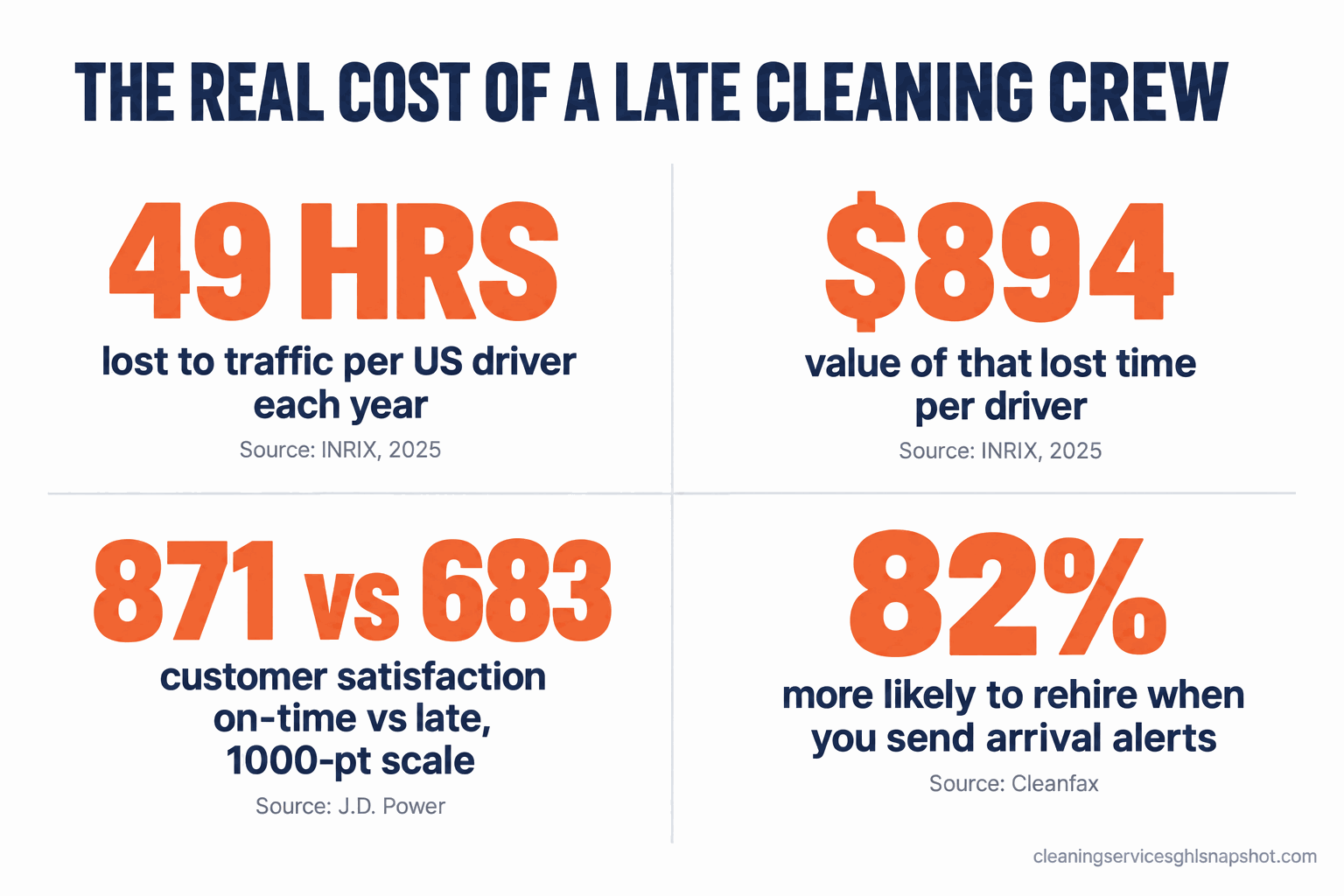
The client relationship. Punctuality is the most visible promise you make, because the client is at the window watching for you. J.D. Power’s in-home technician research shows how hard it moves the needle: an on-time arrival scored 871 out of 1,000, a late one just 683 (J.D. Power). Cleaning clients are even more sensitive, because they are handing you a key. Flip it around and customers are roughly 82% more likely to rehire a company that keeps them posted (Cleanfax).
Wasted paid hours. Every minute a crew sits in traffic or circles for parking is a minute you pay wages for zero revenue. Cleaning is already low-margin and hourly, with a median wage around $17 an hour for the roughly 860,000 maids and housekeeping cleaners in the country (BLS). A crew crosses town all day, so a sloppy route multiplies the traffic tax and you pay it in payroll.
The jobs you cannot fit. A day that runs late ends with a squeezed-out fifth job or overtime to finish. Late is not just a reputation cost, it is capacity you paid for and did not sell.
The 7 real reasons cleaning crews run late
Almost every chronic-lateness case comes down to one or more of these. Read them as a checklist.
1. You book back-to-back with no travel buffer
The number one cause, hiding in plain sight. The schedule says 8:00 and 10:00, the clean takes the full two hours, and there is 25 minutes of driving between. There was never room for the drive. The fix: build the drive plus a 15-minute buffer into every gap, and set durations to the real average for that home. Our appointment automation enforces buffer rules, so the calendar stops selling you impossible days.
2. Your route order zig-zags across the city
Six jobs assigned by who called first instead of who is closest, so a crew drives north at 8, south at 10, and north again at noon. That is pure windshield time. The fix: cluster jobs by geography and run each crew’s day as a tight loop. This one change often recovers an hour a day per crew. The full playbook, with the math, is in route optimization for cleaning businesses.
3. Certain jobs always run long, and you keep pretending they do not
Every operator has them: the house with three dogs and a packed closet, the “quick” move-out that never is. Scheduled at the optimistic time, they blow the back half of the day for everyone behind them. The fix: track actual clean time per property for a month, then reprice or re-time the chronic overruns with a longer block, a higher price, or a slot late in the day.
4. The morning start slips, and the whole day slips with it
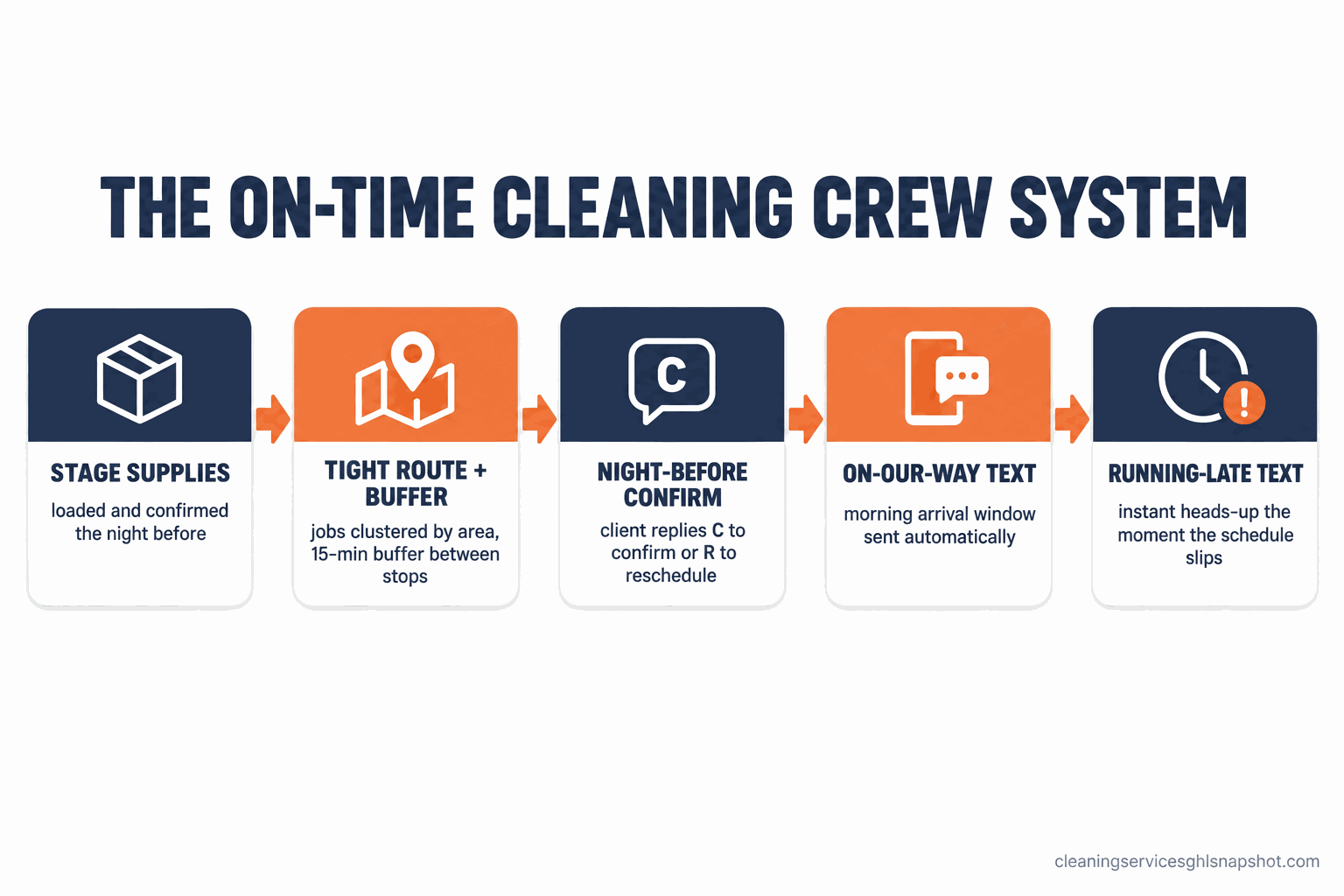
If the first job starts 20 minutes late, every job after it is 20 minutes late, and it compounds. Late starts trace back to the shop: supplies not loaded, a detour to grab a vacuum, a crew that did not know the first address until they showed up. The fix: stage supplies and confirm the first stop the evening before with an automatic crew reminder carrying the address, gate code, and scope. A crew that leaves informed and loaded starts on time.
5. Cancellations and reschedules blow up the route in real time
A client cancels at 7:45am and now your tight loop has a hole in it, or a crew drives to a locked house because nobody said the 9:00 moved to Thursday. The fix: automated confirmations the day before and the morning of, so cancellations surface early enough to re-sequence the route instead of finding out at the door. They also cut the cancellations themselves. We broke down the cadence in cleaning business appointment reminders.
6. Access problems eat 20 minutes at the door
The crew arrives on time and then stands on the porch: wrong lockbox code, no key left out, a building badge nobody mentioned, a loose dog. None of that is drive time, but it makes them late to the next house. The fix: capture access details at booking, push them to the crew with the job, and confirm the day before that the key or code is set.
7. Nobody tells the customer, so a small delay becomes a big deal
This is the one that turns a forgivable delay into a lost account. A crew running 15 minutes behind is normal. A crew running 15 minutes behind in silence, while a client sits by the window guessing, feels like disrespect. The delay is not the problem, the silence is. The fix: an automatic “on our way” text with a real arrival window, and an instant “running about 15 minutes late” text the moment the schedule slips. Customers are about 82% more likely to rehire when you keep them posted (Cleanfax).
The day I stopped blaming cleaners and started auditing the board was the day lateness got better. Nine times out of ten the schedule was the problem. My crews drove 40 wasted minutes a day because I sequenced routes by who booked first. Fix the map and the buffer, automate the “we’re on our way” text, and the angry morning calls just stop.
The texts that save the job when you run behind
You will never eliminate every delay. The operators who keep clients are the ones whose customers hear from them before they have to wonder. Steal these and swap in your business name. For a bigger set, see our cleaning business text message templates.
Night-before confirmation (stops the surprise cancel):
Hi [Name], this is [Company] confirming your cleaning tomorrow between 8:00 and 8:30am. Reply C to confirm or R to reschedule. See you then!
Morning “on our way” text (sets the window):
Good morning [Name]! Your [Company] crew is heading your way and should arrive between 8:00 and 8:30am. Text us here if anything comes up. 🧽
Running-late text (send it the second you know, not on arrival):
Hi [Name], quick heads up: traffic is heavier than usual and your crew is running about 15 minutes behind. New arrival window is 8:45 to 9:00am. Thanks for your patience!
Big-delay text (when it is more than 30 minutes, give them an out):
Hi [Name], I’m sorry, an earlier job ran long and your crew is now about 40 minutes behind. I understand if that does not work today. Want us to still come at 9:30am, or move to a better time this week? Your call.
Crew reminder the night before (prevents the slow start):
Tomorrow’s first stop: [address], arrive 8:00am. Gate code 1234, key in lockbox. Scope: deep clean, 2 bath, pet home. Supplies loaded? Confirm you’re set.
These work because they move the emotional moment. A client who gets the running-late text at 8:20 has already made peace with 8:45 by the time the crew pulls up. A client who gets nothing spent those 45 minutes building a case against you.
The same problem at three sizes
The seven causes are universal, but the fix that matters most changes with the shape of your business.
Solo operator or two-person team. You are the dispatcher, the cleaner, and the person answering the angry text, all at once, so automation matters more for you, not less. Your best move is the communication layer: turn on the night-before confirmation and the on-our-way text so the customer is handled while your hands are full. At your size, one lost recurring client is a real dent in the month.
Mid-size residential team (roughly 3 to 15 cleaners). Your pain is coordination: multiple crews, overlapping routes, a group chat that cannot keep up. Start with route sequencing and buffers, because a bad map multiplies across every crew. Then standardize the morning with staged supplies, a crew reminder carrying the first address and scope, and confirmations that surface cancellations before 8am. This is where a real scheduling system stops being optional.
Large or commercial and janitorial (15 to 50+). Bid-based contracts, night crews, and stricter accountability change the game. Late can be a contract-compliance issue with penalties attached, not just a satisfaction ding. Your priorities are access management (badges, alarm codes, after-hours contacts kept current and pushed to the crew) and hard schedule adherence, so a no-show cleaner on the night shift gets caught before the client notices. High turnover makes it worse: the BLS projects on the order of 320,000 openings a year for janitors and building cleaners (BLS), so you are constantly onboarding people who do not yet know the routes. A system that hands every crew the address, access details, and scope automatically keeps quality steady while the roster churns.
The clean you are late to today is rarely worth just its own ticket. It is worth the whole year of visits behind it, plus the referrals that client would have sent. That is why the fix pays for itself so fast.
The objections I hear from owners
“My cleaners are just unreliable.” Sometimes there is a real performance issue. But run the schedule audit first. In most cases the same crew that was “always late” becomes reliable the moment you give them a possible route and the information to start on time. Do not fire your way out of a scheduling problem.
“I can’t control traffic.” True, but you control whether you account for it with realistic drive times, buffers, and geographic clustering. When it is worse than expected, the running-late text turns an uncontrollable delay into a forgivable one.
“Customers don’t really care about 15 minutes.” They care about the silence, not the minutes. The J.D. Power gap between on-time and late is 188 points, and the rehire lift from keeping people informed is about 82% (Cleanfax). A warned delay barely registers; an unexplained one gets you replaced.
“I already text my customers.” Manually, when you remember, when you are not elbow-deep in a job? That is the gap. The value is in the texts firing automatically every time, including the mornings you are too slammed to think about it. The buffers, confirmations, and arrival texts are not features you have to remember to run. If you would rather not build them from scratch, that is what the Cleaning Snapshot is: the whole system pre-built and installed, so you are not wiring workflows on live clients.
Frequently asked questions
Why is my cleaning crew always late?
Usually it is a scheduling problem, not a lazy crew. The three most common causes are booking jobs back-to-back with no travel buffer, sequencing routes by who called first instead of by location, and underestimating how long certain homes take. Audit one crew's real day (clean times plus honest drive times) and you will usually find the schedule was impossible before they started.
How much travel buffer should I schedule between cleaning jobs?
Block the realistic drive time between the two addresses, plus about 15 minutes for parking, supplies, and the door conversation. A calendar that assumes zero transition time will always produce late arrivals. If you use online booking, cap how tightly slots can stack so an impossible day cannot be booked at all.
Do customers really care if the crew is a few minutes late?
They care far more about not being told than about the minutes. J.D. Power in-home service data shows satisfaction dropping from 871 to 683 (on a 1,000-point scale) when a technician arrives late, and customers are roughly 82% more likely to rehire a business that sends arrival notifications (Cleanfax). A delay you warn about is usually a non-event.
What should a running-late text to a cleaning client say?
Keep it short and send it the moment you know, not on arrival. Identify your business, state the delay, and give a new window: 'Hi [Name], your [Company] crew is running about 15 minutes behind due to traffic. New window is 8:45 to 9:00am. Thanks for your patience!' For delays over 30 minutes, add a reschedule option.
Is late arrival a bigger deal for commercial and janitorial contracts?
Yes. Commercial work is often bid-based with service levels written into the contract, so a late or missed clean can be a compliance issue with real penalties, not just a satisfaction ding. With high turnover on night crews, the priority is tight access management and automatic schedule adherence: push every crew the address, codes, and scope, and confirm coverage before the client notices a gap.
The bottom line
Your cleaning crew is probably not late because they do not care. They are late because the schedule was impossible, the route zig-zagged, one house always runs long, or nobody warned the customer. Every one of those is a system you can fix, and none requires firing a good cleaner.
Start this week with the two changes that pay off fastest: audit one crew’s board for realistic buffers and route order, and turn on the automatic on-our-way and running-late texts. From there, tighten the morning start, the confirmations, and the access details until an on-time day is the default. If you would rather not build all of that by hand, the Cleaning Snapshot ships it pre-wired, or book a walkthrough first. On-time is a system you install, not a personality trait you hope your crew has.
About the author
Marisol Vega is a Cleaning Operations Strategist in Austin, TX. She spent nine years scaling a residential maid service from two vans to a fourteen-crew operation before moving full-time into systems work. She writes about the unglamorous mechanics of a profitable cleaning business: route density, recurring-attach rate, and the texts that keep a Tuesday schedule full. Her rule of thumb: if an automation does not show up in revenue inside 30 days, it is not earning its seat in the workflow.
Related posts
- Route Optimization for Cleaning Businesses: Fit More Jobs Per Day
- Cleaning Business Appointment Reminders: Cut No-Shows and Cancellations
- Why Your Crew Keeps Showing Up to the Wrong Address
- 7 Cleaning Automations That Fill Your Week and Protect Your Weekend
Sources
- INRIX: 2025 Global Traffic Scorecard, US
- CNBC: The most congested US cities in 2025
- J.D. Power: US In-Home Service Technician Study
- Cleanfax: Survey shows the effect of punctuality on repeat business
- U.S. Bureau of Labor Statistics: Maids and Housekeeping Cleaners (OEWS)
- U.S. Bureau of Labor Statistics: Janitors and Building Cleaners (Occupational Outlook Handbook)
- HomeAdvisor: House cleaning and maid service cost