
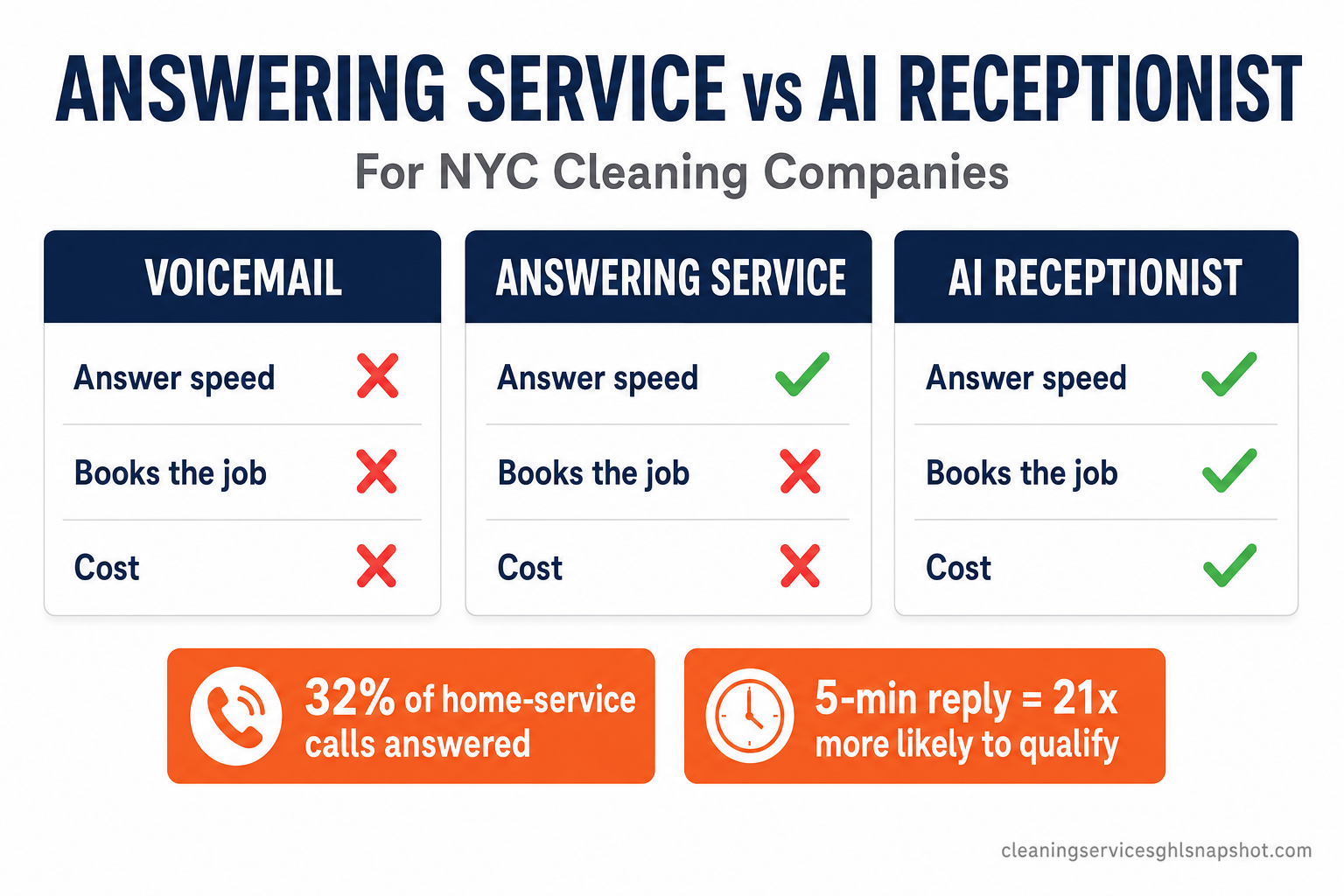
For a New York City cleaning company, an AI receptionist beats a traditional answering service on the three things that decide whether a call becomes a booked clean: it answers instantly on every call, it books the job straight into your calendar, and it costs a flat, predictable monthly fee instead of per-minute talk time. A live answering service will take a message and maybe read a script, but it rarely quotes a price, rarely books the job, and bills you by the minute for the privilege. In a market with roughly 71,710 janitorial business locations across New York State (IBISWorld), the operator who answers and books first is the one who keeps the recurring customer — and in the worst-performing home-service trades, as few as 32% of inbound calls are actually answered by a person (Invoca).
This is written for cleaning operators across the five boroughs — Manhattan, Brooklyn, Queens, the Bronx, and Staten Island — plus the surrounding metro in Westchester and on Long Island, who are paying for leads (Google Business Profile, local SEO, referrals) but losing too many of them at the one moment that matters most: the phone call. If you’re deciding between hiring a human, signing up for a live answering service, or deploying an AI receptionist, this is the head-to-head. Every number below is sourced; nothing is invented.
Key Takeaways
- The missed call is the leak. Across home-service trades, answer rates run from just 32% to 74% — meaning in the worst cases roughly two-thirds of inbound calls never reach a person (Invoca, 2026). A cleaning crew mid-deep-clean can’t pick up, and voicemail loses the caller.
- Speed decides the sale. Responding to a new lead within 5 minutes instead of 30 makes you about 21× more likely to qualify it — and about 100× more likely to reach it (MIT / InsideSales lead-response study). A live answering service adds a handoff; an AI receptionist answers on the first ring.
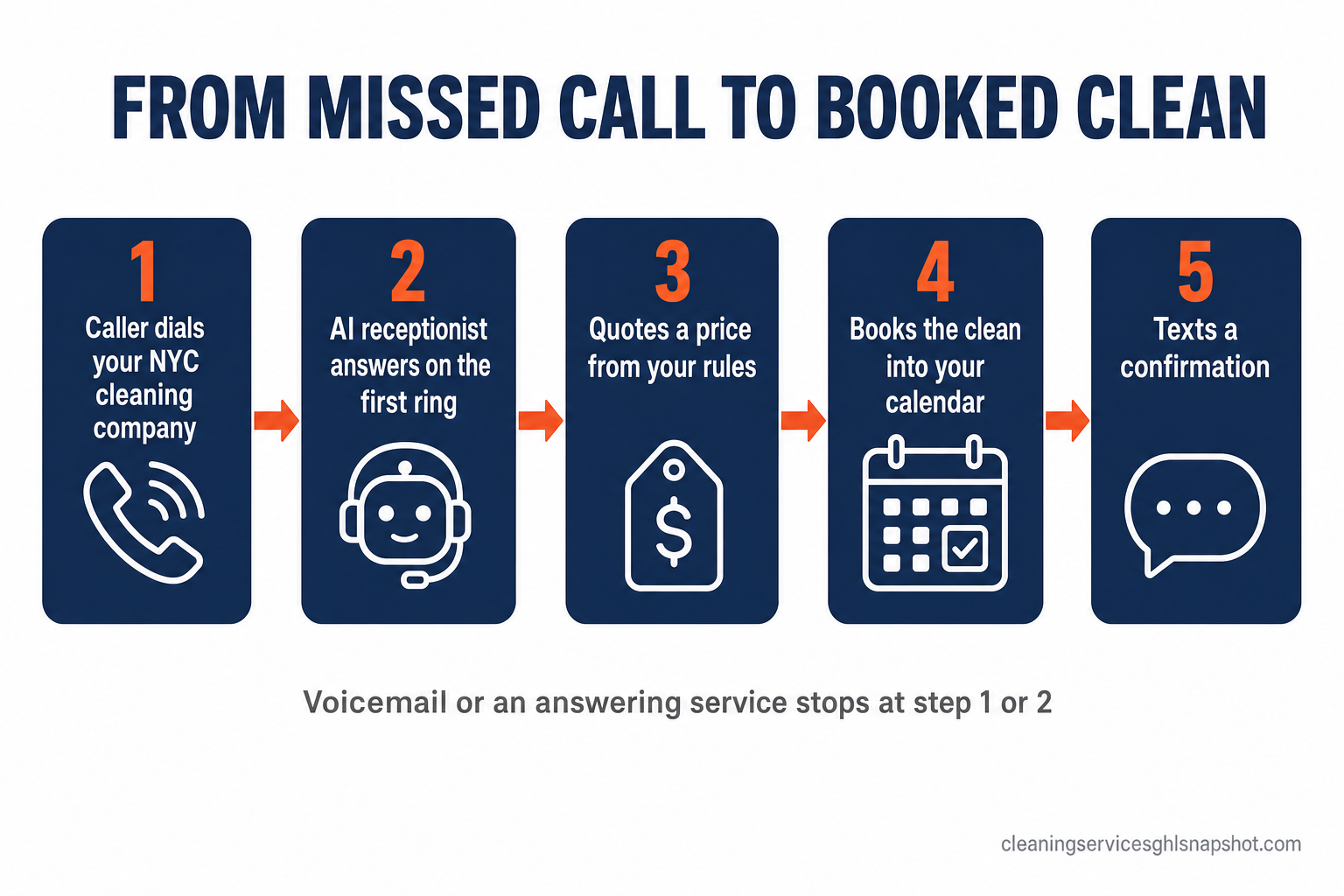
- An answering service takes a message; an AI receptionist books the job. A traditional service typically screens and relays. An AI receptionist quotes, books into your calendar, and texts a confirmation — the whole instant-quote-to-booking flow.
- The cost models are different. Live answering services bill roughly $0.65–$1.75 per minute and land around $135–$800/month for a small business (Nextiva). An AI receptionist is a flat monthly fee that doesn’t spike when call volume does.
- NYC labor makes the math worse for humans. New York City’s minimum wage is $17.00/hour as of January 2026 (NY Governor’s Office), and a single 9-to-5 receptionist still leaves nights and weekends uncovered.
Table of contents
- Why NYC cleaning companies miss the call that matters
- Option 1: Voicemail (the expensive “free” choice)
- Option 2: A traditional live answering service
- Option 3: An AI receptionist
- Head-to-head: the comparison table
- The speed-to-lead math
- Why texting beats a phone message
- The NYC cost math
- Which should a NYC cleaning company choose?
- FAQ
Why NYC cleaning companies miss the call that matters
Here’s the trap every owner-operator knows. The phone rings while you’re on a ladder wiping a Brooklyn brownstone’s crown molding, or your one office person is already on another line booking a Queens move-out. The homeowner on the other end is comparing three cleaners they found on Google, and they’re calling all three right now. If you don’t pick up, they don’t wait — they call the next name on the list.
The data backs up how common this is. Invoca’s analysis of tens of millions of calls found home-service answer rates ranging from 32% to 74% across sub-industries (Invoca, 2026). Those aren’t spam calls — the same report found that when a person does answer, phone leads in home services convert at roughly 46%. In other words, the phone is your single best-converting channel, and it’s the one most likely to go unanswered when you’re a small crew doing the actual cleaning.
So the real question isn’t “should I answer my phone?” — it’s how you answer it when you physically can’t. You have three realistic options: let it go to voicemail, pay a human answering service, or deploy an AI receptionist. Let’s take them in order.
Option 1: Voicemail (the expensive “free” choice)
Voicemail feels free because you already have it. It isn’t. A caller who reaches a recorded greeting has done exactly the same work as a caller who reached a person — they dialed, they waited — but they walk away with nothing booked and a reason to try your competitor. Most people comparing cleaners simply hang up and dial the next result.
Voicemail also fails the speed test completely. Even if you’re diligent and return every message within the hour, you’ve already lost the 5-minute window where you were 21× more likely to qualify the lead. For a cleaning business that lives on “house cleaning near me” and “move-out cleaner in [neighborhood]” searches, voicemail is a slow leak that never shows up as a line item — you just quietly book fewer jobs than the traffic you paid for should produce. If voicemail is your current plan, start with the cheaper first step: a missed-call text-back that fires an automatic SMS the instant a call goes unanswered.
Option 2: A traditional live answering service
A live answering service is a call center — human agents, often shared across many businesses, who answer in your company’s name using a script you provide. For decades this was the only way a small operator could “always” answer the phone.
What it does well. A real person answers, which some callers prefer. Agents can take a detailed message, screen out spam, and handle simple, scripted questions. For after-hours emergency coverage, a human voice can reassure a panicked customer.
Where it falls short for cleaning businesses:
- It usually takes a message, not a booking. Most services relay a message for you to act on later — which drops you right back into the slow-callback problem. Booking directly into a cleaning calendar with real availability, service durations, and travel time is beyond a generic shared agent.
- It rarely quotes accurately. A shared agent doesn’t know your square-footage pricing, your recurring discount, or your move-out add-ons, so they can’t turn the call into a confirmed price the way your own instant-quote flow can.
- You pay by the minute. Pricing typically runs $0.65–$1.75 per minute of talk time, with small-business plans landing around $135–$800/month and per-call rates of roughly $0.99–$5.00 (Nextiva, Alliance Virtual Offices). A chatty caller or a call-volume spike raises your bill, not your bookings.
- After-hours coverage costs more. True 24/7 coverage usually adds a premium on top of the base plan.
A live answering service solves “someone picks up.” It rarely solves “the job gets booked while the caller is still on the line.”
Option 3: An AI receptionist
An AI receptionist is a voice agent that answers your cleaning company’s phone the instant a human can’t. It picks up on the first ring — every ring, 24/7 — greets the caller in your business’s name, answers common questions, quotes a price from your rules, books the clean into your calendar, and texts a confirmation. Adoption of this kind of tool is no longer fringe: 58% of US small businesses reported using generative AI in 2025, up from 40% the year before (U.S. Chamber of Commerce).
What it does well for a cleaning operator:
- Instant answer, every time. No ring queue, no “all agents are busy.” It captures the 5-minute window on the first minute.
- It books, not just screens. Because it’s wired into your calendar and your pricing rules, it can confirm a Tuesday recurring slot or a Saturday move-out and send the confirmation text before hanging up.
- Flat, predictable cost. You’re not billed per minute, so a busy week doesn’t inflate your bill.
- It never sleeps. Nights, weekends, and holidays — when Airbnb turnovers and last-minute move-outs actually happen — are covered without an overtime premium.
- It hands off cleanly. Genuinely complex or sensitive calls get routed to you or taken as a detailed message, so nothing falls through.
The trade-off is honest: for a small set of callers, a human voice still feels better, and an AI agent has to be configured carefully to sound natural and stay TCPA-compliant on any follow-up texts. Deployed well, though, it does the one thing an answering service usually can’t — it turns the call into a booked job. (For the full deep dive on how these agents work and what they cost versus a human, see our guide to AI receptionists for cleaning businesses.)
Head-to-head: the comparison table
Here’s how the three options stack up on what actually matters to a NYC cleaning operator:
| What matters | Voicemail | Live answering service | AI receptionist |
|---|---|---|---|
| Answer speed | Missed → callback later | Rings queue to a shared agent | Instant, first ring |
| Hours covered | Whenever you check it | Business hours; 24/7 costs extra | 24/7, no premium |
| Quotes a price | No | Rarely (no pricing rules) | Yes, from your rules |
| Books into your calendar | No | Usually takes a message | Yes, with availability |
| Texts a confirmation | No | Sometimes | Yes, automatically |
| Cost model | “Free” (lost jobs) | ~$0.65–$1.75/min, ~$135–$800/mo | Flat monthly fee |
| Scales with call spikes | n/a | Bill rises with minutes | Flat — no surge pricing |
| Best at | Nothing | A human voice, message-taking | Turning calls into booked cleans |
Pricing ranges: Nextiva and Alliance Virtual Offices, 2024–2026. Feature comparison reflects typical shared-agent answering services vs a calendar-integrated AI voice agent.
The speed-to-lead math
Every option above lives or dies on speed. The classic lead-response research is unambiguous: contacting a fresh lead within five minutes versus thirty makes you dramatically more likely to both reach and qualify them.
How much more likely you are to qualify or reach a lead when you respond within 5 minutes vs 30 minutes. Source: MIT / InsideSales lead-response research, via Harvard Business Review, “The Short Life of Online Sales Leads.”
A voicemail scores zero on this chart — the caller is gone before you hear the message. A live answering service scores partially: someone picks up, but the booking still waits on your callback. An AI receptionist is the only option that captures the qualify-and-book moment inside that five-minute window, because there is no window — it answers and books on the same call.
Why texting beats a phone message
There’s a second reason the AI approach wins for a modern cleaning business: follow-up. When a call can’t close on the spot, what happens next matters, and today’s customers want a text, not a phone tag. In a 2024 survey, texting became the #1 preferred customer-support channel for the first time — 35% chose text over 31% for email and 29% for phone — and 42% of consumers expect a business to respond within 15 minutes (EZ Texting, 2024 Consumer Behavior Texting Report).
Preferred customer-support channel, US consumers (share choosing each). Source: EZ Texting, 2024 Consumer Behavior Texting Report.
A traditional answering service typically ends with a phone message left for you. An AI receptionist ends with a confirmation text in the customer’s hand and a two-way SMS thread they can reply to — the same channel they already prefer. That thread is where reschedules, quote questions, and recurring bookings actually get handled. It’s the front door to the whole customer-relationship engine a cleaning company runs on.
The NYC cost math
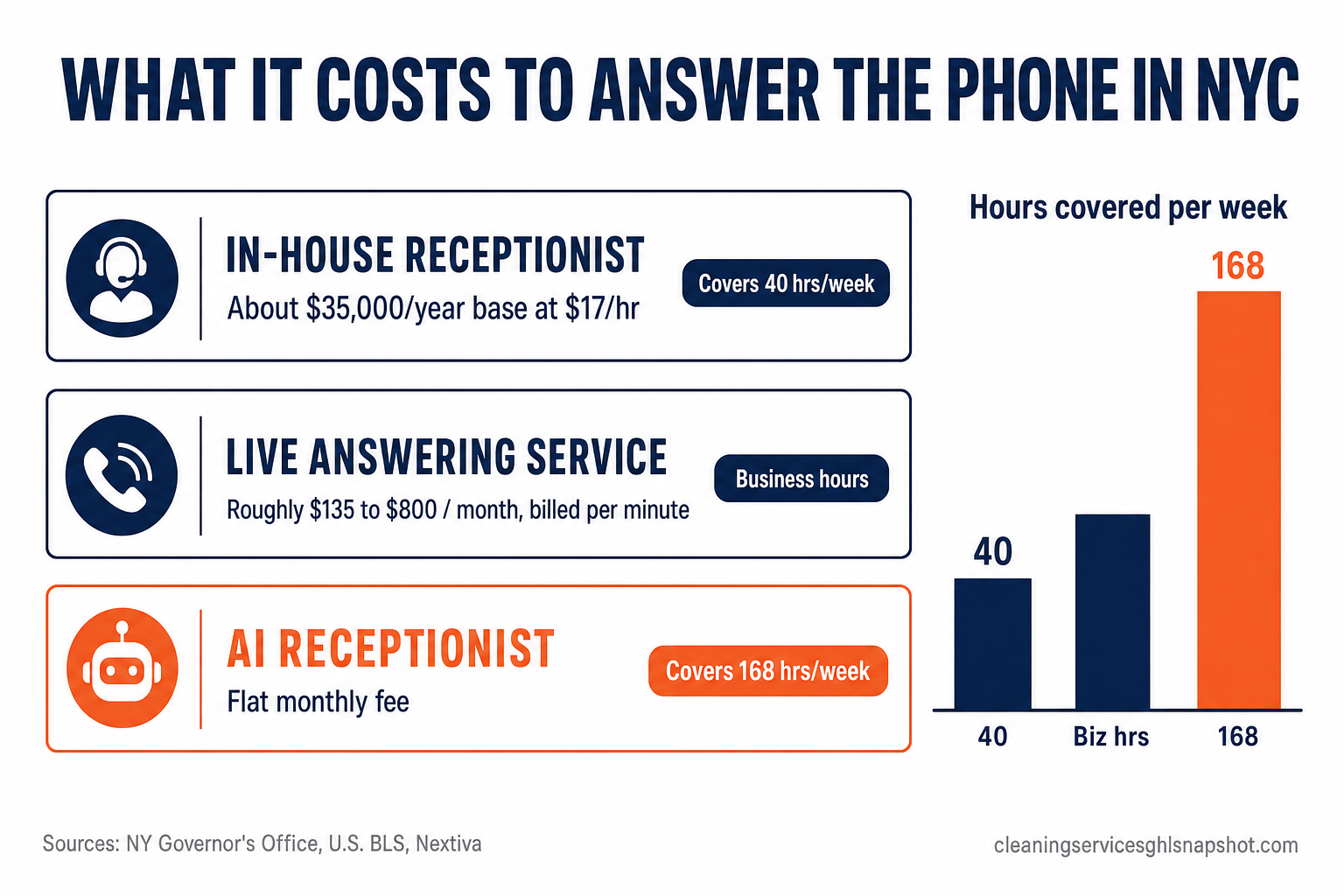
New York City is exactly where the cost gap between a human and an AI answer opens widest. As of January 1, 2026, NYC’s minimum wage is $17.00/hour (NY Governor’s Office), and the national median wage for receptionists is $17.90/hour (about $37,230/year) (U.S. Bureau of Labor Statistics) — with NYC-metro pay running above that national median.
Do the arithmetic on a single in-house receptionist covering just a standard 40-hour week. At $17.00/hour that’s roughly $35,000/year in base wages before payroll taxes and benefits, which typically push the loaded cost 25–40% higher — and that person still goes home at 5 p.m., leaving every night, weekend, and holiday uncovered. A live answering service fills those gaps but bills you by the minute. An AI receptionist covers all 168 hours in the week for a flat fee.
Which should a NYC cleaning company choose?
Here’s the honest guidance, matched to where you are:
- If you’re currently on voicemail: you’re leaking the most. Start today with a missed-call text-back so no unanswered call goes cold, then add an AI receptionist to actually book the job.
- If you want a human voice for a specific reason — high-touch commercial accounts, sensitive buildings — a live answering service still has a place for message-taking and reassurance. Just don’t expect it to book cleans or quote prices.
- If your goal is more booked cleans per lead you already pay for — which, for most residential and turnover operators, it is — an AI receptionist is the better fit. It answers instantly, quotes from your rules, books into your calendar, and texts the confirmation, 24/7, for a flat fee.
For most NYC cleaning operators, the smartest setup isn’t “either/or” — it’s an AI receptionist as the always-on front line, with a clean handoff to you (or a human) for the rare call that needs it. That’s exactly how the Cleaning Services GHL Snapshot is built: instant answer, instant quote, booking, and TCPA-aware two-way SMS in one system.
Prefer to have someone run it for you? Our cleaning-niche GHL VA plan manages the whole setup — receptionist, calendar, and follow-up sequences — so you stay on the job while the system fills your schedule.
Frequently asked questions
What's the real difference between an answering service and an AI receptionist for a cleaning business?
A traditional live answering service is a shared human call center that answers in your name, screens calls, and takes a message for you to act on later — it usually can't quote your prices or book into your calendar. An AI receptionist is a voice agent wired into your pricing rules and calendar, so it answers instantly, quotes a price, books the clean, and texts a confirmation on the same call. The short version: an answering service takes a message; an AI receptionist books the job.
How much does a live answering service cost in 2026?
Industry pricing guides put live answering services at roughly $0.65–$1.75 per minute of agent talk time, with small-business plans commonly landing between about $135 and $800 per month depending on call volume, and per-call rates around $0.99–$5.00. True 24/7 coverage usually adds a premium (Nextiva, Alliance Virtual Offices). Because you're billed by the minute, a busy week or a call spike raises your bill rather than your bookings.
Is an AI receptionist cheaper than hiring a receptionist in New York City?
For round-the-clock coverage, almost always. NYC's minimum wage is $17.00/hour as of January 2026 (NY Governor's Office), and the national median receptionist wage is $17.90/hour (BLS). A single 40-hour-a-week hire runs roughly $35,000/year in base wages before taxes and benefits — and still leaves nights and weekends uncovered. An AI receptionist covers all 168 hours in a week for a flat monthly fee.
Will an AI receptionist annoy my customers or sound like a robot?
Configured well, modern voice agents sound natural and get the caller to a booked appointment quickly, which is what most people calling a cleaner actually want. The keys are a natural voice, a tight script built around your services, and a clean handoff: genuinely complex or sensitive calls should route to you or be captured as a detailed message so nothing falls through. Any follow-up texts must also be TCPA-compliant.
Why does answering speed matter so much for cleaning leads?
Because callers comparing cleaners contact several at once and book the first good answer. Responding within 5 minutes instead of 30 makes you about 21× more likely to qualify a lead and 100× more likely to reach it, yet the average company takes 42 hours to respond and about 23% never respond at all (MIT / InsideSales research via HBR). Voicemail and delayed callbacks miss that window; an instant AI answer captures it.
Can I keep my current phone number and still use an AI receptionist?
Yes. An AI receptionist sits in front of your existing number — it answers when you can't (or on every call, if you prefer), and routes or escalates to you as needed. You keep your number, your Google Business Profile, and your brand; you just stop sending callers to voicemail. Book a walkthrough and we'll show you exactly how the routing works with your setup.
Marisol Vega spent nine years scaling a residential maid service before moving full-time into systems work. She writes about the unglamorous mechanics of a profitable cleaning business — route density, recurring-attach rate, and the texts that keep a Tuesday schedule full. Cost, wage, and conversion figures cited here come from the linked third-party sources; answering-service pricing reflects published industry ranges, and any snapshot pricing reflects our current offer.
Related reading: AI receptionists for cleaning businesses · Missed-call text-back · Instant quote vs. callback · Online booking for cleaning companies · Why a cleaning business CRM pays for itself