
It is 8:10 on a Tuesday. You are between jobs, phone against your shoulder, and a woman who found you on Google asks what a biweekly clean runs. You give her the number. A pause, then: “Oh. That’s more than I expected. The last company was cheaper.” This is the moment that decides your month. Drop the price on the spot and you just taught her the number was made up, and you clipped your margin on every visit for a year. Go quiet and she books the cheaper company. Say the right thing, calmly, and you book the job at your rate.
The short answer: “too expensive” is almost never about the money. It is a question you have not answered yet. Your job is not to talk her down and not to cave. It is to find out what she is really worried about, show her what your price buys, and make saying yes easy. This guide gives you the verbatim scripts for every version of the price objection a cleaning operator hears, plus the follow-up text when they go quiet and the one time you should let the job walk.
Key Takeaways
- “Too expensive” is information, not a no. It means a worry you have not surfaced yet. Diagnose it before you answer, and never answer it with a discount by reflex.
- Discounting costs more than it looks. With labor alone running a median of $17.07 an hour, a 15% price cut can erase a third of your profit on a job. Hold the price and add value instead.
- The script is always the same shape. Acknowledge, ask one diagnosing question, restate the value in their words, then make the next step small. Memorize that shape and you can handle any objection you have not seen before.
- Steal the five scripts below. The phone quote, the cheaper competitor, the deep-clean price gap, the follow-up text that revives a quiet quote, and the graceful walk-away.
- Automate the follow-up, not the conversation. The live price talk is yours. The quote that goes quiet should get worked by a sequence, not forgotten. That part is pre-built in the Cleaning Snapshot.
Table of contents
- What “too expensive” is really costing you
- What a customer actually means by “too expensive”
- The one script shape that handles every objection
- The 5 scripts: what to say to each kind of price pushback
- Three businesses, three different price conversations
- Why you literally cannot price below the floor
- Common objections to using scripts at all
- How to make the follow-up automatic
- Frequently asked questions
What “too expensive” is really costing you
Every operator has the same reflex when they hear “that’s a lot”: they knock something off. Ten percent here, “I can do the first one for $99” there. It feels like saving the job. It is quietly bleeding the business.
Start with what a clean costs to deliver. Your cleaners earn a median of $17.07 an hour (BLS OEWS, May 2025), and that wage does not move when a customer pushes back. Supplies, drive time, payroll taxes, and insurance stack on top. So when you discount, you are not giving away profit the customer talked you out of. You are giving away the thin slice left after you have paid everyone else. Take a standard clean at $150, mid-range for the typical $120 to $280 (Housecall Pro, 2026). Here is what a “small” discount does to your take-home.
Illustrative profit per visit on a $150 standard clean, after about $51 in labor (two cleaners, ~90 minutes at the $17.07 median wage) plus roughly $35 in supplies, taxes, and overhead. A 15% discount cuts take-home by about a third; 25% off cuts it nearly 60%. Your costs do not drop when your price does.
That is one visit. A biweekly client runs about 26 visits a year, so a 15% discount hands back hundreds in profit annually, for a customer who will still leave the day a cheaper flyer shows up. The customers you win on price are the customers you lose on price. The ones worth keeping buy reliability, which you can sell without touching your rate. The scripts below are how.
What a customer actually means by “too expensive”
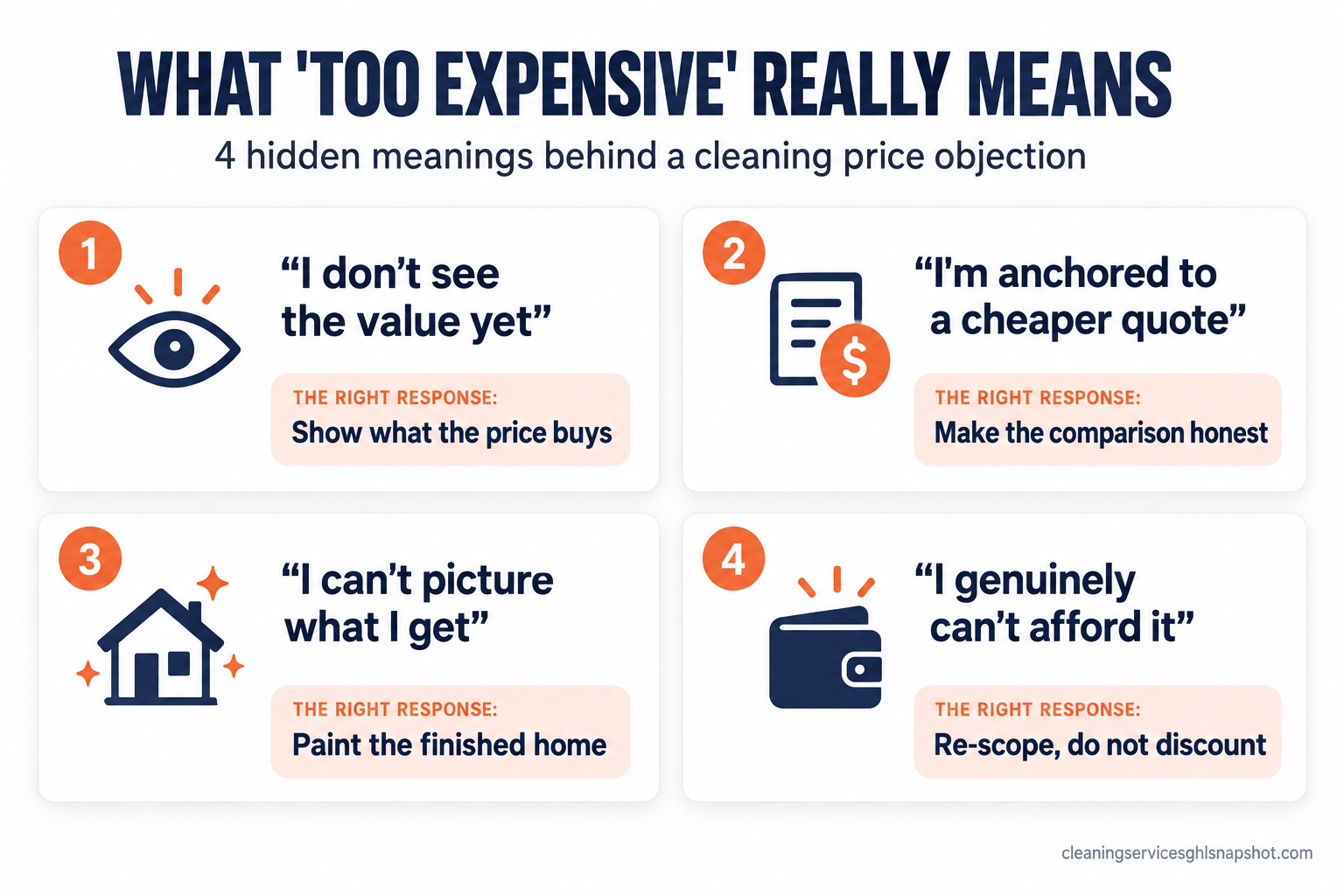
You cannot answer the objection until you know which objection it is. “Too expensive” is four different sentences wearing the same coat. Learn to hear which one you are getting.
1. “I don’t see the value yet.” The most common by far. They are comparing a number to nothing, because you have not told them what the number buys. Not a price problem, a value-communication problem, and entirely fixable.
2. “I’m anchored to a cheaper quote.” They got a number from a solo cleaner with no insurance, no backup, and no system, and they treat it as the market rate. Make the comparison honest instead of matching a price that leaves out what you include.
3. “I can’t picture what I actually get.” Cleaning is invisible until it is done, so a customer who cannot tell two cleans apart defaults to the cheapest. Paint the picture and the price stops being abstract.
4. “I genuinely can’t afford this.” Real, and rarer than you think. When it is real, the answer is a smaller scope or a less frequent plan that fits the budget, not a discount. That keeps your rate intact and still wins a customer.
The one script shape that handles every objection
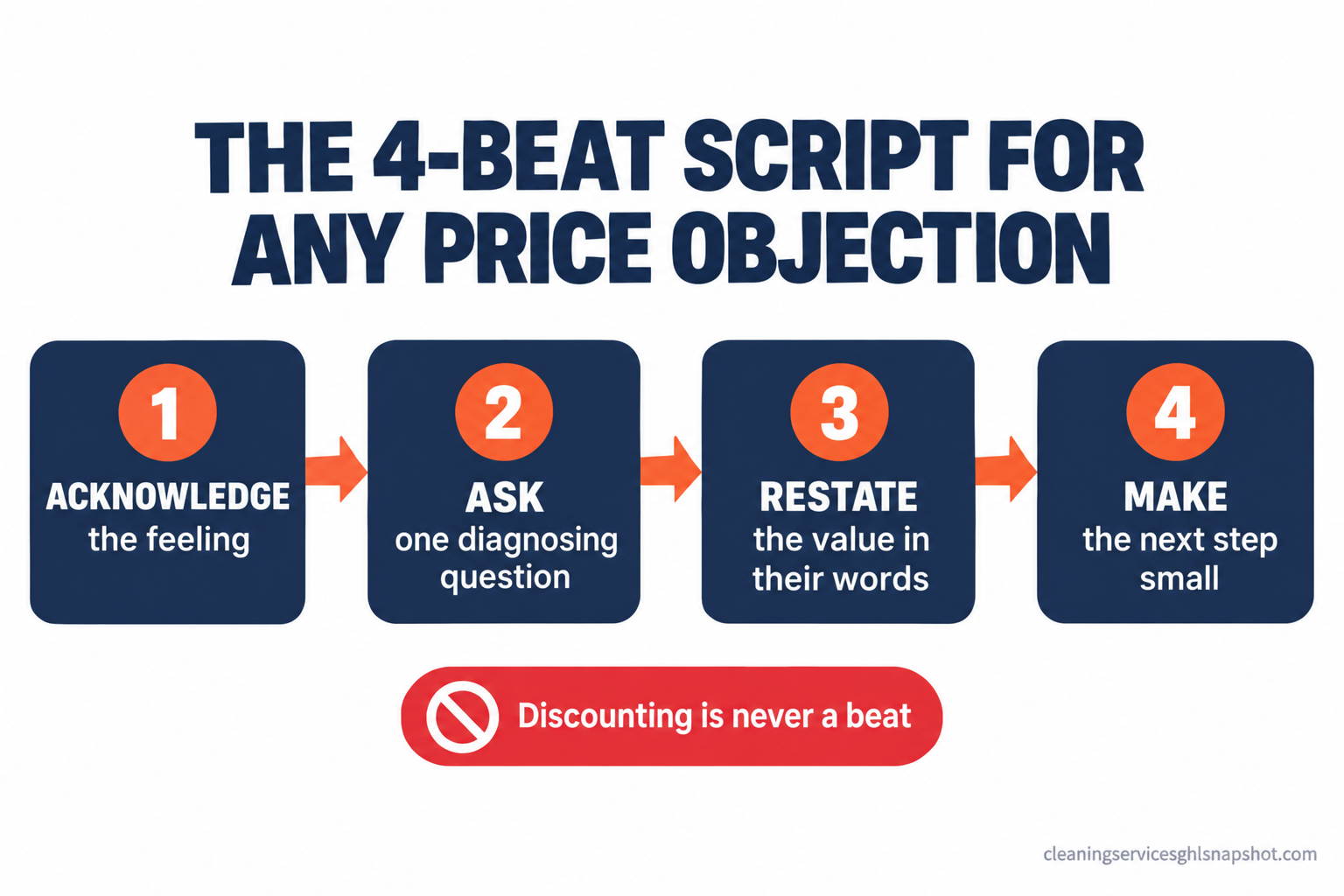
Memorize this and you can improvise through an objection you have never heard. Every good response has four beats:
- Acknowledge. Never argue with the feeling. “That’s a fair question.” This drops their guard so they actually hear the next part.
- Ask one diagnosing question. Surface which of the four you are facing, then stop talking.
- Restate the value in their words. Tie your price to what they just told you they care about: the pets, the move-out deposit, the last crew that no-showed.
- Make the next step small. Not “so do you want to book?” but “want me to hold Thursday at 10 while you think?” A tiny yes beats a big one.
Acknowledge, ask, restate, shrink the step. Every script below is that shape with the words filled in.
The 5 scripts: what to say to each kind of price pushback
These are written for the phone and the text thread, where cleaning quotes actually die. Say them in your own voice; the structure matters more than the exact words.
Script 1: the phone quote, “that’s more than I expected”
They say: “Oh wow, that’s higher than I thought.”
Don’t say: “Well, I could maybe do a bit less…” (You just confirmed the price was negotiable, so now everything is.)
Say this: “Totally fair, a lot of people are surprised the first time. Can I ask what you had in mind? … Got it. So that number covers a two-person insured crew, all the supplies, and the same team every visit so nobody’s relearning your home. The cheaper quotes you’ll see are usually one person, no insurance, and whoever’s free that day. Want me to hold a spot this week so you can try us once with no commitment?”
Why it works: You acknowledged, asked, then restated your price as a list of real things instead of defending it. “Try us once” shrinks the decision from “hire a company forever” to “let one clean happen.”
How it breaks: You rattle off the value before asking what they expected, so you guess at the objection and talk past it. Ask first, always.
Script 2: “the other company quoted me less”
They say: “Someone else said they’d do it for $90.”
Don’t say: “I can match that.” (Now you are the $90 company with worse margins.)
Say this: “They might be a great fit, honestly. One thing worth checking before you decide: ask them if they’re insured and bonded, and whether you get the same cleaner each time. A lot of the lower quotes are a single person with no coverage, which is fine until something breaks or they cancel on you. We’re a bit more because you’re paying for backup and accountability. If budget’s the real constraint, I can also build you a plan that fits. What matters most to you, the price or not having to think about it?”
Why it works: You armed the customer to compare honestly instead of trashing the competitor, and the closing question reframes it from price to peace of mind, which is what recurring clients buy. For pricing against low-ballers, see how to price residential cleaning.
How it breaks: You get defensive or badmouth the other company, which makes you look insecure about your own price. Stay generous and let the comparison do the work.
Script 3: “why is a deep clean so much more than a regular one?”
They say: “The standard clean was $150 but the deep clean is $350? That’s crazy.”
Don’t say: “Yeah, deep cleans are just more.” (True and useless, and it sounds like you picked the number out of the air.)
Say this: “Great question, they’re basically two different jobs. A standard clean maintains a home we already know. A deep clean is hands-and-knees: inside the oven and fridge, baseboards, built-up soap scum, the stuff that’s been sitting. It’s two to three times the hours and harder on my crew, which is why it runs 50 to 100 percent more across the board, not just with us. The upside is after the deep clean, your regular visits stay cheap because the house is already caught up. Want to start there and drop to biweekly after?”
Why it works: You explained the price with labor and scope, not “because,” and turned the big number into the on-ramp to a cheaper recurring plan. The 50-to-100-percent markup is the real industry range (Housecall Pro, 2026).
How it breaks: You discount the deep clean to close it, then eat the labor when it runs long, which deep cleans always do. Price it for the hours it takes.
Script 4: the follow-up text when they go quiet on the quote
Half of price objections never get spoken. The customer just stops replying. That silence is still an objection, and it has a script too. Send this, not “Just following up!”
Why it works: Each text has a clear reason to exist (a question, a deadline, a cheaper option, a graceful close) instead of nagging. The Day 7 “lighter plan” catches the budget objection the customer never said out loud. This is the single highest-ROI thing most operators are not doing. The full version is in the cleaning quote follow-up sequence.
How it breaks: You send it once, by hand, when you remember, which is never. The follow-up only works if it fires on a schedule whether you are up a ladder or not.
Script 5: when you should actually let the job walk
Not every objection should be overcome. Some customers are telling you the truth: they want a price you cannot deliver at a profit. Chasing them is how you end up busy and broke.
Say this: “Totally understand, and I’d rather be honest than win you on a price I can’t do well. At that budget you’re better off with a solo cleaner, and I’m happy to be your backup if that doesn’t work out. Keep my number, okay?”
Why it works: You walk away as the professional, not the salesperson who could not close. That customer remembers you when the $90 cleaner ghosts them, and they refer the clients who can afford you. A clean no protects your calendar for the jobs worth having.
How it breaks: You take the job at their number “to stay busy,” then resent it every visit and cut corners, which earns the bad review that costs you three good leads. Know your walk-away number before the call.
Three businesses, three different price conversations
The same four beats play out differently depending on how big you are. Run the framework through three operators.
The solo operator. You are on the phone and on the mop, so your scripts stay short and your walk-away number stays firm, because every job you take at a loss is one you work for free. Script 2 is your strongest play, since you are usually compared to an even cheaper solo cleaner: sell insurance, reliability, and the fact that you answer your phone. Your biggest leak is Script 4, the follow-up. Automate that first.
The mid-size team (3 to 15 cleaners). The “same team every visit” line in Script 1 is your real edge, so train whoever answers the phone on these scripts word for word. A $150 account quoted badly by a part-timer is gone before you hear about it, and a habit of 10% discounts across the book is the difference between hiring a coordinator and not. This is where raising your average ticket with add-ons quietly beats discounting.
The large residential or janitorial operation. Now “too expensive” shows up in a bid and means “justify your number against two other bids.” Scripts 2 and 3 scale up: you sell insurance limits, bonding, background-checked crews, and a contract that holds. You rarely discount, you re-scope, dropping a frequency or a service line rather than the rate so your per-hour stays intact. Slower conversation, bigger dollars, identical shape.
Two ways to answer 'too expensive'
| Plan | Drop the price (the reflex) | Diagnose and hold (the play) recommended |
|---|---|---|
| Price | Loses money | Keeps margin |
| Feature 1 | Confirms your price was negotiable | Finds the real worry with one question |
| Feature 2 | Cuts a third of profit at 15% off | Restates price as insured, reliable, same crew |
| Feature 3 | Trains the customer to haggle again | Trades frequency for a lower per-visit rate |
| Feature 4 | Wins the client who leaves on price | Wins the client who stays for years |
| Feature 5 | Resentment and cut corners on the job | A clean walk-away when the budget is real |
| See the real cost per clean | Automate the follow-up |
Why you literally cannot price below the floor
Sometimes the right response to “too expensive” is to know why you cannot say yes, so you hold the line without guilt. That floor is what it costs to put an insured, legal crew in a home, and in 2026 it is rising. The median cleaner wage is $17.07 an hour and climbing (BLS OEWS, May 2025), and payroll taxes, workers’ comp, and supplies push the true cost of an hour well above the wage. Then there is classification, where operators quietly break the law to quote lower. Paying cleaners as 1099 contractors to dodge payroll taxes feels cheaper, but under a strict ABC test like California’s AB5, cleaning companies almost always fail it and owe back taxes plus penalties of $5,000 to $25,000 per violation (Labor Code 226.8). We break down the real number in 1099 vs W-2 for cleaning businesses.
Hourly wages for maids and housekeeping cleaners, US. Labor is your single largest and least flexible cost, which is why there is a hard floor under every honest quote. Source: BLS OEWS, May 2025.
So when a customer wants you 25% under your number, the honest answer is often that no legitimate, insured, properly-classified company can do the work at that price. Whoever quoted it is losing money, uninsured, or paying their crew in a way that will catch up with them. That is the reason your price is what it is. In a field of roughly 357,000 residential cleaning businesses facing the same wage floor (IBISWorld, 2026), the survivors charge what the work costs and sell the value well enough that customers pay it.
Common objections to using scripts at all
“Won’t scripts make me sound robotic?” Only if you read them like a telemarketer. A script is not a cage, it is a map so you never freeze or fold on the call. Learn the four beats, say them in your own voice, and you will sound more natural than you do now because you are not scrambling. The customer feels you are calm and sure, which is exactly what makes your price believable.
“What if the customer genuinely can’t afford it?” Two honest moves, neither a discount. Re-scope to a smaller job (kitchen and baths only, or every four weeks instead of two) at your real per-hour rate, or walk away warmly per Script 5. What you never do is cut your rate to fit a budget, because that customer becomes your reference price and tells three friends what you “really” charge.
“I’m a cleaner, not a salesperson. I hate this part.” You are not selling, you are explaining. Every operator who got good at the price talk started out hating it, and the fix was not charisma, it was having the words ready. The scripts just stop you from discounting out of nervousness in the three seconds after someone says “wow.” Practice them out loud twice and the dread goes.
How to make the follow-up automatic
Any script only works if the conversation happens, and half do not: the customer takes the quote, says they will think about it, and vanishes. You mean to follow up. You are cleaning a house. The quote dies.
The live price talk has to be you, on the phone. Everything around it should run on its own. The quote-went-quiet sequence from Script 4 fires on Day 1, 3, 7, and 14 whether or not you remember. A card on file is a link the customer taps. Deposits on deep cleans collect themselves at booking, per your cancellation policy. The Day 7 “lighter biweekly plan” is a pre-built offer sent in one click. That is the difference between a shop that handles price objections by the owner’s memory and one that handles them by a system.
Handling a price objection: memory vs system
Quote given on the phone, then forgotten · follow-up only when you remember, so basically never · cash deals you can't track · deposits you skip because asking is awkward · discounts given in a panic · no record of who you quoted or why they didn't book
Quote logged the moment you send it · Day 1/3/7/14 texts fire on their own · card on file captured at booking · deposit collected automatically on deep cleans · one price for everyone, held calmly · every lost quote sitting in a win-back list for later
You keep the human part. You hand the machine the part you were never going to do by hand anyway. That is how a small shop quotes like a big one.
Frequently asked questions
What do you say when a cleaning customer says you're too expensive?
Don't discount by reflex. Acknowledge it, ask one diagnosing question ('can I ask what you were expecting to pay?'), then restate your price as what it buys: an insured two-person crew, all supplies, and the same team every visit. End with a small next step like a one-time trial clean. Usually 'too expensive' means the customer doesn't see the value yet, which you can fix without dropping your rate.
Should I match a competitor's lower cleaning price?
Almost never. Lower quotes are usually a solo, uninsured cleaner with no backup, so matching them takes on their margins and their risk. Arm the customer to compare honestly: ask if the other company is insured and bonded and whether they get the same cleaner each time. If budget is the real constraint, offer a smaller scope or a less frequent plan at your true per-visit rate instead of cutting the rate.
How much does discounting actually cost a cleaning business?
More than it looks, because your costs don't fall when your price does. On a $150 clean with roughly $51 in labor (two cleaners, ~90 minutes at the $17.07 median wage, BLS OEWS May 2025) plus about $35 in supplies and overhead, a 15% discount cuts your take-home by about a third and a 25% discount by nearly 60%. Across a biweekly account's 26 visits a year, that hands back hundreds in profit.
Why is a deep clean so much more expensive than a standard clean?
They're two different jobs. A standard clean maintains a home you know; a deep clean is inside the oven and fridge, baseboards, and built-up grime, two to three times the hours. That's why deep cleans run 50 to 100 percent more across the industry (Housecall Pro, 2026), not just at your company. Frame it as the on-ramp: after a deep clean, recurring visits stay cheaper because the home is caught up.
When should I just let a price-sensitive customer go?
When the budget is real and sits below what an insured, properly-classified crew can deliver profitably. Chasing that job means working at a loss and resenting it, which shows up as cut corners and a bad review. Walk away warmly: a solo cleaner is a better fit at that budget, and you're happy to be their backup. A clean no protects your calendar and often wins the referral later.
The bottom line
Back to that Tuesday call. The woman says you are more than the last company. You do not flinch and you do not discount. You say, “Totally fair, can I ask what you had in mind?” She says $110. You tell her your number covers an insured two-person crew and the same team every time, that the cheaper quotes are almost always one person with no coverage, and you offer to hold Thursday so she can try you once. She books. You protected your rate for a year, in four sentences.
That is all a price objection ever was: a question you had not answered, dressed up as a no. Diagnose it, answer the real worry, trade frequency for price when you need to, and walk away clean when the budget is honestly too low. Hold your rate, because the wage floor does not negotiate and neither should you.
Everything around the live conversation, the follow-up texts, the card on file, the deposits, the recurring offers, is already built in the Cleaning Snapshot for $997, installed in your GoHighLevel account in a day. Or book a walkthrough and watch a quote go from “that’s too expensive” to a booked card-on-file client without a single discount.
About the author
Darnell Pierce is a GHL Automation Consultant in Atlanta, GA. He runs a small GoHighLevel agency serving home-service operators, with cleaning companies making up the bulk of his book. He’s allergic to half-built funnels and TCPA shortcuts, and he’d rather ship one bulletproof quote-to-book flow than ten clever-but-fragile ones. He covers the agency side of the business: what to white-label, what to charge, and how to onboard a cleaning client in a week without breaking their existing calendar.