
It is Thursday afternoon and you are staring at next week’s schedule. Twenty-two cleans booked, crews full, no slot left to sell, and you are still short of the number you need. So you do what most owners do: you start thinking about more ads, more leads, more customers. More work to get more work.
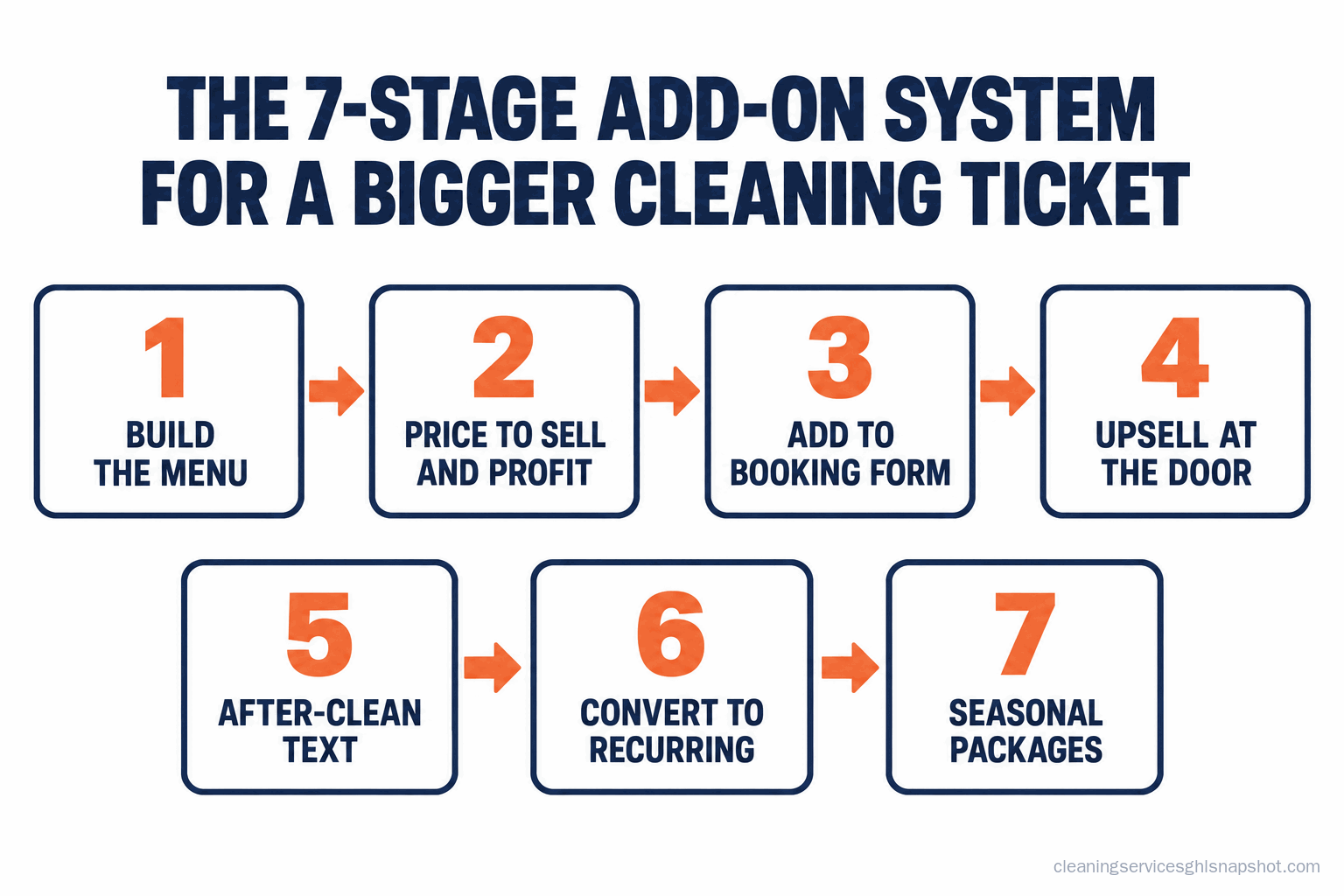
Here is the part nobody tells you. The fastest money in a cleaning business is not a new customer. It is a bigger ticket from the clean you are already driving to. The average standard house clean runs about $175 (Angi, 2026). Lift that by $40 on even half your jobs and you add real money without booking one extra appointment, hiring anyone, or spending a dollar on leads. This is the seven-stage system I use to do it: build the menu, price it right, and put it in front of the customer at the three moments they actually say yes.
Key Takeaways
- Average ticket beats lead volume. A full schedule has no room for more jobs, but every job has room for a bigger number. Lifting the ticket needs no new leads and no new crews.
- You are selling to the easiest buyer there is. An existing customer says yes to an offer 60 to 70 percent of the time, versus 5 to 20 percent for a cold prospect (Marketing Metrics, Farris et al.). Winning a new customer costs 5 to 25 times more than keeping one (Harvard Business Review, 2014).
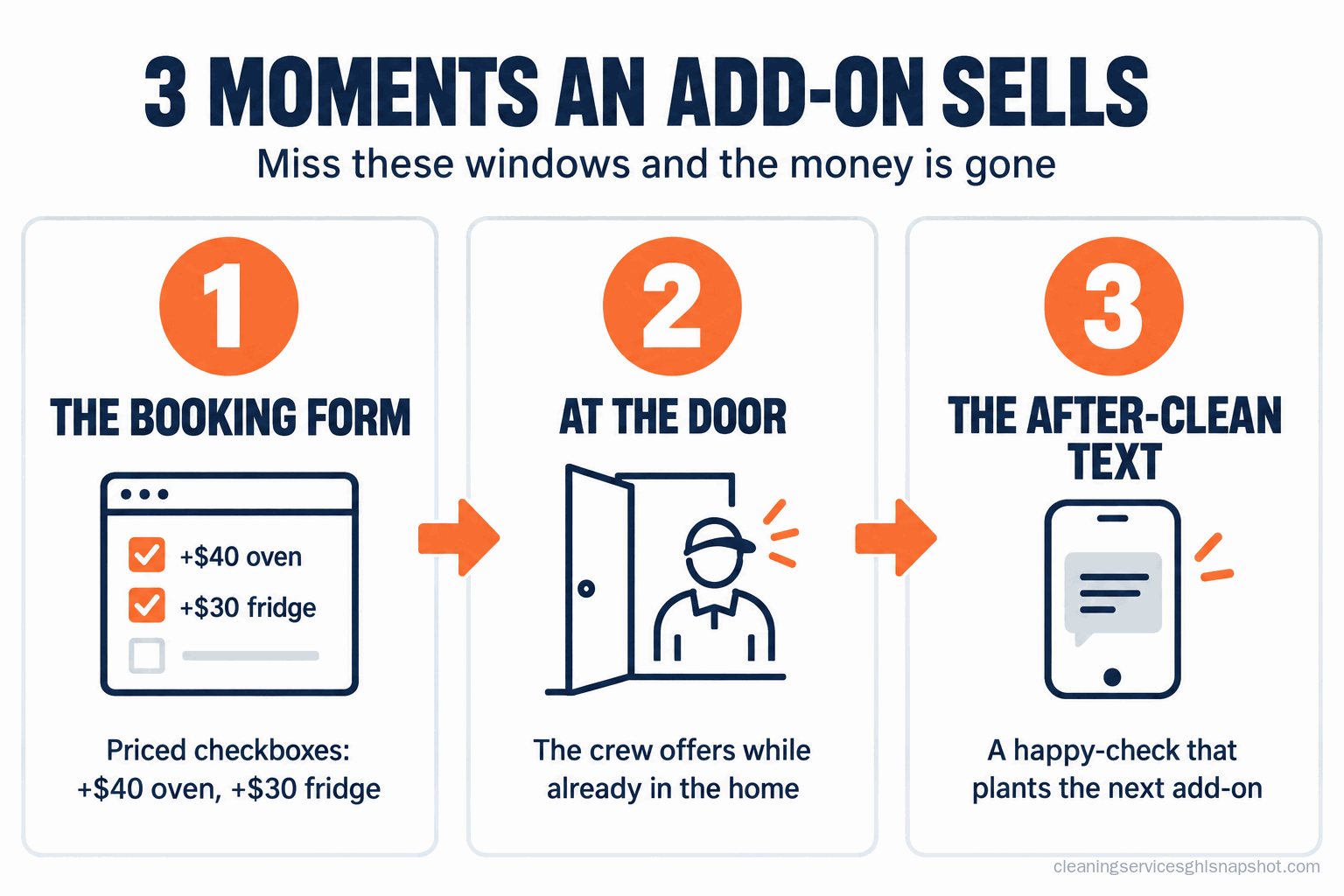
- Timing is the whole game. Add-ons sell at three moments: the booking form, the door, and the text after the clean. Miss those windows and the money is gone.
- Seven stages: build the menu, price it, put it on the form, sell it at the door, text it after, upgrade to recurring, then package it by season. The booking labels, crew script, and texts below are copy you can paste today.
Table of contents
- Why your average ticket is the fastest money you have
- Stage 1: Build an add-on menu customers actually want
- Stage 2: Price your add-ons so they sell and still pay
- Stage 3: Put the add-ons on the booking form, not in your head
- Stage 4: The at-the-door upsell, and the mid-clean one
- Stage 5: The after-clean text that books the next add-on
- Stage 6: Turn one-time cleans into recurring, then move recurring up
- Stage 7: Seasonal packages and membership tiers
- The same system at three sizes
- The objections I hear from owners
- Frequently asked questions
- The bottom line
Why your average ticket is the fastest money you have
Average ticket is just a job’s revenue divided by the number of jobs. If you did 22 cleans last week and billed $4,180, your average ticket was $190. Nudge it to $225 and the same 22 cleans bill $4,950: same crews, same route, same day. That is $770 a week, roughly $40,000 a year, and you did not answer one new call to get it.
Chasing new customers is the expensive way to grow. Winning a new customer costs five to twenty-five times more than keeping one you have (Harvard Business Review, 2014). The odds run the same way: a cold prospect buys 5 to 20 percent of the time, an existing customer says yes 60 to 70 percent of the time (Marketing Metrics, Farris et al.). The person whose house you are already standing in is far likelier to say yes than the stranger you are paying to reach, yet most owners spend on the stranger.
This is not nickel-and-diming. It is offering the fridge, the oven, and the inside windows to people who want them cleaned and never knew they could ask. A deep clean runs up to $380, and add-ons price at roughly $0.10 to $0.25 per square foot on top of the base (Angi, 2026). The demand is already in the house. You just have to name it.
Stage 1: Build an add-on menu customers actually want
You cannot sell an add-on you have never named. Most owners have a vague sense that they “do extras sometimes,” which means extras only happen when a client happens to ask. The first move is a fixed menu offered on every job, by every crew.
Here is the menu I start every residential operator with. These are the jobs a standard clean skips and the customer can see were skipped, which is exactly why people say yes:
Inside the oven · Inside the fridge · Interior windows · Baseboards (whole home) · Blinds (dusted or wiped) · Interior cabinet fronts · Laundry: one load washed, dried, folded · Change and make beds · Pet-hair deep removal
For commercial and janitorial accounts the menu changes but the idea is identical: floor stripping and waxing, carpet extraction, high dusting, window cleaning, pressure washing, and day-porter hours on top of the base contract. These are the line items that turn a flat nightly rate into a bigger monthly invoice.
Six to ten add-ons is the sweet spot; a menu of thirty paralyzes people and slows the crew. Then price them, which means knowing your costs: the oven adds about 25 minutes plus product, and if you do not know your true cost per clean, you will price by feel and give the margin away. Build the menu first, then cost each line.
Stage 2: Price your add-ons so they sell and still pay
An add-on has two numbers: what it costs you in crew time and product, and what the customer will happily pay. Too low and you donate labor; too high and nobody bites. Price it time-plus-margin: figure the extra minutes the task adds, multiply by your loaded crew cost per minute, then mark it up to your target margin. Inside the oven is usually 20 to 30 minutes, so most operators land it at $30 to $45. Inside the fridge, $25 to $35. Interior windows, $5 to $8 each. Whole-home baseboards, $35 to $60 by size. These sit inside the $0.10 to $0.25 per square foot that deep-clean work runs (Angi, 2026), so they read as fair.
Three rules make add-ons sell faster:
- Round, simple numbers. $40, not $37.50. The customer is deciding in two seconds on a form, not studying a quote.
- Bundle two or three into a named upgrade. “Deep Clean Pack: oven, fridge, and baseboards, $99.” One decision beats three, and the bundle price beats buying them separately.
- Anchor against the deep clean. Next to a $380 deep clean (Angi, 2026), a $40 oven add-on looks like a bargain.
The menu sits on top of a clean pricing-tier structure, not in place of one, so if your base pricing is a mess, fix that first.
Stage 3: Put the add-ons on the booking form, not in your head
This is the biggest single change in the system, and most owners skip it. Add-ons that live only in your head sell when you remember them. On the booking form as checkboxes, every customer sees them, with zero effort from you.
When a customer books online, the add-ons appear as a short checklist before they confirm, each with a label and a price. The customer self-selects, and you wake up to a bigger ticket before anyone touched a mop. An online booking flow that ends the phone tag pays for itself twice: in saved time and in a lifted ticket.
Here is the add-on block I put on booking forms. Copy it straight across:
Want to add any of these to your clean? (optional, check any) ☐ Inside the oven, $40 ☐ Inside the fridge, $30 ☐ Interior windows, $6 each ☐ Baseboards, whole home, $45 ☐ Blinds dusted, $25 ☐ Deep Clean Pack (oven + fridge + baseboards), $99 (save $16) Not sure? Leave it blank and we’ll ask when we arrive.
That last line matters: it tells the hesitant customer there is no pressure and hands the decision to the door, which is Stage 4.
Stage 4: The at-the-door upsell, and the mid-clean one
The door is where the hesitant customer says yes: the crew is in the home, the customer can see the oven, and the ask is natural, not salesy. The catch is that the crew must make the offer every time, in the same words, or it never happens. Train one short door script and make it the rule:
“Morning! Two quick things before we start. One, anything you especially want us to focus on today? Two, we’ve got a few add-ons if you’d like them while we’re already here: inside the oven is $40, the fridge is $30, and baseboards for the whole place is $45. Want any of those added on?”
That takes fifteen seconds, it is helpful rather than pushy, and it catches the customer when the need is visible. Mid-clean, the lead flags what they see: “The living-room blinds are dusty, want those done for $25 while we’re set up?” Specific and visible beats generic.
Stage 5: The after-clean text that books the next add-on
The booking form and the door catch today’s add-on. The after-clean text sets up next time, and it is the most-ignored money in the business. A few hours after the crew leaves, send one short message that does two jobs: it checks the customer is happy and plants the next offer. Here is the sequence, ready to paste into your message templates:
Same evening, satisfaction + plant: Hi [Name], it’s [Company]. Hope the house feels great! Quick question, everything up to your standard today? (Reply 1 = loved it, 2 = something was off.) P.S. next visit we can add the inside of your oven for $40 if you’d like it sparkling too.
If they reply “1” (happy): Love to hear it! Want me to pencil the oven in for your next clean, or save it for a spring deep clean? Either works.
3 days later, review + soft offer (happy customers only): Thanks again, [Name]! If you’ve got 30 seconds, a quick Google review really helps a small crew like ours: [link]. And whenever you want the fridge or windows done, just reply and I’ll add it.
The offer rides on a genuine check-in: you ask if they are happy and mention one thing they can add. That is why it does not read as spam, and why happy customers who would never phone to ask will tap “yes” to a text. Pair it with the system that stops clients disappearing after one visit.
Stage 6: Turn one-time cleans into recurring, then move recurring up
Add-ons lift a single ticket. Recurring lifts every future ticket at once, which is why the biggest win is converting a one-time clean into a weekly or bi-weekly customer. A $175 one-time clean is one ticket; the same customer on bi-weekly is roughly $4,500 a year. The best moment to win it is the day of a great first clean. The offer that converts is simple and time-boxed:
Hi [Name], the crew loved your place today. If you’d like to keep it feeling like this, I can hold a recurring spot (same crew, same day) and take 15% off your next clean when you start before Friday. Want me to set it up?
Once recurring, a customer offers a second lever: move them up a frequency or tier, since a bi-weekly who keeps buying extras is often happier on weekly. The full mechanics live in our recurring-revenue playbook, and the booking should auto-schedule so you are not rebooking by hand. One recurring conversion beats a hundred add-on offers, because it multiplies every ticket from now on. Offer it on every strong first clean, with a reason to start this week.
Stage 7: Seasonal packages and membership tiers
The last stage packages your add-ons so customers buy them in groups and on a calendar instead of one at a time. You stop selling single extras and sell a plan.
Seasonal packages bundle the right add-ons for the time of year and give a reason to book now. A “Spring Deep Refresh” bundles baseboards, windows, blinds, and the oven at a package price in March and April; a “Holiday-Ready Clean” bundles the fridge, oven, and guest-room detail in November. In warmer markets it flips: a Phoenix operator sells fall and winter “snowbird home-prep” packages, where demand peaks in the cool months. Match the package to your market’s real season.
Membership tiers turn add-ons into a monthly plan. A “Plus” recurring tier folds one rotating add-on into every visit (oven, then fridge, then baseboards) for a flat monthly premium. The customer never decides again, your ticket on those jobs is permanently higher, and a plan is harder to cancel than a loose arrangement. Stages 1 through 6 lift tickets one job at a time; Stage 7 raises the floor for whole seasons at once.
The same system at three sizes
The seven stages do not change with the size of your business, but where you spend your effort does.
Solo operator (you and maybe one helper). Your cheapest win is the booking form with add-on checkboxes, because it sells without you having to remember. Add the same-evening satisfaction text and the recurring offer on strong cleans, and skip crew spiffs since you are the crew. These three moves alone can lift a solo operator’s average ticket 15 to 25 percent.
Mid-size team (three to eight crews). Now the door upsell matters, because your crews are in homes you never see, and that only works if the script is trained and the spiff is paid. Track who sells, and fire the after-clean texts automatically off the completed job, not off someone remembering. This is the size where a lifted ticket turns into serious money, because you have the volume to multiply it.
Large shop (ten-plus crews, or janitorial contracts). The menu becomes standardized line items and the packages become products. On the commercial side your “add-ons” are floor care, high dusting, and day-porter hours scoped into contract renewals. You manage it with reporting: average ticket by crew, attach rate by location, package uptake by season.
The objections I hear from owners
“Won’t customers feel nickel-and-dimed?” Only if you spring the extras after the fact or pressure them. Done right it is the opposite: you are telling a customer the oven, which a standard clean never touches, can be cleaned if they want it. The resentment comes from surprise charges, not a clear menu offered up front. Put the prices on the booking form and it disappears.
“My crews won’t do it.” They will if you pay them and give them words. Crews resist vague orders to “sell more” and resist extra work for the same pay. A fixed fifteen-second script plus a spiff on every add-on solves both, and within a month it is a habit.
“I’m not technical, this sounds like setup.” The menu and scripts take an afternoon and no technical skill. Only the booking form and the automated texts need setup, a one-time job you can hand off or buy done.
Frequently asked questions
What is a good average ticket for a cleaning business?
There is no single right number; it depends on your market and your mix of standard, deep, and recurring cleans. The useful target is your own trend: your average ticket should rise quarter over quarter. A standard single visit averages about $175 nationally, so if yours sits at or below that, add-ons and recurring are your fastest gains.
How do I calculate my average ticket?
Divide your total cleaning revenue for a period by the number of completed jobs in it. If you billed $19,000 across 100 cleans last month, your average ticket is $190. Track it monthly. Turn on the booking-form add-ons and the after-clean texts and you should see it move within 30 to 60 days.
Which cleaning add-ons sell the best?
Inside the oven, inside the fridge, interior windows, and baseboards are the consistent winners, because they are the visible jobs a standard clean skips and customers can see were skipped. Bundling two or three into a named 'Deep Clean Pack' at a small discount turns three small decisions into one easy yes.
How much can add-ons realistically raise my revenue?
A solo operator who adds booking-form checkboxes and an after-clean text commonly lifts average ticket 15 to 25 percent, which on a full schedule is thousands of dollars a month with no new customers. Because the odds of a yes from an existing customer run 60 to 70 percent, the ceiling is higher than most owners expect.
Won't upselling hurt my reviews?
Not when the offer is clear and optional. Reviews suffer from surprise charges and pushy sales, not from a menu offered openly. Pairing the after-clean satisfaction check with the review request (happy customers only) tends to lift ticket and review volume at once.
The bottom line
Go back to that Thursday schedule with twenty-two cleans and no room left. You do not need a twenty-third job. You need those twenty-two to be worth more, and the demand is already sitting in every one of those homes: the oven nobody cleans, the fridge, the baseboards, the recurring spot the happy customer would gladly hold. That is your growth, and none of it needs a new lead, a new hire, or a new van.
Pick one stage this week. If you do nothing else, put the add-on checkboxes on your booking form. It is the one change that sells without you, and the fastest raise you will ever give yourself.