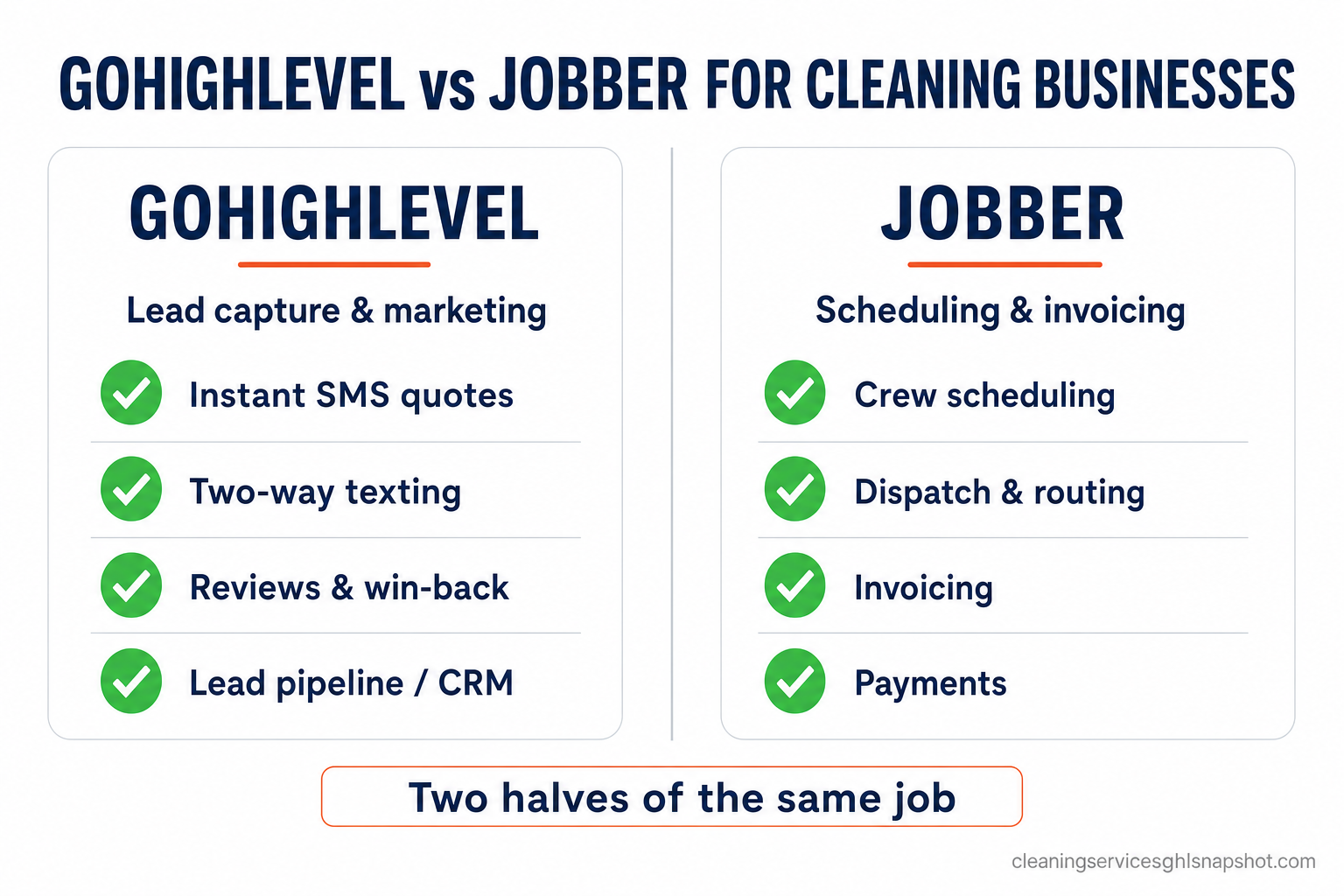
For a cleaning business in 2026, GoHighLevel and Jobber solve two different halves of the same problem — and most operators only realize it after they’ve lost a season of leads. Jobber is field-service software: it schedules the crew, dispatches the route, sends the invoice, and takes the payment. GoHighLevel is a CRM and marketing-automation platform: it captures the lead the second it comes in, texts a quote before a competitor calls back, and runs the review, recurring, and win-back sequences that keep the schedule full. Jobber assumes the job is already booked. GoHighLevel is how it gets booked. If you have to choose one, choose the tool that fixes your actual bottleneck — and for most cleaning companies, the bottleneck is speed-to-lead, not invoicing.
This guide compares the two head-to-head for a cleaning company specifically: what each is built to do, where each wins, the speed-to-lead data that decides how many jobs you book, real pricing, and the option most operators miss — running both, connected. Every statistic below is sourced; none are invented.
Key Takeaways
- They’re not really competitors — they’re two layers. Jobber runs operations (scheduling, dispatch, invoicing, payments) for 300,000+ home-service pros across 27M+ properties (Jobber). GoHighLevel runs lead capture and marketing (CRM, two-way SMS, review + win-back automation).
- Speed-to-lead is the profit lever, and it favors GoHighLevel. Replying within five minutes makes you 100× more likely to make contact and 21× more likely to qualify a lead than waiting 30 minutes (MIT / InsideSales). Yet the average business takes 42 hours to respond, and 23% never do (HBR).
- Jobber is the stronger back office. If your problem is a messy calendar, double-booked crews, or slow invoicing, Jobber’s scheduling and payments are excellent and purpose-built.
- Pricing is structured differently. Jobber is a monthly subscription that scales with team size — roughly $39/mo (Core) up to $599/mo (Plus) (Jobber). The Cleaning Services GHL Snapshot is a one-time $997 deployment on GoHighLevel (pricing).
- You can run both. The highest-performing cleaning operations keep Jobber for job execution and add GoHighLevel for lead capture and follow-up — connected so nothing is re-keyed (GHL development).
Table of contents
- GoHighLevel vs Jobber: what each is actually for
- The feature comparison, cleaning-business first
- Speed-to-lead: the number that decides who books the job
- Follow-up and retention: where the recurring money is
- Pricing compared
- When Jobber is the right call
- The move most operators miss: run both, connected
- Frequently asked questions
GoHighLevel vs Jobber: what each is actually for
Both tools are popular with cleaning operators, and both are good — but they were built to solve different jobs, and confusing the two is how owners end up frustrated with whichever one they picked.
Jobber is field-service management software. Its core is operations: quoting, scheduling, dispatching crews, tracking jobs, invoicing, and collecting payment. It’s used by more than 300,000 home-service professionals serving over 27 million properties in 60+ countries as of late 2025 (Jobber, via PR Newswire). If a customer is already booked and you need to get a crew to the door and get paid, Jobber is built for exactly that.
GoHighLevel is a CRM and marketing-automation platform. Its core is the front of the funnel: capturing leads, running them through a pipeline, and automating the texts, emails, reviews, and follow-ups that turn a stranger into a booked — and then recurring — customer. GoHighLevel ranked No. 516 on the 2025 Inc. 5000 with 781% three-year revenue growth (HighLevel), largely on the back of agencies and service businesses using it to replace a stack of separate marketing tools.
The distinction matters because a cleaning company’s biggest leak is almost never “we couldn’t schedule the job.” It’s “the lead texted three cleaners and booked whoever answered first — and it wasn’t us.” That’s a lead-capture and speed-to-lead problem, and it lives in GoHighLevel’s half of the map, not Jobber’s.
The feature comparison, cleaning-business first
Here’s the head-to-head on the capabilities a cleaning operator actually uses day to day. “Native” means it’s built in; “add-on/manual” means it exists but takes extra tools or work.
| Capability a cleaning business needs | GoHighLevel (+ Snapshot) | Jobber |
|---|---|---|
| Instant SMS quote to a new lead | ✅ Native, automated | ⚠️ Quotes exist, but not instant auto-text on lead-in |
| Two-way texting with customers | ✅ Native, TCPA-ready | ✅ On higher tiers |
| Lead pipeline / CRM stages | ✅ Native | ⚠️ Basic client list, not a sales pipeline |
| Missed-call text-back | ✅ Native | ❌ Not built in |
| Crew scheduling & dispatch | ⚠️ Via snapshot/calendars | ✅ Best-in-class, purpose-built |
| Route optimization | ⚠️ Add-on / integration | ✅ Native |
| Invoicing & payment collection | ⚠️ Native payments, lighter | ✅ Best-in-class |
| Automated review requests | ✅ Native | ⚠️ Add-on |
| Recurring & win-back sequences | ✅ Native automation | ❌ Reminders only, no marketing automation |
| Website / funnels / booking pages | ✅ Native | ⚠️ Basic booking page |
| Pricing model | 💲 One-time $997 snapshot | 💲 $39–$599/mo subscription |
Read the table in one line: Jobber wins the back office, GoHighLevel wins the growth engine. For a cleaning company whose calendar is fine but whose lead flow is leaky, the green checks that matter most are all on the GoHighLevel side.
Speed-to-lead: the number that decides who books the job
If you take one section from this comparison, take this one — because it’s the clearest, best-documented reason cleaning leads slip away, and it’s the capability gap between the two tools.
The classic MIT / InsideSales Lead Response Management study analyzed 15,000+ leads and 100,000+ call attempts and found that contacting a web lead within five minutes rather than thirty makes you 100× more likely to make contact and 21× more likely to qualify that lead (MIT / InsideSales). Harvard Business Review’s audit of 2,241 U.S. companies found firms that responded within an hour were 7× likelier to qualify a lead than those who waited just one hour longer — and 60× likelier than those who waited 24+ hours (HBR).
Now the gut-punch from that same HBR study: the average company took 42 hours to respond to a web lead, and 23% never responded at all (HBR). Your competition is slow. That’s the opening.
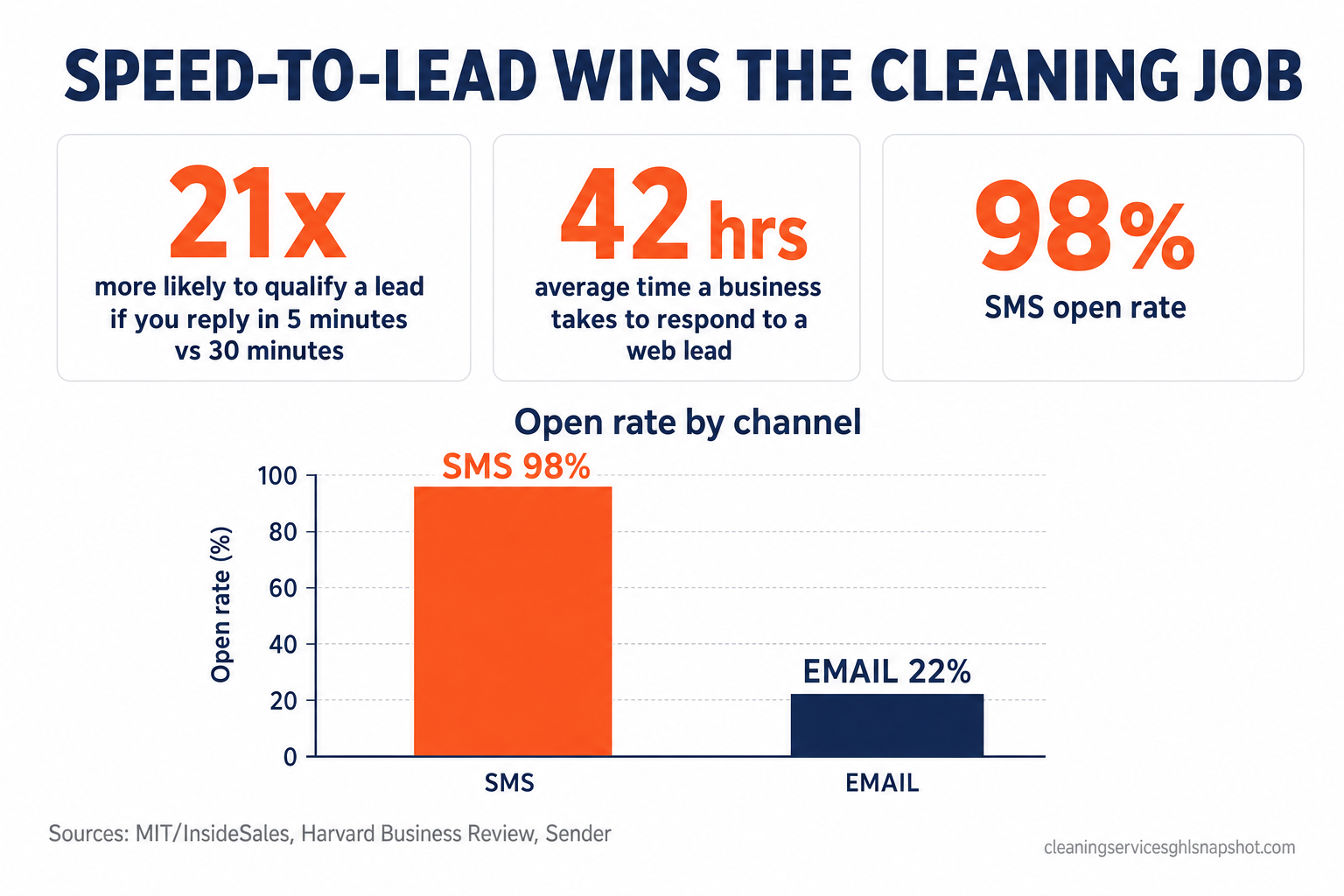
How many times more likely you are to reach and qualify a lead by responding in 5 minutes vs 30 minutes. Source: MIT / InsideSales Lead Response Management study.
This is where the two tools diverge hardest. Jobber is excellent once a job exists, but it isn’t designed to win the lead in the first five minutes. GoHighLevel is — the instant-quote-versus-callback flow fires an SMS quote automatically the moment a form or ad lead comes in, and missed-call text-back catches the calls you can’t pick up because you’re on a job. When a lead reaches out, they hear from you in seconds, not the 42-hour industry average.
And the channel matters as much as the speed. SMS is read almost immediately: text messages are read within three minutes of delivery 90% of the time (Tatango), and SMS open rates are commonly cited around 98%, versus roughly 20–25% for email (Sender). An instant text quote isn’t just faster than a callback — it lands in the one channel your customer actually checks.
Approximate open rate by channel (%). The ~98% SMS figure is a widely cited industry estimate, not a precise measured number. Source: Sender SMS benchmarks.
When I scaled my maid service, the switch that moved revenue wasn’t a better invoice — it was answering the lead in ninety seconds instead of that evening. Whoever texts the price first usually wins the job. Software that only helps you after the booking is optimizing the wrong minute.
Follow-up and retention: where the recurring money is
The first clean is the expensive one to earn. The profit is in the second, tenth, and fiftieth — and that’s automation, not scheduling. The often-cited Bain research summarized by Harvard Business Review found that increasing customer retention by just 5% increases profits by 25% to 95% (HBR). For a cleaning business, that “retention” is your recurring-attach rate: turning one-off deep cleans into weekly and bi-weekly standing jobs.
This is another gap. Jobber sends appointment reminders, but it isn’t a marketing-automation engine — it won’t run a recurring-revenue conversion sequence, a photo-triggered review request, or a win-back campaign for the customer who lapsed three months ago. GoHighLevel does all three natively, and the Cleaning Services GHL Snapshot ships them pre-built. Miss those and you’re paying to acquire customers you then quietly let churn.
There’s a reputation angle too. 71% of consumers regularly read online reviews for local businesses, and Google is the most-used platform at 83% (BrightLocal 2025). Automated, photo-triggered review requests — sent at the moment the crew marks a job complete — are exactly the kind of loop GoHighLevel automates and Jobber leaves to you.
Pricing compared
The two price completely differently, so compare the model, not just the sticker.
Jobber is a monthly subscription that scales with your team. Plans run roughly from $39/month (Core) up to $599/month (Plus) depending on tier and crew size, with higher tiers unlocking two-way texting, automations, and QuickBooks sync (Jobber pricing). It’s a recurring cost that grows as you add users — fair for a tool you run the whole operation on, but it never stops.
The Cleaning Services GHL Snapshot is a one-time $997 (pricing) that installs the full lead-capture, quoting, review, and recurring automation system into a GoHighLevel account — no per-seat subscription on the snapshot itself. You do need a GoHighLevel plan underneath it (starting at $97/month via our partner link, which also unlocks up to 30% off the snapshot), but the automation system is bought once and owned.
If you’d rather not run any of it yourself, our cleaning-niche GHL virtual assistant operates the CRM and follow-up for you from $700/month — so you run the business while the automation runs in the background.
When Jobber is the right call
To be fair — and because a comparison that only bashes the other tool isn’t honest — Jobber is genuinely the better choice in some situations:
- Scheduling and dispatch are your actual pain. If crews get double-booked, routes are a mess, or you’re losing time coordinating jobs, Jobber’s operations tooling is purpose-built and hard to beat.
- Invoicing and payment collection are slow. Jobber’s quote-to-invoice-to-payment flow is tight and mature.
- You don’t run marketing. If your leads all come from word of mouth and you have no ad or web funnel to capture, the marketing-automation muscle of GoHighLevel is less urgent.
The honest read: if your calendar is the bottleneck, Jobber. If your lead flow is the bottleneck, GoHighLevel. Most cleaning owners, when they look at where the money is actually leaking, find it’s the second one — but not all.
The move most operators miss: run both, connected
Here’s what the best-run cleaning operations do: they stop treating it as either/or. Keep Jobber for what it’s great at — scheduling, dispatch, invoicing — and add GoHighLevel for lead capture and follow-up — then connect the two so a job booked in one shows up in the other with nothing re-keyed.
That’s exactly the work we do on the GHL development side. We build custom Jobber ↔ GoHighLevel integrations (sync contacts, jobs, recurring plans, and pipeline stages in one or both directions), and for operators who’d rather consolidate, a clean Jobber → GoHighLevel migration that brings customers, recurring schedules, and history across intact. Either way, you stop losing the leads Jobber quietly assumes you already booked.
The deeper point is the one this whole comparison keeps returning to: your cleaning-business CRM is where jobs are won, and your field-service tool is where they’re executed. Get the first one right and the second one has more to do. Get online booking and instant-quote flows humming, and you’ll book enough work that Jobber’s scheduling becomes the good problem to have.
Frequently asked questions
Is GoHighLevel a replacement for Jobber?
Not exactly — they overlap but lead with different strengths. Jobber is field-service software built for scheduling, dispatch, invoicing, and payments, used by 300,000+ home-service pros. GoHighLevel is a CRM and marketing platform built for lead capture, instant SMS quotes, pipelines, reviews, and recurring/win-back automation. GoHighLevel can handle booking and light payments, so some cleaning businesses do run on it alone via the Cleaning Services GHL Snapshot — but if your scheduling and invoicing needs are heavy, keeping Jobber for that and adding GoHighLevel for marketing is often the stronger setup.
Which is better for a cleaning business, GoHighLevel or Jobber?
It depends on your bottleneck. If crews get double-booked and routes are a mess, Jobber's operations tooling wins. If leads go cold before you call back and one-off cleans never become recurring, GoHighLevel wins — because responding to a lead in five minutes instead of thirty makes you 21× more likely to qualify it, and that's a lead-capture problem Jobber isn't built to solve. Most cleaning owners find lead flow is the real leak.
How much do GoHighLevel and Jobber cost?
Jobber is a monthly subscription that scales with team size, roughly $39/month for the Core plan up to about $599/month for Plus (Jobber pricing). The Cleaning Services GHL Snapshot is a one-time $997 that installs the full automation system into GoHighLevel (pricing); you also need a GoHighLevel plan underneath it, starting at $97/month through our partner link, which also unlocks up to 30% off the snapshot.
Can I use Jobber and GoHighLevel together?
Yes, and it's what many high-performing cleaning operations do. Keep Jobber for scheduling, dispatch, and invoicing, and add GoHighLevel for lead capture and follow-up. We build custom Jobber ↔ GoHighLevel integrations that sync contacts, jobs, recurring plans, and pipeline stages so nothing is entered twice.
How do I switch from Jobber to GoHighLevel without losing data?
With a proper migration. Our team moves your customers, recurring schedules, pipelines, line-item pricing, and history from Jobber into GoHighLevel, then rebuilds your booking and reminder flows as native automations — nothing lost, nothing re-keyed. See our guide to migrating a cleaning business to GoHighLevel or book a walkthrough.
Why does response speed matter so much for cleaning leads?
Because cleaning is a shop-around, high-intent purchase — a homeowner texts several companies and books whoever answers first. Firms that respond within an hour are 7× likelier to qualify a lead than those who wait one hour longer, yet the average business takes 42 hours to respond. An instant SMS quote closes that gap, and SMS is read within three minutes 90% of the time (Tatango).
Marisol Vega is a Cleaning Operations Strategist who scaled a residential maid service from two vans to a fourteen-crew operation before moving into systems work. She writes about the unglamorous mechanics of a profitable cleaning business — route density, recurring-attach rate, and the texts that keep a Tuesday schedule full. Pricing and industry figures cited here are from the linked third-party sources; the $997 snapshot price reflects our current pricing.
Related reading: Migrate a cleaning business to GoHighLevel · Why a cleaning business CRM pays for itself · Instant quote vs. callback · Missed-call text-back for cleaners · Recurring revenue for cleaning companies