
It is Thursday and a deep clean you did two weeks ago went perfectly. The client texted a photo of her kitchen to her sister, tipped in cash, and said, “This was amazing, we should do this every month.” You drove off sure you had landed a recurring customer. Then nothing. No reply to your follow-up, none to the one after. No complaint, no bad review. She went quiet, and a $175 visit that should have become a $2,000 year turned into a one-off.
Here is the honest answer most owners do not want to hear: when a happy client disappears after one visit, it is almost never the cleaning. It is that nothing asked for the next appointment at the right moment, so a busy person forgot you existed. Ghosting is a follow-up problem wearing a quality-problem costume. Fix the six gaps below and most one-and-done cleans become the recurring book that pays your bills. This guide covers why it happens, the rebook system that stops it, the texts you can steal, and how it changes at three sizes of business.
Key Takeaways
- Ghosting is a follow-up gap, not a cleaning failure. Happy clients go quiet because nobody asked for the next date while the clean was fresh.
- Retention is where the money is. Per Harvard Business Review, a 5% lift in retention can raise profit 25% to 95%, and winning a new customer costs 5 to 25 times more than keeping one.
- The second booking is the whole game. A one-time $175 clean is a rounding error. The same client on a biweekly plan is worth thousands a year, and the only thing between the two is a rebook ask.
- Text, do not email. SMS gets opened about 98% of the time versus roughly 20% for email, and most texts are read within five minutes.
- Build the ask into the job, not your memory. A system that fires on its own beats a sticky note you forget by the third house on Friday.
Table of contents
- What ghosting actually costs a cleaning business
- The 6 real reasons cleaning clients ghost after one visit
- The rebook system that stops the ghosting
- The exact texts you can steal
- Does texting actually beat email for rebooking?
- The same problem at three sizes
- Texting rebooks without breaking TCPA
- The objections I hear from owners
- Frequently asked questions
- The bottom line
What ghosting actually costs a cleaning business
Run the math on one client. A one-time clean is $175. That same home on a biweekly plan at $150 a visit is 26 cleans a year, or $3,900. A monthly client is $1,800. So every happy first-timer you let drift is not a $175 miss, it is a $1,800 to $3,900 miss, repeated across every lead you fought to win.
Stack that against what a new customer costs. Harvard Business Review reports acquiring one runs 5 to 25 times more than keeping an existing customer, and a 5% bump in retention can raise profit 25% to 95%. You pay for ads and your own time to fill the funnel, then let the easiest money, the second booking, leak out the bottom.
The labor side sharpens it. With about 860,670 maids and housekeeping cleaners employed at a median $17.07 an hour (BLS OEWS, May 2025), your crew cost is the same whether the client is a one-off or a lifer, so the route, drive, and payroll all earn more per mile when the house repeats. In a $18.8 billion US residential cleaning market of roughly 357,000 businesses (IBISWorld, 2026), the winners are the shops whose clients never have to think about booking again.
The 6 real reasons cleaning clients ghost after one visit
1. You never actually asked them to rebook
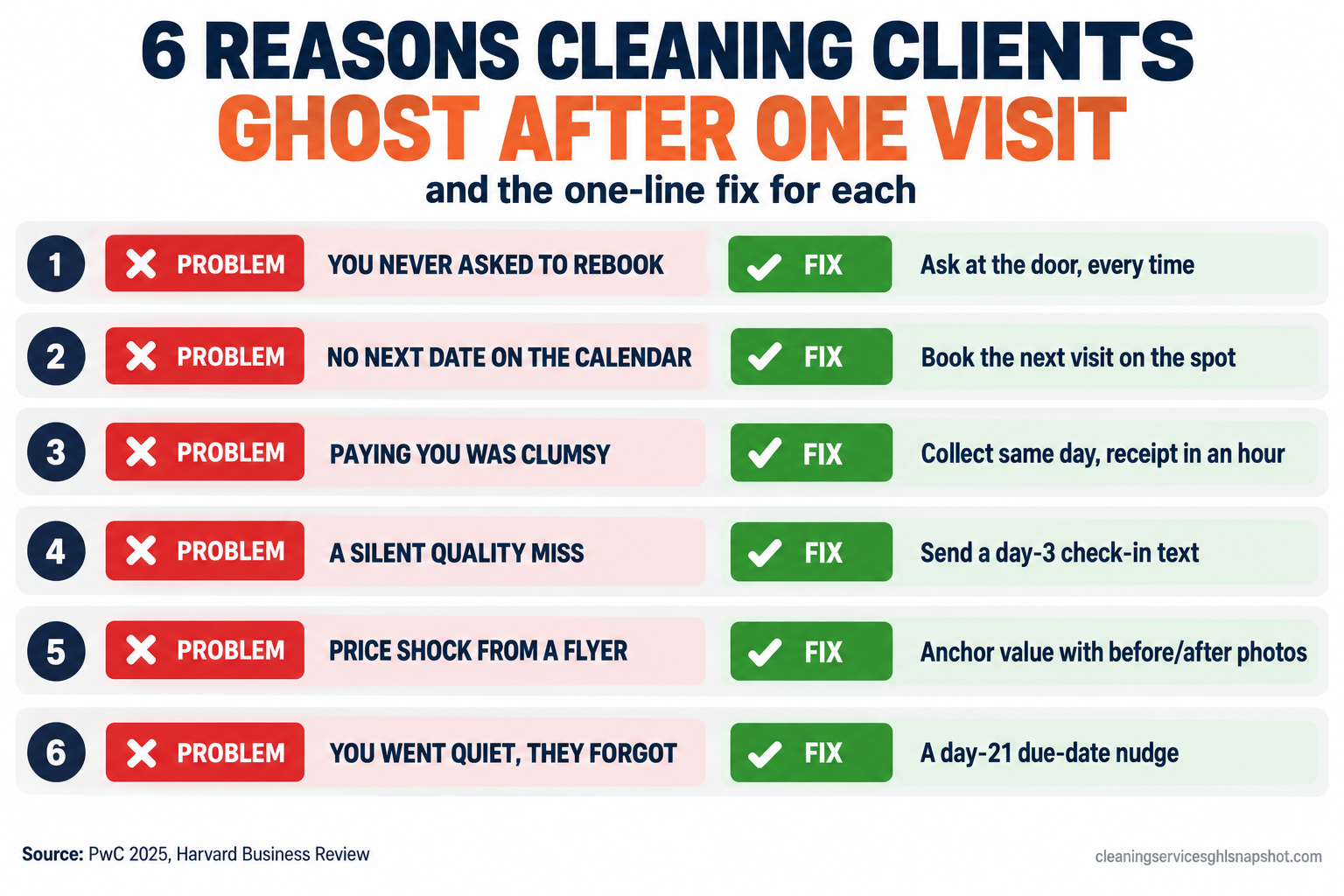
This is the big one, and almost always the true cause. You did a great job, assumed the work would speak for itself, and never said the sentence that matters: “Want me to lock in your next clean before I go?” A client who says “we should do this every month” is paying a compliment, not committing, and compliments do not show up on your calendar. Asks do.
How it breaks and the fix: you rely on her to circle back, life buries the thought, and by the time she remembers, the glow is gone. So ask at the door, every time, while the house is spotless. Make “did you offer the next date?” a step that is checked off, not a thing you remember.
2. There was no next date on the calendar when they left
Even when you ask, “I’ll text you to set it up” is where rebookings die: you are depending on two busy people to reconnect later. A client who leaves with an actual date is booked. One with a vague promise is a maybe, and maybes ghost.
How it breaks and the fix: the follow-up text lands mid-workday, she flags it for later, later never comes, and you stop chasing. Default instead to booking the next visit on the spot. A recurring slot is the strongest predictor that a client stays, which is why building a recurring book beats chasing new leads.
3. Paying you was harder than it should have been
If the clean was easy but paying meant hunting for your Venmo, a paper invoice, or a “just leave a check” they forgot, you added friction at the worst moment. People do not rebook a service that felt clumsy to pay.
How it breaks and the fix: the invoice goes out late, sits in an inbox, and the transaction ends on annoyance instead of relief, and that is what she remembers. So collect payment the day of the clean on a saved card or one-tap link, and send the receipt within the hour. If late payment is a recurring headache, tighten the flow the way our payment recovery playbook lays out.
4. A small quality miss you never heard about
Not every ghost is thrilled. Some were 85% happy, noticed the baseboards or microwave got skipped, decided it was not worth a confrontation, and simply will not book again. You never get the feedback because you never asked, so you file it under “some people just do one-time cleans.”
How it breaks and the fix: 32% of customers walk away from a brand they love after one bad experience (PwC, 2025), and most never tell you why. The silent miss is the most expensive kind, because you cannot fix what you cannot see. So send a short check-in a few days later that makes it easy to flag what was off. Fix the one thing and you usually convert her into a loyalist, because a business that fixes a miss fast earns more trust than one that never missed.
5. Price shock from a competitor’s flyer
Your client loved the clean, then an $89-move-in-special flyer hit her porch and made your $175 feel steep. With no reason to see the value in what you charge, price is the only number she can compare, and cheaper wins a comparison with no context.
How it breaks and the fix: she does not argue, she just books the cheaper crew, finds out they are not as good, and by then you are out of mind. So anchor your value first: before-and-after photos, a note on what your recurring plan protects (her weekends, a consistent crew, no scramble), and a small loyalty perk. You are not the expensive option, you are the one she does not have to think about.
6. You went quiet and she simply forgot you
Sometimes there is no drama. She would happily book again, but weeks passed, you never showed up in her phone, and cleaning slid down the list. Out of sight really is out of mind: a client who hears from you at the right cadence stays, and one who hears nothing forgets, which looks exactly like ghosting.
How it breaks and the fix: you get busy, the follow-up falls off, and 60 days later she has moved on. Now you are running a win-back campaign to reactivate someone you never had to lose. A light, scheduled cadence prevents that. One helpful text at the three-week mark does more than ten ads, because it reaches someone who already likes you.
The rebook system that stops the ghosting
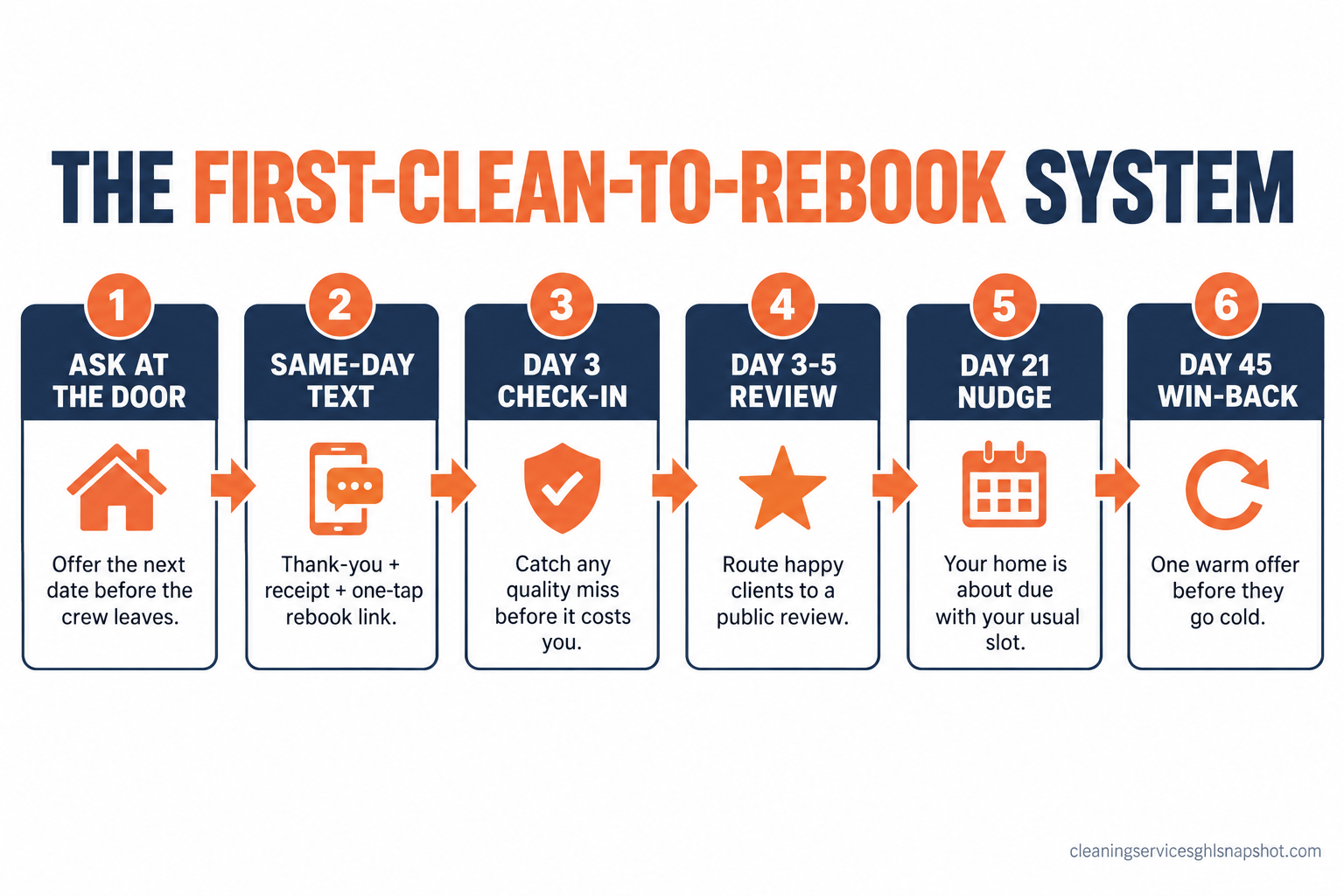
Every reason above traces back to one root cause: the ask lives in your memory instead of a system. So build the system. Here is the six-stage flow that turns a first clean into a recurring client, timed to when she is most likely to say yes.
Stage 1, at the door. Before the crew leaves, offer the next date out loud: not “I’ll text you,” but “want me to put you down for the 14th?” This one habit rebooks more clients than any automation, because it lands while she is standing in a spotless kitchen.
Stage 2, same day. A thank-you text goes out that evening with the receipt and a one-tap rebook link. It closes the payment loop and gives the client who was not ready at the door a frictionless way to lock the next visit.
Stage 3, day 3. A quality check-in asks how everything held up and makes it easy to flag anything off, catching the silent miss (reason 4) before it becomes a permanent ghost.
Stage 4, day 3 to 5, only if happy. Once a client says the clean was great, route her to a public review. Reviews are a rebooking cue, not just reputation, because 97% of consumers read reviews before choosing a local business (BrightLocal, 2025). Our review playbook covers the smart routing so unhappy clients come to you, not to Google.
Stage 5, day 21. For anyone not on a recurring plan, a gentle “your home is about due” nudge with her usual slot pre-filled. This reaches the client from reason 6 before she forgets you, the highest-ROI text in the flow.
Stage 6, day 45. If she still has not rebooked, one last warm win-back before she goes cold, ideally with a small incentive to restart. After this she moves to longer-cycle nurture instead of a hard chase.
The exact texts you can steal
You do not need clever copy, just clear, warm messages that make saying yes easy. Steal these, swap in your name and slot, keep them short. (More in our text message templates for cleaners.)
Does texting actually beat email for rebooking?
Yes, and it is not close. The day-21 nudge works only because it gets read, and email mostly does not.
Open and response rates by channel, percent. Most texts are opened within five minutes. Source: Sakari SMS Marketing Statistics, 2025-2026.
By text you reach nearly all of your clients, versus one in five by email, and get an answer far faster. Use text for time-sensitive asks (rebook, check-in, due nudge) and email for newsletter-style nurture, the same logic behind why missed-call text-back beats a voicemail nobody hears.
The same problem at three sizes
The reasons clients ghost are universal. What the fix looks like depends on your size.
The solo operator. You are the system, which is a strength (you are in the kitchen and can ask for the next date yourself) and a weakness (on a packed Friday you forget the follow-up texts). Your highest-impact move is stage 1 plus one automated day-21 nudge, so the follow-up does not depend on your memory. You do not need much software, just a trigger that fires the “your home is due” text without you.
The mid-size residential shop (5 to 15 cleaners). You cannot be at every door, so the ask has to be trained and tracked. Make “offer the next date” a step your crew leads own, and put the full flow on autopilot so every client gets the same follow-up. Your key metric becomes recurring-attach rate: of new first-time clients this month, what percent left on a recurring plan? If you cannot answer that, you are blind on the thing that funds the business. This is where a proper recurring-revenue engine pays for itself fast.
The commercial and janitorial operation (15 to 50-plus). Ghosting looks different. Nobody rebooks a nightly office clean visit by visit, so the equivalent of a ghost is a contract that does not renew. Same idea at a slower cadence: a scheduled check-in with the account contact, a quarterly review before renewal, and a documented QC log. The silent quality miss (reason 4) is deadliest here, because a facilities manager rarely complains, they just do not renew.
Texting rebooks without breaking TCPA
Automated rebook texts are marketing under the Telephone Consumer Protection Act, so run them right: get clear consent when the client books (a checkbox that they agree to service and appointment texts), keep a record, honor STOP instantly, and text during reasonable hours. There is a second trap too. If you send from a US 10-digit number, carriers now require A2P 10DLC registration, and unregistered traffic gets filtered or blocked, which is why plenty of owners switch on SMS and cannot figure out why their texts vanish. None of this is legal advice, and your compliance is your responsibility, but the short version is: get permission, register your number, honor STOP. Our TCPA guide for cleaners walks the details.
The objections I hear from owners
“Won’t all these texts annoy my clients?” Not if they are useful and spaced out. A receipt, a check-in, and a due nudge over three weeks is service, not spam, and each gives an easy opt-out. The businesses that annoy people go silent for months and then blast a promo. If anyone replies STOP, they are gone instantly.
“I already ask them verbally, isn’t that enough?” Keep doing it, it is the most important step. But verbal-only rebooks the clients who say yes on the spot and loses everyone who needed a night to think, which is most of them. The same-day text and day-21 nudge catch the “let me check my schedule” crowd, where most of your recurring revenue hides.
“Recurring discounts will kill my margin.” A modest recurring rate is not a discount, it is a trade: a few dollars a visit for route density, predictable revenue, and near-zero acquisition cost for a year. Given that winning a new customer costs 5 to 25 times more than keeping one, a client who books 26 times at $150 beats a $175 one-off you replace with paid ads.
Frequently asked questions
Why do cleaning clients ghost after one visit?
Usually because nobody asked them to rebook while the clean was fresh. Happy clients go quiet for follow-up reasons, not quality reasons: no next date on the calendar, payment friction, a small unspoken quality miss, price shock from a competitor, or simply forgetting you. Fix the follow-up gaps and most one-time cleans become recurring.
How soon after a clean should I ask for the next booking?
At the door, out loud, before your crew leaves and while the client is thrilled. That single ask rebooks more clients than anything else. Back it up with a same-day thank-you text with a one-tap rebook link, then a due-date nudge around day 21 for anyone not yet on a recurring plan.
Is it better to text or email a rebooking reminder?
Text. SMS is opened about 98% of the time versus roughly 20% for email, and most texts are read within five minutes, so a time-sensitive ask actually gets seen. Use text for rebook asks, check-ins, and due nudges, and save email for newsletter-style content.
Are automated rebooking texts legal?
Yes, when you follow the rules. Marketing texts fall under the TCPA, so get clear consent when the client books, keep a record, honor STOP immediately, and text during reasonable hours. From a US 10-digit number you also need A2P 10DLC registration or carriers filter your messages. This is not legal advice; your compliance is your responsibility.
What is a good recurring-attach rate for a cleaning business?
Track it before chasing a benchmark: of your new first-time clients this month, what percent left on a recurring plan? Most shops that ask at the door and run an automated follow-up flow can move that number meaningfully within a quarter. Watching it climb matters more than any target.
The bottom line
Go back to the client who texted her sister and then vanished. She did not fire you. Nothing asked for her next clean at the moment she would have said yes, so a busy person forgot and a recurring customer became a one-off. That is not a cleaning problem you can scrub away with a better mop. It is a follow-up problem, and follow-up is a system you build once and run forever.
Ask at the door. Text the receipt. Check in on day three. Route the happy ones to a review. Nudge on day 21. Win back on day 45. Do those six things for every client, automatically, and the ghosting mostly stops, because the people who loved the clean finally get asked back while they still remember how good it felt. The cleaning was never the problem. The silence after was.
Illustrative figures here (visit prices, plan values) are examples to show the math, not quotes or guarantees. Cited statistics link to their sources.