
It is 7:50am and your phone buzzes before you have had coffee. “Hi, the crew left yesterday but the whole master bathroom looks untouched and there’s dust on every blind. We paid for a deep clean.” Your stomach drops. You know the crew. They are good people. They worked hard. And the client is still upset, probably writing a review in her head right now. So you apologize, you promise to send someone back today, and you lose a half-day of a crew’s time fixing a job you already paid for once.
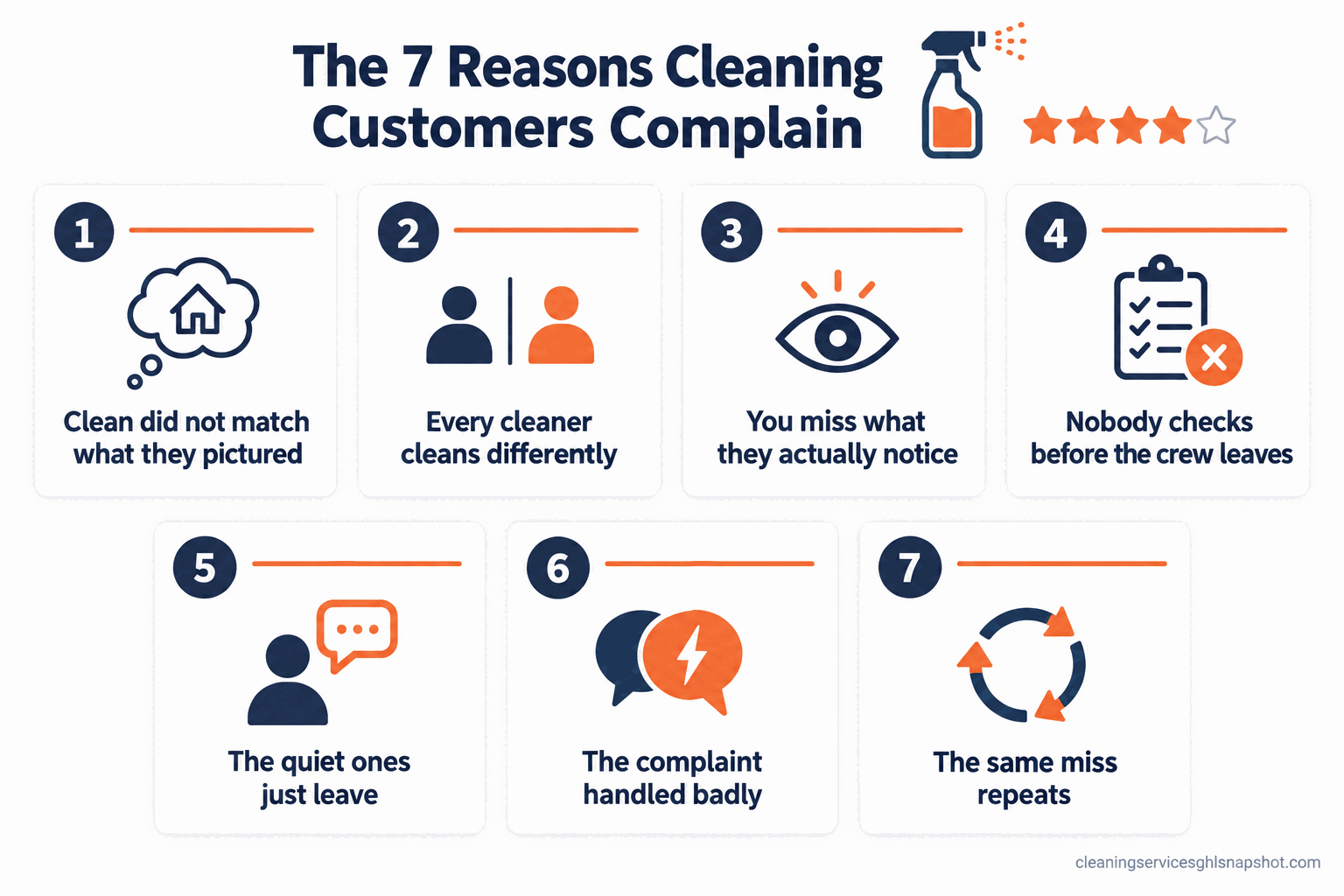
If this happens more than once in a blue moon, the problem almost certainly is not careless cleaners. It is that no system catches the gap between what the client pictured and what the crew delivered. Complaints feel like a people problem. They are almost always a system problem, and that is good news, because systems are fixable. This guide names the seven causes behind nearly every cleaning complaint, how to spot the one biting you, and the fix for each, with the exact texts you can copy.
Key Takeaways
- Complaints are a system gap, not a bad crew. Nearly every one traces to a missing step between the booking and the moment the crew leaves.
- One redo costs more than the job earns. You pay the crew twice, lose a trip, burn your own time, and still risk the review.
- The star threshold moved. 68% of consumers now only use a business rated 4 stars or higher, up from 55% a year earlier (BrightLocal 2026). One 1-star redo can drag a 5.0 below the line.
- Catch it the same day. A 30-second satisfaction text the evening of the clean finds the quiet unhappy client before she becomes a review.
- Seven causes: expectation gap, no standard, missed hot spots, no final check, silent churn, bad complaint handling, no feedback loop.
Table of contents
- Complaints are a system problem, not a people problem
- Cause 1: The clean didn’t match what they pictured
- Cause 2: Every cleaner cleans differently
- Cause 3: You nail the big stuff and miss what they notice
- Cause 4: Nobody checks the work before the crew leaves
- Cause 5: The quiet ones never complain, they just leave
- Cause 6: You handle the complaint badly
- Cause 7: The same miss happens again next week
- The same problem at three sizes
- The objections I hear from owners
- Frequently asked questions
- The bottom line
Complaints are a system problem, not a people problem
When an owner tells me customers keep complaining, the first thing they reach for is a name. “It’s the new hire.” “It’s the Tuesday crew.” Usually it is not, because the same crew that got a complaint on Tuesday got a glowing text on Wednesday. What changed was not the people. It was whether anyone set the expectation, whether there was a checklist, and whether anyone checked the work before the van pulled away.
A complaint is not just an awkward phone call. It is money leaving three ways: you pay a crew to redo work you already paid for, you lose the slot that crew could have billed, and you risk the review that decides whether the next ten strangers call you or scroll past. 97% of consumers read reviews before choosing a local business, and 68% will only use one rated four stars or higher, up from 55% a year before (BrightLocal 2026). It takes a stack of five-star cleans to carry one angry one-star, and the angry client is the one most motivated to post.
This is a different problem from a cleaning business that is stuck and not growing, which is about leads, pricing, and churn. This is about delivery: you can have plenty of leads and fair prices and still bleed customers because the work is inconsistent and nobody catches it. Fix the seven causes below and the complaints dry up, the redos stop eating your margin, and the reviews start compounding in your favor.
Cause 1: The clean didn’t match what they pictured
How it shows up: The crew did a solid standard clean. The client expected a top-to-bottom deep clean with baseboards, blinds, and inside the oven. Both sides think the other one is wrong, and neither is lying.
This is the most common complaint I see, and it has nothing to do with how well anyone cleaned. The gap was baked in at the booking. “A clean” means ten different things to ten different people: to you a defined scope, to the client “my house, perfect.” If you never wrote down what is included, you handed her a blank space to fill with her imagination, and imagination always beats the package she paid for.
The fix: Set the scope in writing before the clean, not after the complaint. When a job is booked, send a short confirmation that lists what is included, what is an add-on, and what a standard clean does not cover. Spell out the ones people assume: inside the oven, inside the fridge, interior windows, baseboards, and blinds. A written scope turns “you missed the blinds” into “blinds are a deep-clean add-on, want me to add them for $35?” Get this right at signup with cleaning business client onboarding, and put the full version in your service contract and scope of work.
Here is the booking-confirmation text I hand every operator. Send it the moment a standard clean is booked:
Hi [Name], you’re booked for a standard clean on [date] at [time]. That covers all rooms: dusting, floors, surfaces, kitchen and bathrooms cleaned and sanitized, trash out. Not included in a standard: inside the oven/fridge, interior windows, baseboards, and blinds. Want any of those added? Just reply and I’ll quote it. See you [day]!
Cause 2: Every cleaner cleans differently
How it shows up: One crew leaves a house spotless. A different crew cleans it next visit and the client notices a drop. Nothing is obviously wrong, but the house does not feel as consistent, and recurring clients notice consistency more than anything. With no written standard, every cleaner falls back on their own idea of “good enough,” and the client gets a house that is great one week and fine the next.
The fix: Write one standard checklist, room by room, and make it the law. Record yourself doing one house on your phone while you narrate it, and that video plus the checklist is your training program. Hire for attitude and train the process, so the output is identical no matter which crew shows up. A rough standard looks like this:
Kitchen: counters, stovetop, microwave in/out, sink and faucet, outside of appliances, floor. Bathrooms: toilet, tub/shower, mirror, counter and sink, fixtures, floor. Every room: dust surfaces top-down, cobweb check, vacuum/mop, trash emptied, left tidy. Final: quick walkthrough, lights off, door locked, photo of kitchen and each bathroom.
Cause 3: You nail the big stuff and miss what they notice
How it shows up: The crew scrubbed the whole house and the client’s one complaint is a smudge on the glass door, a trash can that was not emptied, or a hair in the bathroom sink. All that work and the review hinges on a 30-second miss.
Clients do not inspect the way you do. Their eye lands on a short list of high-visibility spots, and if those are off, the whole clean feels sloppy. The crew made the floors perfect and lost the client over a streaked mirror, because the mirror is at eye level and the floor is not.
The fix: Build a “client-notices” hot-spot list and make it the last thing every crew touches before leaving: streak-free mirrors and glass, a wiped-out and lined trash can, no hair in sinks or tubs, fingerprints off stainless and switch plates, floors with no visible debris, and a pleasant smell at the door. It is a 90-second final pass that protects the whole job. The last two minutes in a house carry more weight than any two minutes in the middle, because the client’s first impression walking in is the entire clean to her.
Cause 4: Nobody checks the work before the crew leaves
How it shows up: The crew finishes, packs up, and drives to the next job. The client gets home, finds a miss, and now the only fix is a return trip tomorrow. The gap was never caught because nobody looked before the van door closed. This is the structural cause under causes 2 and 3: even a good crew cannot always tell their own work is incomplete after three hours in a house, so without a check the first person to inspect the work is the client.
The fix: Add a verification step that does not require you to drive to every house. Before/after photos are the cheapest, most powerful quality tool in this business. Have the crew photograph the kitchen and each bathroom before they leave, every job. Taking the photo makes them look, and looking catches the miss while they can still fix it in 30 seconds. The photos also settle disputes: when a client says the tub was dirty, you have a timestamped photo of a clean tub, and for recurring and janitorial accounts they double as proof of service. Pair the photo check with the final walkthrough from cause 3 and most misses never leave the house.
Cause 5: The quiet ones never complain, they just leave
How it shows up: A client was not thrilled, but she is not the confrontational type. She does not call. She just does not rebook, and three weeks later you see a 3-star review that says “it was fine.” You never got the chance to fix anything, because she never told you.
The clients who complain are doing you a favor; they give you a shot at the fix. The dangerous ones say nothing and churn silently, and the first you hear of it is a lukewarm review or an empty recurring slot. Keeping a client is 5 to 25 times cheaper than winning a new one (Harvard Business Review), so a silent churn is one of the most expensive things in your week.
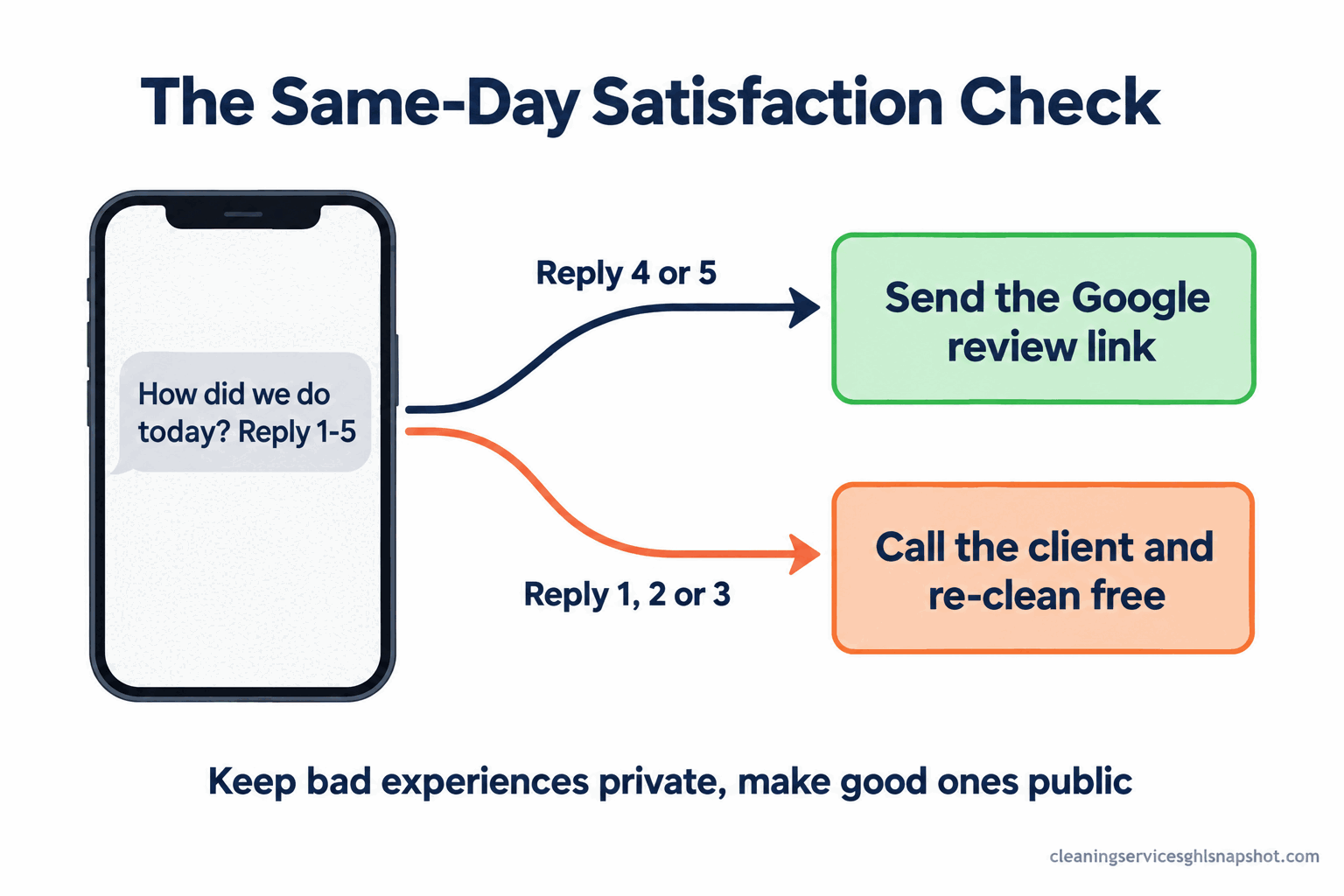
The fix: Ask every client, the same day, before they stew or post. A short satisfaction-check text the evening of the clean surfaces the quiet unhappy client while you can still save her, and routes a happy one toward a review. Make it a 1-to-5 reply: 4 or 5, you send the review link; 3 or below, you do not ask for a review, you call. That one gate keeps your bad experiences private and your good ones public. The same engine powers the rebooking system that stops clients ghosting after one visit.
The same-day satisfaction check, fired the evening of the clean:
Hi [Name], it’s [Company]. On a scale of 1 to 5, how did we do on today’s clean? Just reply with a number. If anything wasn’t right, tell me and I’ll make it right, no charge.
And the branch for a happy reply (4 or 5):
So glad to hear it! Would you take 30 seconds to leave us a quick review here? [link] It genuinely helps a small business like ours. Thank you!
Cause 6: You handle the complaint badly
How it shows up: A client complains and it goes sideways. You get defensive, or you go quiet for two days because you are dreading it, or you argue about whether the spot was really there. A complaint that a quick re-clean would have fixed turns into a one-star review and a lost customer.
How you respond matters more than the complaint itself. A client who gets a fast, gracious fix often ends up more loyal than one who never had a problem. A client who gets excuses is gone, and she tells people. It shows in reviews too: 80% of consumers favor a business that responds to its reviews, and 89% expect owners to reply at all (BrightLocal 2026). Silence and defensiveness both read as “they don’t care.”
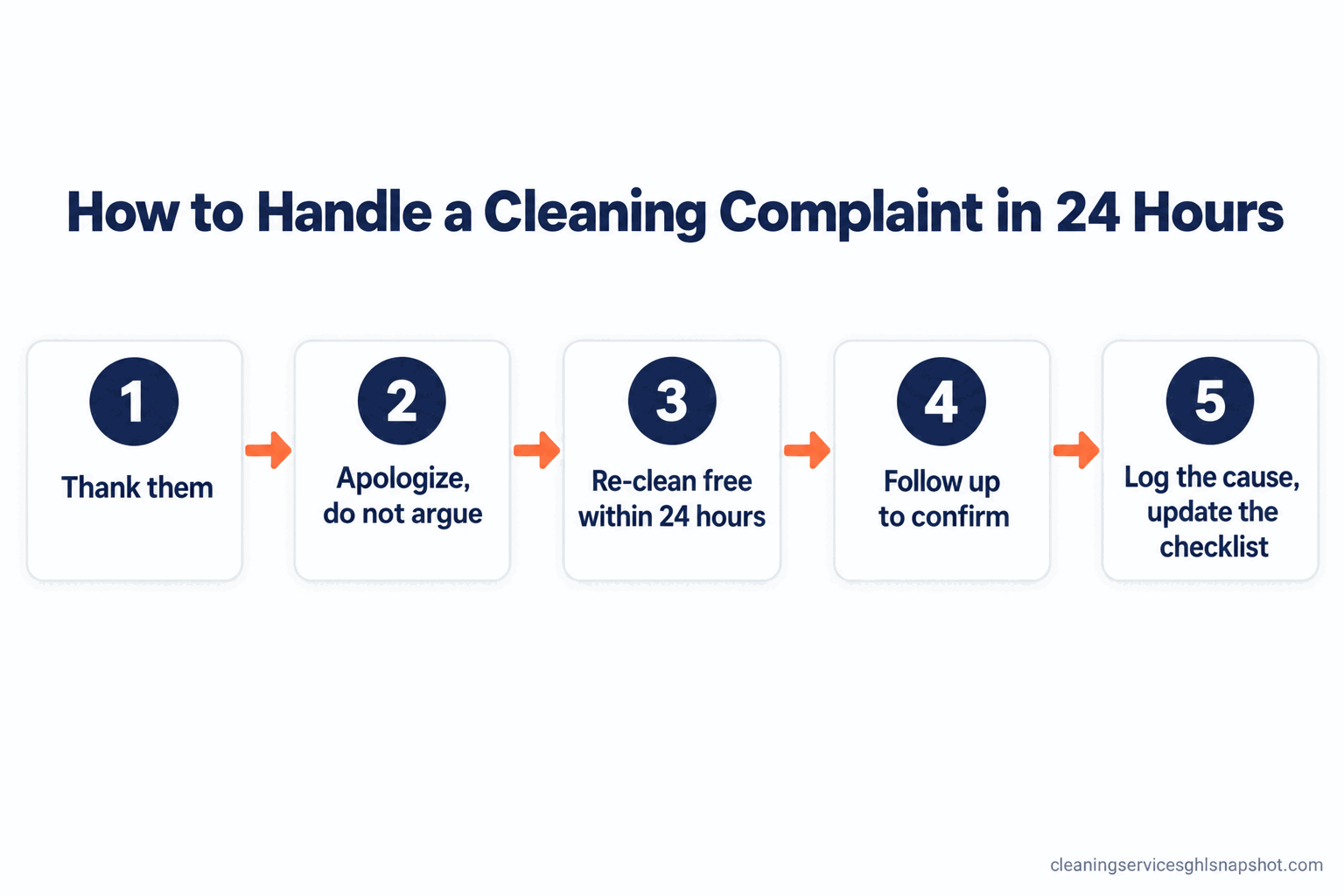
The fix: Have one response ready so you are not improvising while upset: thank them, apologize without arguing, fix it fast, follow up. Offer a no-charge re-clean inside 24 hours, every time, for a legitimate miss. A return trip costs a couple hours of crew time; a bad review costs months of leads. Decide in advance that the re-clean is always worth it and you will never agonize over a complaint again. Train whoever answers the phone to use the same words, and once a client is happy again, route her toward a public Google review so the good experiences outnumber the rare bad one.
The complaint-response script, for the phone or a text:
Hi [Name], I’m so sorry the clean wasn’t up to standard, that’s on us and I want to make it right. Can we send a crew back [tomorrow / today] to redo [the areas] at no charge? And thank you for telling me, it’s the only way I can fix it.
Cause 7: The same miss happens again next week
How it shows up: You fixed the complaint, sent the crew back, smoothed it over. Then the same thing happens at a different house the following week. You are playing whack-a-mole, fixing complaints one at a time and never getting ahead of them.
A complaint you fix once but never learn from is one you will get again. If nobody writes down what went wrong and why, the miss lives only in your memory, and your memory is full. The streaked-mirror problem is not solved by re-cleaning one mirror; it is solved by noticing mirrors are a recurring miss and adding “streak-free glass” to every crew’s final pass. Without a feedback loop, you treat symptoms forever.
The fix: Log every complaint by cause, even in a simple note, and read the list monthly. Patterns jump out fast: one crew, one type of miss, one kind of house. Then you coach the specific crew, update the checklist, or tighten the scope that keeps getting misread. Tracking this in one place alongside your jobs and clients, instead of scattered across texts and memory, is exactly why a cleaning business outgrows the spreadsheet. And remember what one redo costs: two crew-hours of a return trip at a loaded wage near $22 (the BLS median for cleaners is about $17 before taxes), the slot that crew could have billed, and your time on the phone. One redo can erase a job’s entire margin.
The same problem at three sizes
The seven causes are universal, but which one hurts most depends on the shape of your business.
Solo or two-person team. Causes 1 and 5 are your biggest risks. Consistency is less of an issue because you are the one cleaning, but you have no second set of eyes, so one bad review hits harder and one silent churn is a real chunk of your month. Start with the expectation text at booking and the same-day satisfaction check; both cost nothing. Decide now that the 24-hour re-clean is automatic, because you will not want to think clearly about it at 7:50am.
Mid-size residential, 3 to 15 cleaners. Causes 2, 4, and 7 dominate. With multiple crews, consistency is your whole brand, and without a written standard and a photo check, quality drifts crew to crew and you cannot see it until the reviews slip. Get the room-by-room checklist in place, make before/after photos non-negotiable, and log complaints by cause so you coach the specific crew instead of lecturing everyone.
Commercial and janitorial, 15 to 50-plus. Causes 4 and 7 are the contract killers. A facilities manager does not call you upset; she documents the misses and declines to renew, and a lost contract costs far more than a lost house. Verification photos become proof of service on the account, and a logged complaint history is what you bring to a quarterly review to show you are improving. Keeping a contract is cheaper than bidding a new one.
The objections I hear from owners
“My cleaners are good, this isn’t a quality problem.” It usually is not a skill problem, it is a system problem, and that is the point. Good cleaners miss things when there is no checklist, no final pass, and no verification. The fixes here are not about hiring better people; they are about catching the normal human misses before the client does.
“I don’t have time to send texts after every clean.” You do not send them by hand. The satisfaction check and review ask fire automatically off the completed job, so the whole thing runs without you touching it. The time you spend is zero; the time you save is every redo you now prevent.
“Won’t asking ‘how did we do’ just invite complaints?” It invites them to you, privately, the same day, when you can still fix it, instead of to the public internet three weeks later when you cannot. You are intercepting the complaints that already exist and were going to land as reviews.
“A free re-clean every time? That’ll cost me a fortune.” A legitimate redo is rare once the checklist and photo check are in place, and each costs a couple hours of crew time. A single one-star review that crosses you under four stars costs a slice of every new lead that reads it. The re-clean is the cheap option.
Frequently asked questions
Why do my cleaning customers keep complaining even though my crew works hard?
Because effort and consistency are different things. Hard-working crews still miss spots with no written standard, no final walkthrough, and no verification before they leave. Nearly every complaint traces to a system gap: the scope was never set at booking, there was no checklist, or nobody looked at the work before the van pulled away. Fix those steps and complaints drop sharply without changing a single person.
How do I stop redos and callbacks in my cleaning business?
Add a verification step before the crew leaves every job. The cheapest is a required before/after photo of the kitchen and each bathroom plus a 90-second walkthrough of the spots clients notice most: mirrors, trash cans, sinks, switch plates, and floors. Photographing makes the crew look, and looking catches the miss while it can still be fixed in 30 seconds instead of a return trip tomorrow.
How should I respond when a cleaning client complains?
Thank them, apologize without arguing, and offer a no-charge re-clean within 24 hours for a legitimate miss. How you handle it matters more than the complaint itself: a client who gets a fast, gracious fix often becomes more loyal than one who never had a problem. Keep one script ready so you and whoever answers the phone respond the same calm way every time.
How do I protect my Google rating from one bad clean?
Use a same-day satisfaction check that gates who you ask for a public review. Text every client a 1-to-5 question the evening of the clean. Send the Google review link only to 4s and 5s, and call anyone who answers 3 or below to fix it privately. That keeps unhappy experiences in a private conversation and routes happy clients to your public profile.
What should a standard cleaning checklist include?
Room by room: kitchen counters, stovetop, microwave inside and out, sink, outside of appliances, floor; each bathroom's toilet, tub or shower, mirror, counter, fixtures, and floor; every room dusted top to bottom, vacuumed or mopped, trash emptied; and a final pass on the high-visibility spots. Spell out what is NOT included, such as inside the oven, inside the fridge, interior windows, baseboards, and blinds, so those become paid add-ons instead of complaints.
How many bad reviews does it take to hurt a cleaning business?
Fewer than owners think. 68% of consumers now say they will only use a business rated four stars or higher, up from 55% a year earlier (BrightLocal, 2026), and 97% read reviews before choosing a local business. A single one-star review can pull a small profile from a 5.0 under the four-star line, and that line is where two-thirds of shoppers stop calling. That is why catching a complaint the same day is worth so much.
The bottom line
Your customers are probably not complaining because your cleaners are bad. They are complaining because the scope was never set, there was no checklist, nobody checked the work before the crew left, and the quiet unhappy client slipped away before you could fix it. Every one is a missing step, and every missing step has a fix that does not require firing anyone or working harder.
Pick the cause that made you wince and start there. Send the scope at booking. Write the one checklist. Make before/after photos the law. Text every client that night and ask how you did. Keep one calm complaint script ready and re-clean inside 24 hours. Then log what went wrong and fix the root, not the mirror. Do that and the redos stop eating your margin and the reviews start working for you. If you would rather install the whole quality-and-reputation system at once, the Cleaning Snapshot ships the photo check, the same-day satisfaction text, and the review automations pre-built, or book a walkthrough first.
About the author
Darnell Pierce is a GHL Automation Consultant in Atlanta, GA who runs a small GoHighLevel agency serving home-service operators, with cleaning companies making up the bulk of his book. He is allergic to half-built funnels and TCPA shortcuts, and he would rather ship one bulletproof quote-to-book flow than ten clever-but-fragile ones. He writes about the systems that make a cleaning business run the same way on its worst day as its best.
Related posts
- Why Your Cleaning Business Isn’t Growing: 6 Ceilings and How to Break Each One
- Why Cleaning Clients Ghost After One Visit
- How to Get More Google Reviews for a Cleaning Business
- Cleaning Business Client Onboarding: The First-Clean Playbook
- Why a Cleaning Business Needs More Than a Spreadsheet
Sources
- BrightLocal: Local Consumer Review Survey (2026)
- Harvard Business Review: The Value of Keeping the Right Customers
- U.S. Bureau of Labor Statistics: Maids and Housekeeping Cleaners (OEWS, May 2025)
- U.S. Bureau of Labor Statistics: Janitors and Cleaners (OEWS, May 2025)
- Housecall Pro: House Cleaning Prices (2026)
- IBISWorld: Residential Cleaning Services in the US