
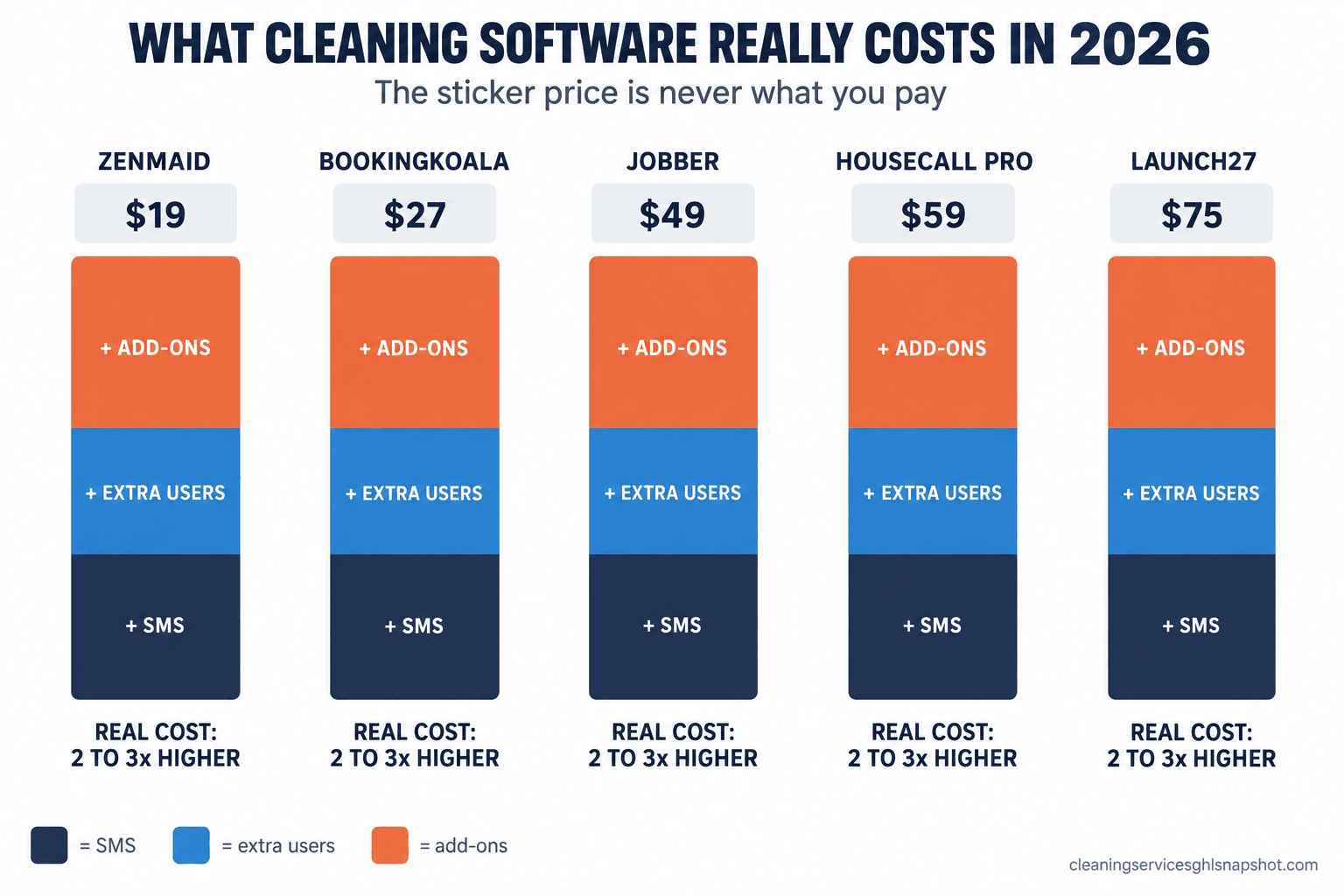
Here is the short version: every major cleaning-software company publishes a low starter price, and almost nobody pays it. Jobber shows you $49. ZenMaid shows you $19. Housecall Pro shows you $59. Then the texting your business runs on turns out to be a paid bundle, the “team” plan charges per cleaner, the marketing tools cost more than the base plan, and the number on your card is two to three times the sticker. This is not a scam. It is just how the pricing is built. Once you know where the meter runs, you can shop like someone who read the whole menu. Below is the real 2026 cost of the five tools cleaning owners actually compare, the add-ons that inflate each one, and honest math for three business sizes.
I have spent nine years inside the numbers of a maid service, and the software line is where owners get quietly bled. Not by one big charge, but by six small ones that each looked reasonable when a rep explained them. Every price below is from the vendor’s own pricing page, linked, and every stat is sourced.
Sources: market size and business count, IBISWorld (2026); wage and employment, BLS OEWS (May 2025).
Key Takeaways
- The sticker price is a starting bid. The plan you can actually run a growing shop on costs roughly 2x to 3x the entry price once texting, extra users, and marketing add-ons are on.
- Texting is the most common hidden cost. Reminders, quotes, and review requests ride on SMS, and on most platforms SMS is metered or a separate bundle.
- “Per user” is the second trap. Housecall Pro and the higher Jobber tiers charge per seat, so the tool gets pricier exactly as you hire.
- The math changes with your size. A solo operator, a five-crew shop, and a fifteen-person janitorial company should each pick a different tool.
- Ask the eight questions below before you sign. Most overpaying comes from not asking what SMS, onboarding, users, and cancellation cost until the invoice lands.
Table of contents
- The short answer: what it costs in 2026
- Jobber’s real cost after the add-ons
- Housecall Pro’s real cost
- ZenMaid’s real cost
- BookingKoala and Launch27: the tier trap
- What it costs at three sizes
- The costs no pricing page lists
- The SMS add-on has a compliance cost too
- Steal this: 8 questions to ask before you sign
- But won’t cheaper software mean worse service?
- Frequently asked questions
The short answer: what it costs in 2026
Here are the published starting prices for the five tools cleaning owners compare most, and the plan a growing shop lands on.
| Tool | Advertised start | Plan a growing shop needs | What inflates it |
|---|---|---|---|
| ZenMaid | $19/mo | Pro, $39/mo | Metered SMS bundle |
| BookingKoala | $27/mo | Growing, $57/mo | SMS unlocks a tier up, then bills your own Twilio |
| Jobber | $49/mo | Connect or Grow, plus add-ons | Marketing, Pipeline, AI Receptionist add-ons |
| Housecall Pro | $59/mo | Essentials, ~$149/mo | ~$35 per extra user, plus card processing |
| Launch27 | $75/mo | Pro, $150/mo | Flat rate, unlimited users, few add-ons |
Advertised prices from each vendor’s pricing page (linked), September 2026. Some show the annual-billing rate; month-to-month is higher. Check the live page before you buy.
A pricing page shows the number designed to get you in the door, and a cleaning business does not run on that number. It runs on three things you bolt on: texting (reminders, quotes, and review requests are all SMS, usually metered or a bundle), extra users (every cleaner on a per-seat plan is another line), and marketing tools (getting more jobs is a paid layer, often priced above the base plan). Let’s walk each tool.
Jobber’s real cost after the add-ons
Jobber is the polished field-service all-rounder, and plenty of cleaning companies run on it happily. Published pricing runs from a Core plan around $49/mo up to a Plus plan around $499/mo, with Connect and Grow in between (Jobber pricing). The base plan schedules jobs, invoices, and takes payments. What it does not do out of the box is the growth work.
Three add-ons catch cleaning owners specifically: Jobber sells a Marketing Suite, a lead Pipeline, and an AI Receptionist as separate paid layers, each with its own monthly fee, commonly in the roughly $29 to $99 range (Jobber pricing). Switch on the marketing and follow-up tools you probably came for, and a $49 Core plan quietly passes $150 a month. Higher tiers also scale with team size.
Who it fits: a shop that wants one clean tool for scheduling, invoicing, and payments and is fine paying separately for marketing. The trap: buying Core on the $49 sticker, then finding the review requests and follow-up campaigns you wanted live behind two or three add-ons. See the full GoHighLevel vs Jobber breakdown.
Housecall Pro’s real cost
Housecall Pro is Jobber’s closest rival and prices similarly on the surface: Basic around $59/mo, Essentials around $149/mo, and MAX around $299/mo on annual billing (Housecall Pro pricing). Two things push the real bill well past the sticker.
First, per-user pricing. Above a plan’s included seats you pay roughly $35 per additional user per month, so every cleaner you add is another line, exactly as cash gets tight. Second, payment processing. Card payments run around 2.59% per transaction, and for a busy shop that is the largest software cost you have. A company running $40,000 a month in card volume pays over $1,000 a month in processing, which dwarfs the subscription.
Who it fits: an established shop that likes the polish and built-in payments and books enough that per-user and processing fees are acceptable. The trap: the per-user charge scaling against you, and a processing rate you never negotiate. Our GoHighLevel vs Housecall Pro comparison goes deeper.
ZenMaid’s real cost
ZenMaid is the specialist, built only for maid services and in the market since 2013. It carries the lowest sticker in the group: Starter $19/mo, Pro $39/mo, Pro Max $49/mo (ZenMaid pricing). Two catches turn the $19 headline into something else.
That Starter plan caps you at 40 appointments a month, which a real recurring maid service blows through in a week or two, so almost everyone lands on Pro or Pro Max. And SMS, the reminders that make the tool worth running, is a separate metered bundle sold in blocks, commonly starting around $14 per set of messages (ZenMaid pricing). Larger crews also pick up a small per-user fee.
Who it fits: a residential maid service whose bottleneck is scheduling, not getting the phone to ring. The trap: expecting it to fill the schedule. It does not chase leads or run marketing, so if the problem is not enough inbound, ZenMaid is not the fix. See the GoHighLevel vs ZenMaid breakdown.
BookingKoala and Launch27: the tier trap
These two are the online-booking specialists, and both price around the same trap: the feature you actually need sits one tier up.
BookingKoala starts at $27/mo, which looks great until you notice the Starter plan has no SMS notifications at all. Text reminders only unlock on the Growing plan at $57/mo, and even there the texting runs through your own connected Twilio account, so you pay Twilio’s per-message fees on top (BookingKoala pricing). The full feature set lives on Premium at $197/mo. The real question is not “what’s the cheapest plan,” it is “which plan can actually text my customers.”
Launch27 takes the opposite approach on seats. Plans run about $75, $150, and $299/mo, and every tier includes unlimited users and bookings (Launch27). No per-seat creep as you hire, so you choose a tier by features, not headcount. That makes it one of the more predictable bills in the group.
Who they fit: a shop whose main pain is a booking form that ends phone tag. Just read which tier carries SMS before you sign. If online booking is the priority, our online-booking playbook shows a good flow.
Advertised starting price per month, 2026 (US dollars). These are entry-tier stickers, not what a growing shop pays once SMS, users and add-ons are on. Sources: ZenMaid, BookingKoala, Jobber, Housecall Pro, Launch27.
What it costs at three sizes
There is no single cheapest tool, because the math flips as you grow.
Solo operator (you, maybe one helper, 30 to 60 jobs a month). You do not need five seats or a marketing suite. If scheduling is the whole job, ZenMaid Pro at $39/mo plus a small SMS bundle, roughly $55/mo all-in, is hard to beat. If you want the booking form itself to sell, Launch27’s base tier at $75/mo flat is the predictable choice.
Mid-size (3 to 6 cleaners, residential, 150 to 300 jobs a month). This is where per-user and SMS math bites. A rough all-in for a five-cleaner shop sending around 2,000 texts a month, built from the published prices above:
| Tool | Base plan | Add-ons for this size | Est. all-in / month |
|---|---|---|---|
| BookingKoala | Growing, $57 | Your Twilio SMS usage | ~$90 |
| ZenMaid | Pro, $39 | Extra users + SMS bundle | ~$120 |
| Housecall Pro | Essentials, ~$149 | 5 users included | ~$149+ |
| Launch27 | Pro, $150 | None (flat, unlimited users) | ~$150 |
| Jobber | Connect + one add-on | Marketing or Pipeline | ~$200+ |
Illustrative all-in estimates for a five-cleaner residential shop, from each vendor’s published plan and add-on prices (linked above). Your real number depends on texts sent, card volume, and add-ons; card processing is not included here.
Notice the sticker order barely survives a real five-person shop. Once texting and users are on, the spread narrows and the “expensive” flat-rate tool ends up mid-pack.
Large or janitorial (15+ people, bid contracts, night crews). Now per-user pricing dominates, so a flat-user tool usually wins on raw subscription, but you also need reporting and payroll features that push you to a top tier anyway. Keep the proportion in mind: at the BLS May 2025 median of $17.71 an hour for janitors and building cleaners (BLS), one crew’s wages for a week dwarf any of these subscriptions for a month. At this size, optimize for the tool that cuts admin hours, not the $30 saving.
The costs no pricing page lists
The monthly plan is the number they show you. These are the ones they do not, and any can cost more than the subscription.
- Card processing. A percentage of every card payment, month after month, on a busy shop, is usually your single largest software-related cost. Ask the rate, and whether it drops at your volume.
- Per-user fees. Every seat above your plan’s limit. This grows with your business, so a tool that is cheap at two cleaners can be priciest at ten.
- Onboarding and setup. A one-time implementation fee that never appears on the monthly page. Ask before you sign.
- Data import. Getting your customers and history into the new tool. Sometimes free, sometimes paid, sometimes a weekend of your own copy-paste.
- Getting your data back out. Confirm you can export your customer list and job history if you leave, and whether that costs anything. Trapped data is a switching cost disguised as a feature.
- Your own hours. The build and the learning curve. Cheap tools spend this currency the hardest.
The SMS add-on has a compliance cost too
Here is a cost that lives underneath the SMS line. In the US, business texting runs over a system called A2P 10DLC (application-to-person, 10-digit long code). To send business SMS legally and reliably, your number and your “campaign” have to be registered with the carriers, and there is a small registration and monthly carrier fee attached, on top of whatever your software charges for the messages (The Campaign Registry).
That matters two ways. Skip registration and your texts increasingly get filtered or blocked, so you pay for the bundle and the messages still do not land. And texting customers who never agreed to it is a problem under the Telephone Consumer Protection Act, which the FCC has been tightening (FCC). We cover the operator’s side in the cleaning-business TCPA guide. For a pricing conversation: a cheap SMS add-on on a platform that makes consent and registration your problem is not actually cheap.
Steal this: 8 questions to ask before you sign
Copy these into a note and read them to the rep on the demo. The answers are where the real price lives. I have watched owners knock 30% off a quote by asking number four.
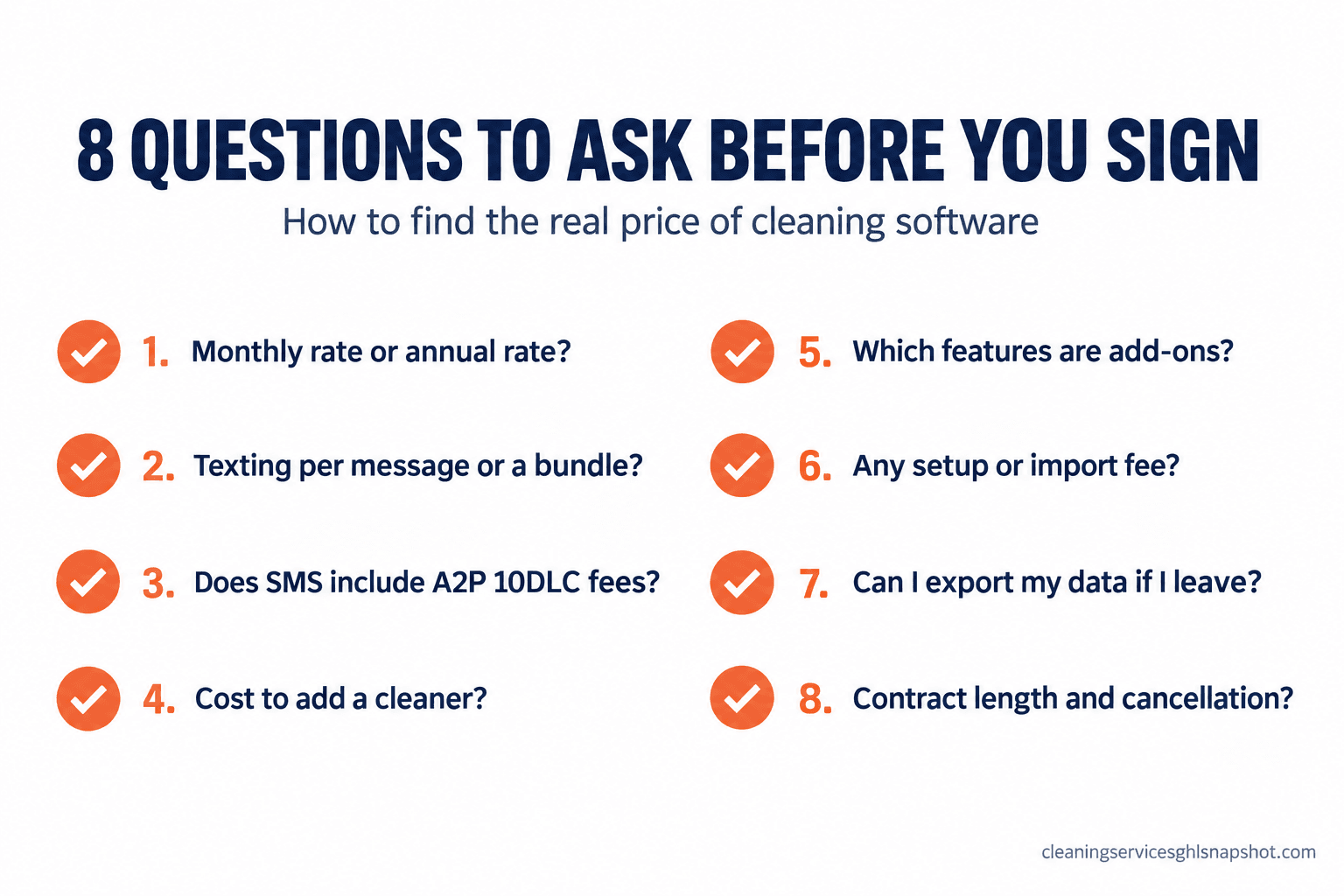
- “Is that the monthly rate, or the annual-billing rate?” Get the month-to-month number so you compare like for like.
- “How much does texting cost, and is it per message or a bundle?” Ask how many texts a shop my size sends, and do the math on the call.
- “Does texting include the A2P 10DLC carrier registration and fees?” If they do not know what that is, that is an answer too.
- “What does it cost to add a cleaner to the app?” Multiply by the crew size you expect in twelve months, not today.
- “Which features I care about are on this plan, and which are a higher tier or add-on?” Name them: online booking, review requests, follow-up, reporting.
- “Is there an onboarding, setup, or data-import fee?” One-time fees do not show on the pricing page.
- “If I leave, can I export my customers and job history, and does that cost anything?” Your data is your bargaining chip. Know if it is trapped.
- “What is the contract length, and what happens if I cancel in month three?” Monthly, annual, and auto-renew are three different commitments.
But won’t cheaper software mean worse service?
The fair objections, answered straight.
“Isn’t a cheaper tool always worse?” No. Price here tracks how many modules a vendor bundles, not how well any one works. ZenMaid is inexpensive and genuinely excellent at the one thing it does. A pricey all-in-one can be worse at booking than a focused cheap tool. Match the tool to your bottleneck; do not pay for a marketing suite you will never open.
“I already pay for Jobber. Should I switch?” Not on price alone. Switching costs you data migration, retraining, and a few weeks of friction. Switch when the tool is actively costing you jobs, when per-user fees have made it pricier than a better-fit tool, or when you pay for three modules and use one. If you move, do it deliberately: our migrate-to-GoHighLevel guide walks the steps.
“Do I need to be technical?” To run it day to day, no. All five are built for non-technical owners. The technical part is setup: connecting texting, building sequences, importing customers, registering for A2P. That is a one-time lift most owners underestimate. Budget a weekend, or pay someone to build it once and hand you the keys.
“Aren’t spreadsheets and a group text free?” They feel free because the cost is your time and the jobs you quietly lose. A missed follow-up is a booking that went to whoever replied first. “Free” is the most expensive plan there is once you are past a few jobs a week.
The bottom line
The cleaning-software market is not overpriced. It is priced to reward the owner who reads the whole menu and punish the one who signs on the sticker. Do the twelve-month all-in math, ask the eight questions, and pick the tool that fits your bottleneck instead of the friendliest starting price.
Back to that first contract I signed years ago. I picked it for the low sticker, then spent eleven months paying for texting, a second seat, and a marketing module I opened twice. Had I run the all-in number first, I would have kept a few thousand dollars. Now you get to skip that tuition. Go in with the real number.
What is the cheapest cleaning business software in 2026?
On sticker price, ZenMaid's entry tier is typically the lowest, and BookingKoala's starter plan is also low. But 'cheapest' depends on what you switch on: once you add texting, extra users, and marketing tools, a low starter plan can cost more than a mid-tier competitor. Compare the twelve-month all-in cost.
Why is my cleaning software bill higher than the advertised price?
Almost always add-ons: a separate SMS bundle, per-user charges for each cleaner, and marketing modules above the base plan. Several vendors also advertise the discounted annual-billing rate, so paying monthly costs more than the headline.
Do Jobber, Housecall Pro, and ZenMaid charge extra for text messages?
In most cases texting is metered or sold as a separate bundle rather than being unlimited on the base plan. Because reminders, quotes, and review requests all run on SMS, this is often the biggest gap between the sticker price and your real bill. Ask whether texting is per message or a bundle, and whether A2P 10DLC carrier fees are included.
What is A2P 10DLC and do I have to pay for it?
A2P 10DLC is the US system for registering business text messaging with the carriers. To send business SMS reliably you register your number and campaign, which carries a small one-time registration fee and a monthly carrier fee on top of what your software charges for messages. Skip it and your texts increasingly get filtered or blocked.
Should I switch cleaning software just to save money?
Not on price alone. Migration costs you data transfer, crew retraining, and a few weeks of friction. Switch when the current tool is costing you booked jobs, when per-user fees have made it more expensive than a better-fit tool, or when you pay for several modules and use one.