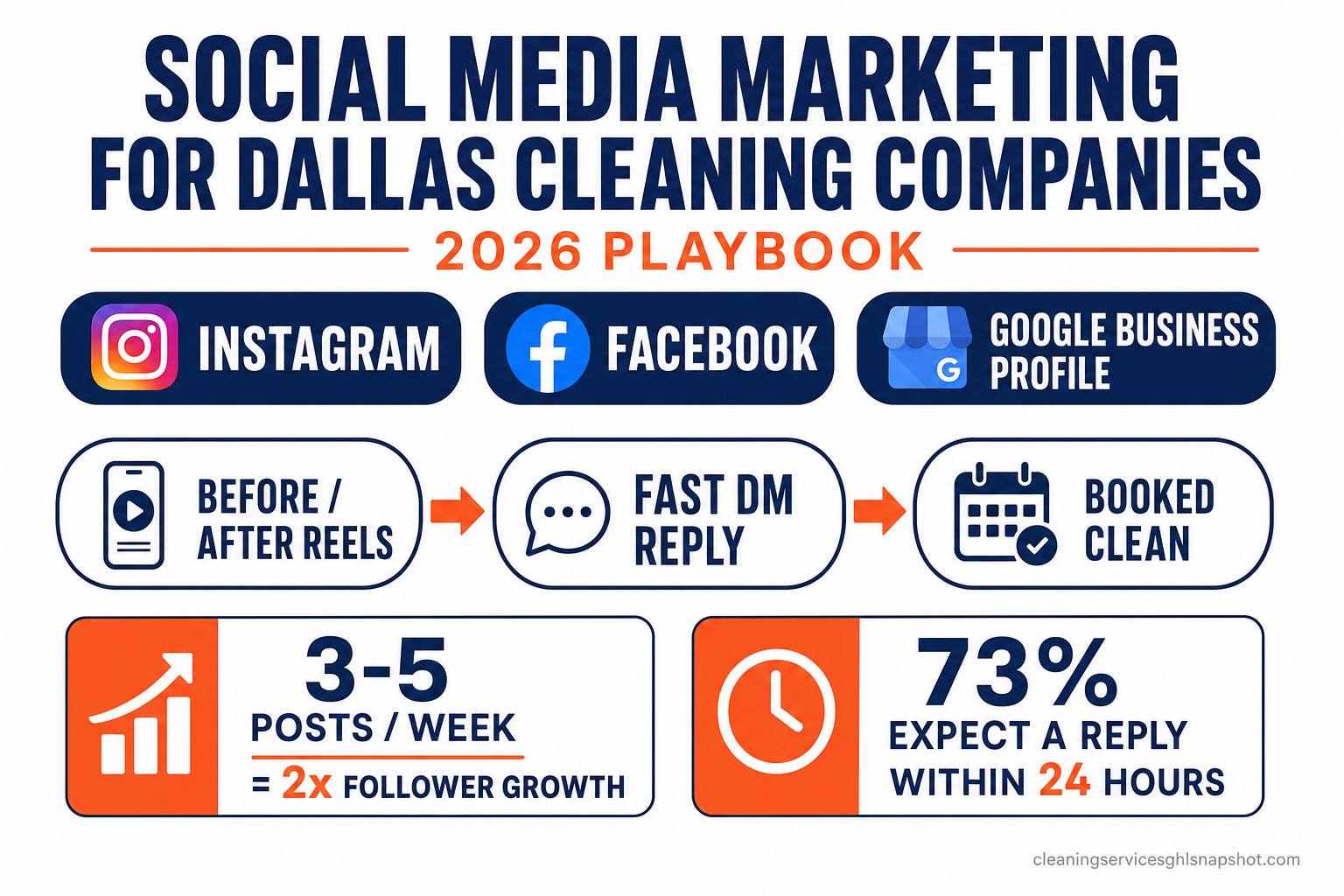
Social media marketing for a Dallas cleaning company comes down to a system you can repeat every week, not a burst of posting when the schedule goes quiet: claim three core channels (Instagram, Facebook, and your Google Business Profile), post a repeatable weekly mix led by before/after Reels, publish 3–5 times a week, and reply to every comment and DM within minutes so an interested homeowner never goes cold. Do that consistently and your profile becomes the thing that books the next clean — because in a metro the size of Dallas–Fort Worth, homeowners decide who to trust by scrolling, not by asking around.
That matters more in 2026 than it used to. Social platforms are now a primary way people find and vet local services: 34% of consumers use Instagram and 23% use TikTok to discover or research local businesses, both rising year over year (BrightLocal, 2024). For a residential cleaner, that’s a homeowner in Plano or Oak Cliff deciding whether your work looks trustworthy before they ever fill out a quote form.
This guide is written for cleaning-business owners and the agencies serving them across Dallas–Fort Worth — from Uptown and Deep Ellum to Frisco, Arlington, and Irving. It’s a plain-English, step-by-step playbook with current sourced numbers (no invented figures), and it ends with the honest math on doing it yourself versus handing it off.
Key Takeaways
- Run three channels, not ten. Instagram, Facebook, and your Google Business Profile are where Dallas homeowners actually look — 34% use Instagram and 23% use TikTok to find local businesses (BrightLocal, 2024). Master those before adding more.
- Lead with before/after Reels. Short-form video has been the highest-ROI content format four years running, with about 21% of marketers naming it their single best format (HubSpot, 2025). Cleaning transformations are tailor-made for it.
- Consistency beats intensity. Buffer’s analysis of 2 million posts across 100k accounts found posting 3–5× a week more than doubles follower growth versus 1–2× (Buffer). Pick a cadence you can keep.
- Speed wins the booking. 73% of consumers expect a reply within 24 hours, and 73% will buy from a competitor if a brand ignores them on social (Sprout Social, 2025). Fast replies — automated on first touch — are how comments become cleans.
- The DIY tax is real. Small-business owners spend around 6 hours a week on social, most of it making content (VerticalResponse). If those hours are worth more on the job, a done-for-you service is the cheaper option.
Table of contents
- Why social media decides who books the next clean in Dallas
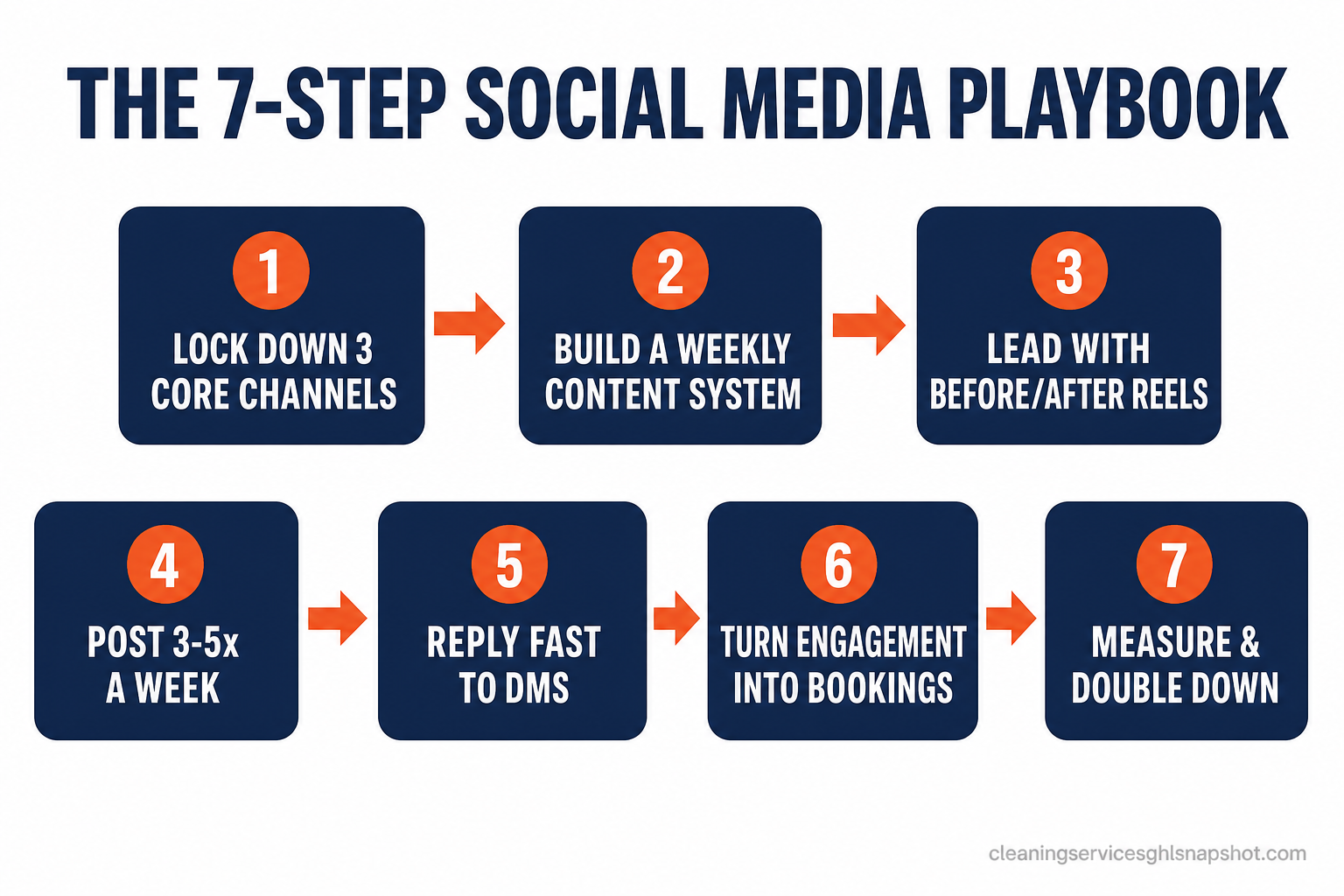
- The 7-step social media playbook
- Step 1 — Lock down your three core channels
- Step 2 — Build a repeatable weekly content system
- Step 3 — Lead with before/after Reels
- Step 4 — Post 3–5 times a week, consistently
- Step 5 — Reply fast to every comment and DM
- Step 6 — Turn engagement into booked jobs
- Step 7 — Measure what matters, then double down
- The Dallas angle: a big, competitive market
- Do it yourself or hand it off? The honest math
- Frequently asked questions
Why social media decides who books the next clean in Dallas
Letting a cleaner into your home is a trust decision, and in 2026 people make trust decisions by scrolling. Before a Frisco homeowner books, they check whether your work looks real: recent posts, actual before/after shots, replies to questions, a stream of five-star reviews. An empty or stale profile reads as “maybe this business isn’t around anymore” — and they move on to the cleaner whose feed looks alive.
The discovery data backs this up. Social platforms are now among the fastest-growing ways consumers find new brands: globally, social-media ads have climbed to 29.7% of brand discovery, closing in on search engines at 32.8% (DataReportal, Digital 2025). For local services specifically, the platforms people reach for are visual and social-proof-driven:
Share of consumers who use each platform to discover or research local businesses — both rising year over year, a shift toward visual, social-proof-driven discovery that favors cleaners who post real work. Source: BrightLocal Local Consumer Review Survey, 2024.
Here’s the part most cleaning owners miss: you don’t need to go viral to win from social. You need to look consistently present and reply fast, so the homeowner who found you — through a hashtag, a shared Reel, or a neighbor’s tag — has zero friction between “this looks good” and “I booked.” The seven steps below build exactly that.
The 7-step social media playbook
This is the whole system on one page. Each step is small on its own; run together, week after week, they compound into a profile that quietly feeds your calendar. Work them in order — the channels and the content system come before cadence and replies, because there’s no point posting five times a week to a profile that isn’t set up to convert.
Step 1 — Lock down your three core channels
Pick three and do them well: Instagram, Facebook, and your Google Business Profile. Instagram is where before/after transformations perform. Facebook reaches the local-group and homeowner audience that still drives a lot of Dallas home-service referrals. Your Google Business Profile is the one that shows up in the map pack when someone searches “house cleaning near me” — and it accepts photos and posts just like a social feed.
For each profile, get the basics airtight before you post anything:
- Consistent name, address, phone, and service area across all three (this also helps local SEO — see our local SEO playbook).
- A clear bio that says what you clean, where (Dallas + your specific suburbs), and one obvious way to book.
- A booking link in every bio pointing to instant online scheduling, not a “call us” dead end.
- Location and neighborhood tags on posts (Uptown, Plano, Arlington) so nearby homeowners surface your content.
Step 2 — Build a repeatable weekly content system
The reason most cleaning-company feeds go dark is that every post is a fresh decision — “what do I post today?” — made at the end of a long day of cleaning. Kill that decision. Build a weekly content template you refill instead of reinvent. A simple, proven mix for a cleaning business:
- Transformation — a before/after Reel or carousel of a real job (the workhorse; more below).
- Social proof — a screenshot of a five-star review, or a happy-customer quote over a clean-home photo.
- Education — a quick tip (“how often to deep-clean a kitchen,” “move-out cleaning checklist”) as a carousel.
- Behind-the-scenes — your crew, your process, your products — this is the trust-builder that makes a stranger comfortable.
- Offer / seasonal — a spring deep-clean promo, a holiday-hosting turnaround, a recurring-plan nudge.
Rotate those five slots across the week and you never stare at a blank screen. The done-for-you social package is built on exactly this template — 1 text post, 1 image, 2 carousels, and 1 Reel a week, published across nine channels — because a repeatable system is the only kind that survives a busy season.
Step 3 — Lead with before/after Reels
If you do one thing on social, make it short-form before/after video. Cleaning transformations are some of the most naturally shareable content on the internet — a grimy oven or a chaotic playroom snapping to spotless is genuinely satisfying to watch — and the format is also the best-performing one in marketing right now. Short-form video has delivered the highest ROI of any content format four years running, with roughly 21% of marketers calling it their single best format (HubSpot, 2025), and video is consistently the top-performing organic format across platforms (Sprout Social).
What a good cleaning Reel looks like:
- Under 30 seconds, vertical, filmed on a phone — no production budget required.
- A hard cut or swipe from “before” to “after” in the first 2 seconds (that’s the hook).
- On-screen captions so it works with the sound off, plus a short voiceover if you’re comfortable.
- A location tag and 3–5 local hashtags (#DallasCleaning, #PlanoMaidService) so it reaches nearby homeowners.
- A caption that ends with a booking nudge — “Want this for your place? Link in bio.”
We go deeper on filming, posting, and turning views into bookings in our Instagram Reels playbook for cleaning businesses. The one rule: ship them consistently. One breakout Reel can fill a week of your calendar, and the only way to get one is to keep posting them.
Step 4 — Post 3–5 times a week, consistently
More isn’t infinitely better — but consistent is. Buffer analyzed over 2 million posts from 100,000 Instagram accounts and found a clear sweet spot: accounts posting 3–5 times a week more than doubled their follower-growth rate compared to those posting once or twice, with a per-post reach lift of about 12%. Push to 6–9 times a week and growth climbs to roughly 3.7×, but the workload rises faster than the payoff (Buffer).
Relative Instagram follower-growth rate by weekly posting frequency (1–2×/week set to a 1.0 baseline). Growth jumps sharply from 1–2 to 3–5 posts a week, then keeps climbing with more effort — making 3–5× the realistic sweet spot for a busy cleaning operator. Source: Buffer analysis of 2M posts.
For a cleaning company, five posts a week, five days a week is the target that balances reach against reality. That’s the cadence the done-for-you package runs on — and the reason to automate or delegate it is simple: the businesses that stall aren’t the ones posting too little in a burst, they’re the ones who post daily for two weeks and then vanish for a month. The algorithm rewards the steady drip, not the sprint.
Step 5 — Reply fast to every comment and DM
This is the step that turns attention into revenue, and it’s the one most cleaners lose on. When a homeowner comments “do you cover Irving?” or DMs “how much for a 3-bed deep clean?”, that’s a lead with their hand up — and the clock is running. 73% of consumers expect a response within 24 hours, and 73% say they’ll buy from a competitor if a brand doesn’t respond to them on social (Sprout Social, 2025). A reply that lands the next morning often lands after they’ve already booked someone else.
Fast engagement does double duty: it wins the individual lead and the algorithm rewards quick, active conversations with more reach. But no owner can watch three inboxes all day while cleaning houses. The fix is to automate the first touch — an instant reply that answers the common question, qualifies the lead, and offers a booking link — then step in personally when it matters. That’s exactly what our Instagram DM automation, Facebook Messenger automation, and AI comment agent do, so a “do you cover my area?” never sits unanswered.
Step 6 — Turn engagement into booked jobs
Views and followers are vanity until they hit your calendar. Every piece of the system should point at one action: book a clean. That means:
- A booking link in every bio and every Reel caption — instant online scheduling, not a phone-tag dead end. (See online booking for cleaning businesses.)
- A web-chat and social chatbot that answers pricing questions and books 24/7, so a midnight scroller can reserve a Saturday slot. (Our AI chatbot does this.)
- A no-show and follow-up sequence so booked-from-social leads actually show up and rebook.
The whole point of consistent, fast, well-targeted social is to shorten the distance between “this cleaner looks great” and “I’m on the schedule.” When those two moments are one tap apart, social stops being a chore and starts being a booking channel.
Step 7 — Measure what matters, then double down
You don’t need a dashboard degree — you need to watch four numbers per channel each month and let them tell you what your Dallas market responds to:
- Reach / views — is your content getting in front of new people?
- Engagement — comments and saves (the signals that predict reach and buying intent).
- Profile actions — clicks to your booking link or website.
- Leads and booked jobs from social — the only number that pays the bills.
Then do more of what wins. If move-out Reels outperform kitchen tips two-to-one, make more move-out Reels. The done-for-you package sends a monthly per-channel report for exactly this reason: so the content compounds toward what books cleans instead of drifting.
The Dallas angle: a big, competitive market
Dallas–Fort Worth is one of the best — and most crowded — cleaning markets in the country. The US residential cleaning industry is roughly a $18.8 billion market with about 357,000 businesses (IBISWorld), and a fast-growing metro like DFW packs a lot of them into every ZIP code. That cuts both ways: there’s deep demand from a large, affluent, dual-income homeowner base across Plano, Frisco, Southlake, and North Dallas — and there are dozens of cleaners competing for the same “house cleaning near me” search.
Social is how you separate from the pack without outspending it. The established competitor may have more trucks, but if their Instagram is three months stale and they take a day to answer a DM, a consistent, fast-replying newcomer looks like the safer, more modern choice. Local specificity is your edge: tag the actual neighborhoods you serve, feature real DFW homes, and speak to Dallas realities (allergy season dust, lake-house turnovers, new-construction move-ins in the northern suburbs). Generic content gets ignored; content that a Frisco homeowner recognizes as their neighborhood gets saved and shared.
The cleaners who win on social in a market like Dallas aren’t the most creative — they’re the most consistent. A steady weekly rhythm and a two-minute reply time beats a clever campaign that runs for a week and dies.
Do it yourself or hand it off? The honest math
You can absolutely run this playbook yourself — it’s deliberately simple. The real question is whether the hours are worth more somewhere else. Small-business owners spend around 6 hours a week on social media marketing, and content creation alone eats up the largest chunk of that (VerticalResponse). Six hours a week is most of a working day — and for an owner whose time is worth far more on a job site or selling recurring plans, that’s an expensive way to make carousels.
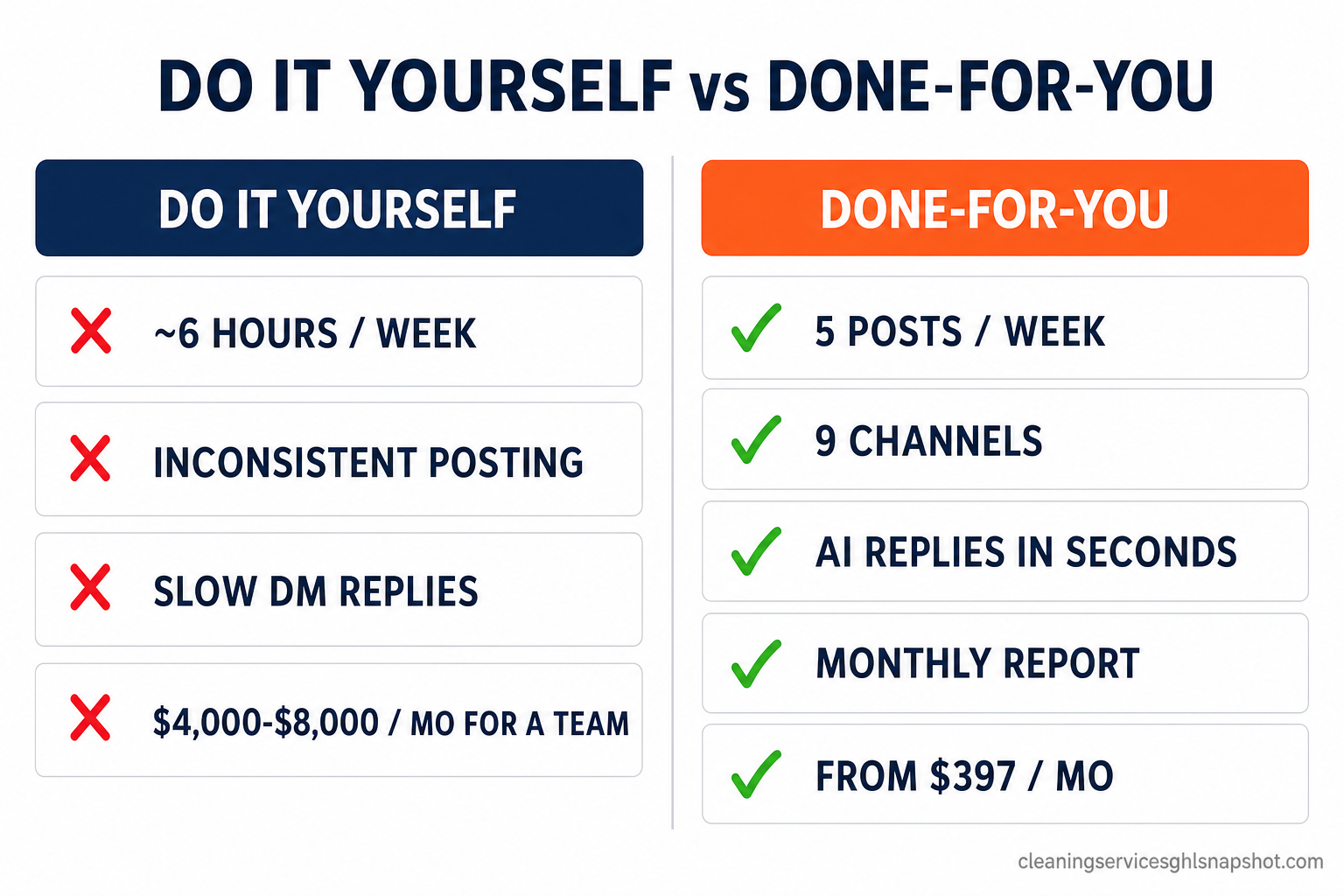
The build-it-in-house alternative is worse math: a designer, a video editor, a social manager, and someone to answer comments and DMs runs $4,000–$8,000 a month combined. A done-for-you service that ships cleaning-specific content five days a week across nine channels — plus AI agents that answer comments, DMs, and web chat instantly — starts at $397/month and is fully white-label for agencies (Cleaning social media package). Either way, the playbook is the same; the only question is whose six hours a week it costs.
Frequently asked questions
Which social media platforms should a Dallas cleaning company use?
Start with three: Instagram, Facebook, and your Google Business Profile. Instagram is where before/after cleaning transformations perform best, Facebook reaches the local-group and homeowner audience that drives a lot of Dallas referrals, and your Google Business Profile shows up in the map pack for 'house cleaning near me' searches. BrightLocal found 34% of consumers use Instagram and 23% use TikTok to discover local businesses, so those visual, social-proof-driven platforms are where your customers actually look. Add TikTok and YouTube Shorts later, once the first three are posting consistently.
How often should a cleaning business post on social media?
Aim for 3–5 posts a week. Buffer's analysis of over 2 million posts across 100,000 accounts found that posting 3–5 times a week more than doubles follower growth compared to posting once or twice, with diminishing returns beyond that (Buffer). Consistency matters more than volume — a steady five-days-a-week rhythm beats posting daily for two weeks and then going dark for a month.
What should a cleaning company actually post about?
Use a repeatable weekly mix so you never stare at a blank screen: before/after transformation Reels (your best performer), social proof like five-star review screenshots, quick educational tips and checklists as carousels, behind-the-scenes crew and process content that builds trust, and the occasional seasonal offer. Rotate those five formats across the week and lead with short-form video, which has been the highest-ROI content format four years running.
Do Instagram Reels really help a cleaning business get more customers?
Yes — cleaning transformations are among the most shareable content online, and short-form video is the best-performing format on social right now. The mechanism is simple: a satisfying before/after Reel reaches new local homeowners, a booking link in the caption and bio captures the interested ones, and a fast DM reply closes them. See our Reels playbook for what to film and how to post it.
How fast do I need to reply to comments and DMs?
As fast as possible — ideally within minutes. Sprout Social's 2025 Index found 73% of consumers expect a response within 24 hours, and 73% will buy from a competitor if a brand ignores them on social. Since no owner can watch three inboxes all day while cleaning, the practical answer is to automate the first touch with an instant reply that answers the common question and offers a booking link, then step in personally when needed. Our DM automation handles exactly this.
Is it worth paying someone to run my cleaning company's social media?
It depends on what your time is worth. Small-business owners spend around 6 hours a week on social media marketing (VerticalResponse), and building an in-house team of a designer, editor, and social manager runs $4,000–$8,000 a month. A done-for-you cleaning-specific service starts at $397/month and posts across nine channels with AI agents answering comments and DMs — so if those six hours are worth more on the job, outsourcing is usually the cheaper option. See our social media package.
Marisol Vega is a Cleaning Operations Strategist based in Austin, TX. She scaled a residential maid service from two vans to a fourteen-crew operation before moving into systems work, and writes about the unglamorous mechanics of a profitable cleaning business — recurring-attach rate, route density, and the marketing rhythms that keep a schedule full. Statistics cited here are from the linked third-party sources (BrightLocal, HubSpot, Buffer, Sprout Social, DataReportal, IBISWorld, and VerticalResponse); market and cost figures are illustrative and vary by operator. State and municipal cleaning-business licensing, insurance, and bonding remain each operator’s responsibility.
Related reading: Instagram Reels for cleaning businesses · Automate Instagram & Facebook DMs · Automate social media comment replies · Get more Google reviews on autopilot · Local SEO for cleaning businesses