
It is 9:15 on a Tuesday. You are on your knees scrubbing grout in a move-out clean when your phone buzzes in your back pocket. By the time you peel off a glove and dig it out, the call has dropped to voicemail. You will ring them back at lunch. You forget. That caller already booked the second cleaner they found on Google. You never knew they existed, so you never counted the loss.
That is how a cleaning business loses money: not in one dramatic moment, but in small, silent leaks you cannot see. A missed call here, a quote that went cold there, a client who drifted off after one visit. Add them up over a year and most owners leave more on the table than their whole marketing budget buys.
Here is the short answer, up front: the six leaks below drain more revenue from the average small cleaning company than any slow month does. None need more leads to fix. They need a system that catches the leads, jobs, and clients you already have before they slip out the back door.
Table of contents
- What a revenue leak actually is
- The 6 places a cleaning business loses money
- The same six leaks at three sizes
- The compliance step you cannot skip
- But won’t this annoy my customers?
- The Tuesday that goes differently
What a revenue leak actually is
A leak is money you already earned the right to, then lost through a gap in your process. Not a lead you never got, but a caller you did not answer, a quote you did not chase, a client who would have stayed if anyone had asked them to rebook. Plugging it costs almost nothing: you add a simple automatic step where a person used to drop the ball.
To size any leak you need three numbers: your average ticket, how often it happens, and what a kept client is worth over time. The US average runs around 120 to 280 dollars for a standard residential clean (Housecall Pro), so the examples below use 200 dollars as a round middle.
The 6 places a cleaning business loses money
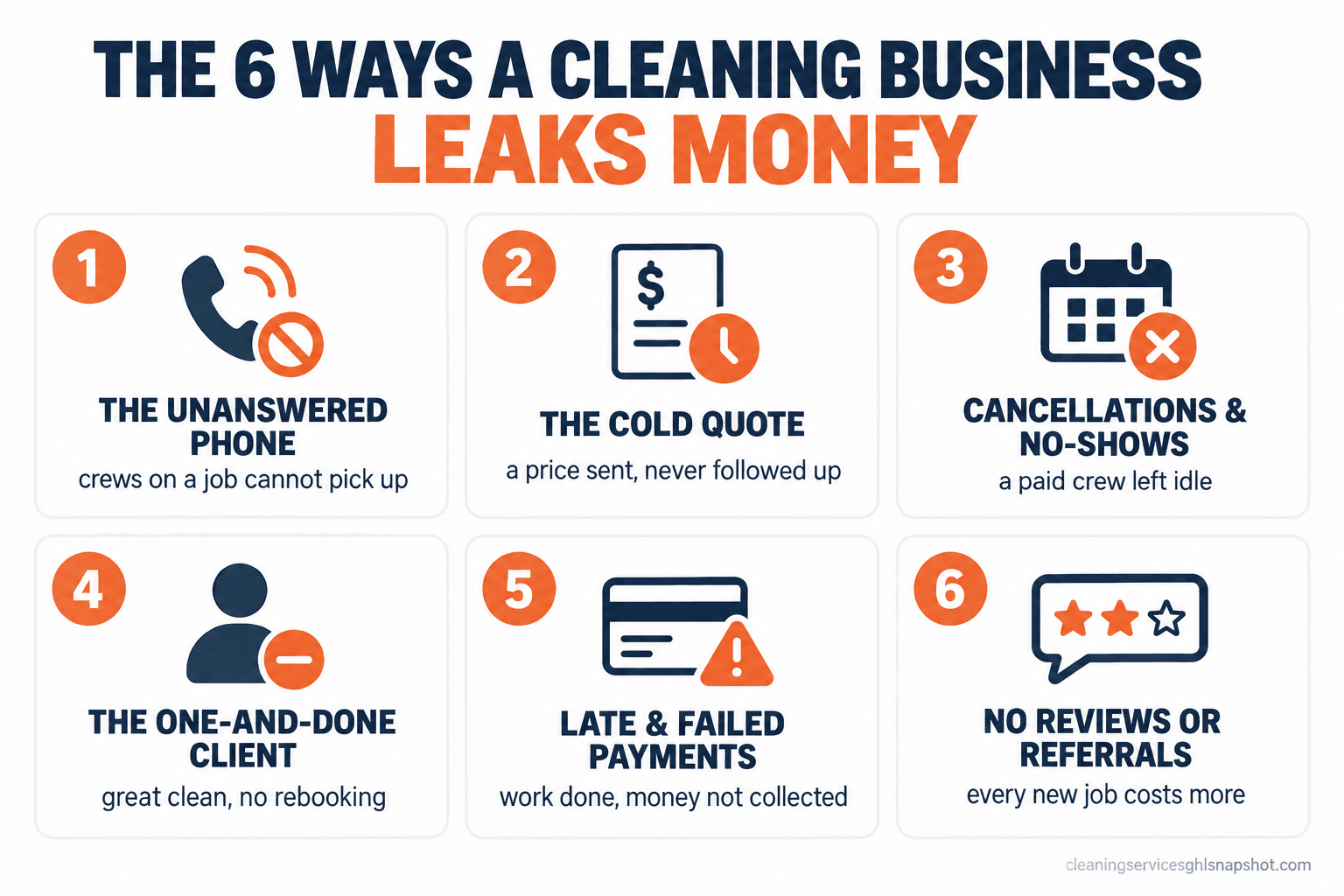
The map, ordered by cost to a typical residential shop, biggest leak last.
| # | The leak | What it looks like |
|---|---|---|
| 1 | The unanswered phone | Crews on a job can’t pick up; caller books someone else |
| 2 | The quote that went cold | You sent a price, never followed up, they ghosted |
| 3 | Cancellations and no-shows | Last-minute drop leaves a paid crew idle |
| 4 | The one-and-done client | First clean is great, nobody rebooks them |
| 5 | Late and failed payments | Work done, money stuck in “I’ll pay you Friday” |
| 6 | The silent happy client | No review or referral, so every new job costs more |
1. The unanswered phone
Your crews cannot stop mid-clean to answer a call, so they do not. That is not a discipline problem, it is physics. And the caller does not wait. A 411 Locals study found 62% of inbound calls to small businesses go unanswered (411 Locals), and about 80% of people who hit voicemail hang up without leaving a message (destinationCRM).
The math is brutal. Miss four callable leads a week, close even half at a 200 dollar first clean, and that is 400 dollars a week walking to a competitor, over 20,000 dollars a year.
How it breaks: Relying on voicemail, which most people ignore. Or a slow callback: odds of qualifying a lead fall 21 times when you respond at 30 minutes instead of 5 (MIT / InsideSales). Your “I’ll call them at lunch” habit is the leak.
The fix: The moment a call goes unanswered, an automatic text fires back within seconds, reaching them in the one channel they will answer before they move on. Full build in missed call text-back for cleaning businesses.
2. The quote that went cold
Someone asked for a price. You texted it over. Then nothing. Most owners read that silence as a no. Usually it is just a distracted person one nudge would have booked. The average business takes 42 hours to respond to a lead and 23% never respond at all (Harvard Business Review). A quote with no follow-up joins that 23%.
How it breaks: You follow up once, the day you send it, then give up. Or you call, hit voicemail, and stall. Or the quote has no clear next step, so the client does not know how to say yes.
The fix: A three-text follow-up sequence that runs on its own, spaced over a few days, each one easy to reply to. Full breakdown in the cleaning quote follow-up guide; here is the skeleton.
3. Cancellations and no-shows
A last-minute cancellation is worse than a lost lead, because you already paid for it: the crew is clocked in, the van is fueled, the slot is blocked. Completed home-service appointments no-show somewhere in the 5 to 20% range depending on the shop, and free estimate visits run higher because the client has paid nothing to hold the slot (ServiceTitan). At a 200 dollar ticket, two avoidable cancellations a week with no backfill is crew time you paid for and could not sell, week after week.
How it breaks: No reminder, so the client forgot. No cancellation policy, so there is no cost to dropping you at 7am. No waitlist, so the hole stays a hole.
The fix: Automatic reminders at 24 hours and 2 hours, a plain-English cancellation and deposit policy the client agreed to at booking, and a quick text to a waitlist when a slot opens. The policy is what most owners skip, and what changes behavior. Exact wording in the cleaning cancellation policy guide.
4. The one-and-done client
This is the big one. You nail a deep clean, the client loves it, and you never hear from them again, because nobody asked them to come back. Every one is a recurring customer you trained, impressed, and let walk. A one-time clean is 200 dollars. The same home on a bi-weekly plan at 150 dollars a visit is 26 visits a year, nearly 4,000 dollars, and recurring clients cost nothing more to acquire. Losing one is not losing 200 dollars. It is losing the picture below.
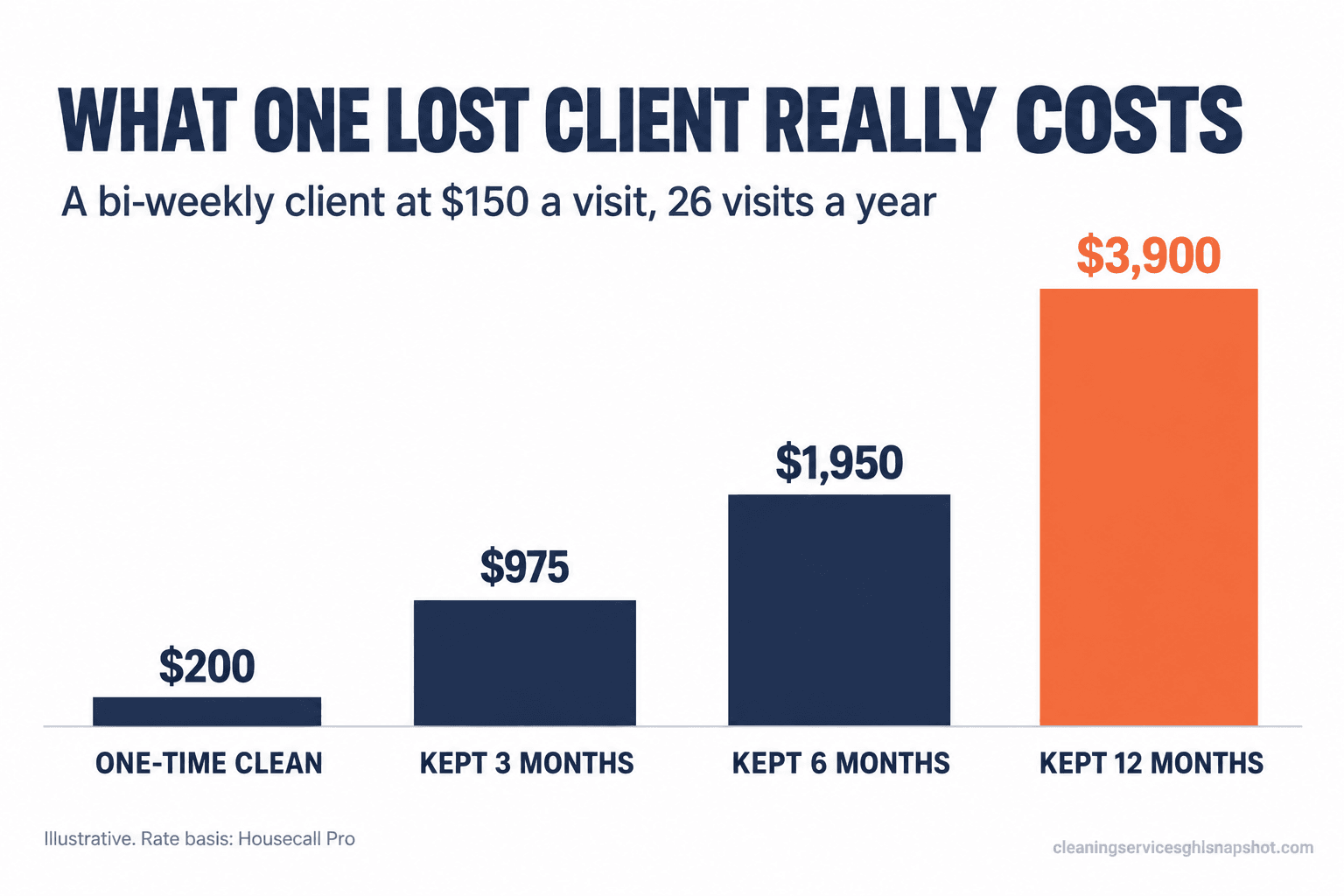
What one client is worth: a single clean versus the same client kept bi-weekly at $150 a visit (26 a year). Illustrative. Rate basis: Housecall Pro.
How it breaks: You wait for the client to call and book the next one. They never do, not because they were unhappy, but because life got busy and you were out of sight. No rebooking prompt at the end of the clean, no recurring plan offered, no check-in a week later.
The fix: Offer the recurring slot before you leave the first job, then a text that makes rebooking one tap. If they decline, a follow-up a week later catches the ones who meant to and forgot. This leak quietly caps most cleaning businesses; more in why cleaning clients ghost.
5. Late and failed payments
This one hits commercial and invoiced work hardest. The clean is done, the client is happy, and the money is still sitting in “I’ll send it Friday.” Every day that invoice ages is cash you earned but cannot use to make payroll. It is rarely a client refusing to pay, but one who forgot, an expired card on a recurring plan, or a bill with no easy way to pay. Each is a fixable gap, not a bad customer.
How it breaks: You invoice manually and chase by phone, which feels awkward so you delay it. A recurring client’s card expires and the charge silently fails, so you clean for free until someone notices weeks later. No automatic nudge, so a 400 dollar invoice drifts for a month.
The fix: Charge recurring clients automatically on file, retry failed cards and text the client when one fails, and send a short, friendly reminder sequence on open invoices. Full playbook in cleaning business payment recovery.
6. The silent happy client
Your happiest clients are the ones you never hear from, and that silence is expensive. Every clean that ends without a review request is a review you did not get, and reviews are how new clients decide whether to call you at all. Consumer surveys consistently find the overwhelming majority read reviews before choosing a local business, many will not use one with too few reviews, and most only trust recent ones (BrightLocal). Thin or stale reviews do not cost you one job, they raise the price of every future job, because you spend more on ads to overcome doubt fresh reviews would erase for free.
How it breaks: You ask only when you remember, which is rarely. You ask by email, which gets ignored. You ask everyone at once, then go quiet for months, so your count looks stale.
The fix: A review request text that goes out automatically a few hours after every completed clean, with a direct link. Route the thrilled ones to Google and catch the unhappy ones in a private reply, so you fix it before it becomes a one-star. Mechanics in how to get more Google reviews.
The same six leaks at three sizes
The leaks are universal, but what they cost, and which to plug first, depends on your size.
The solo operator or 1-crew shop
You are the phone, the quoter, the cleaner, and the collector. Leak 1, the unanswered phone, is your worst by far, because every missed call is a lead gone. Start with missed-call text-back, add the quote follow-up, and chase your handful of invoices by hand for now.
The mid-size residential team, 5 to 15 crews
The biggest leak shifts to churn. Fix in order: rebooking at the first clean, reminders and a real cancellation policy to protect your now-expensive crew hours, then reviews to lower what each new client costs.
The large commercial or janitorial operation, 15 to 50+ crews
Your sales cycle is long and bid-based, so leaks 2 and 5 dominate. A cold quote on a 2,000 dollar monthly contract is a huge miss, so bid follow-up has to be automatic and relentless. With invoiced net-30 work, payment recovery is cash flow, not a nicety. Chase the quote and the invoice first.
Illustrative monthly revenue leak by source for a mid-size residential shop (5 to 15 crews), modeled from a $200 first clean and a $150 bi-weekly rate. Your numbers will differ. Rate basis: Housecall Pro.
The compliance step you cannot skip
Every fix above runs on business text messages, which means you register before you send. In the US and Canada, business texting goes through a process called A2P 10DLC: you register your business and campaign with the carriers, and your texts get delivered instead of silently filtered. The leak you worked to plug reopens if your messages do not arrive. Owners who flip on texting inside a tool like ZenMaid, BookingKoala, or Jobber without registering often find their reminders dying in carrier filters.
The second rule is consent. Under the TCPA you need permission before you text automated messages, which means a clear opt-in at booking and an easy STOP to unsubscribe. The follow-ups above are fine when the client asked you to clean their home and gave you their number. A blast to a scraped list is not. Full walkthrough in the TCPA and 10DLC guide for cleaners.
“But won’t this annoy my customers?”
The honest answer: only if you do it wrong. Here are the objections worth taking seriously.
“Won’t all these automated texts feel spammy?” They feel spammy when they are generic, mistimed, or relentless. A text that answers a missed call in seconds, or reminds someone of a clean they booked, is the thing they wanted. One clear purpose per message, sent from the number they already talk to you on, with an easy way to stop.
“I already pay for Jobber or Housecall Pro. Doesn’t it do this?” Partly. Those tools handle scheduling and invoicing well, and some bolt on texting as a paid add-on. Where they tend to be thin is the connective automation: missed-call text-back, multi-step quote follow-up, the rebooking nudge, review routing. If yours does all six, keep it. If you are stitching it together by hand, that manual work is where the leaks live.
“I’m not technical, and my shop is small.” Neither is a reason to skip this. The logic is simple (a trigger, a wait, a text), and a done-for-you system installs it for you. Small is when leaks hurt most, because you have fewest leads to spare.
The Tuesday that goes differently
Go back to that Tuesday morning. You are still on your knees in the move-out clean, your phone still buzzes, and you still cannot answer. The difference: within 30 seconds that caller gets a text from your number, replies with their address, and books a quote before they think to dial the next cleaner. The quote follows up on its own. They show up because they got a reminder, say yes to bi-weekly after the clean, and leave a five-star review a day later.
None of that needed one extra lead or dollar of ad spend. It needed the back door closed. That is the whole move: find your six leaks, plug them in the order your size demands, and keep the clients, calls, and jobs you already earned. If you would rather not build it by hand, the Cleaning Snapshot ships with every fix pre-built and installed in about a day.
Cleaning business revenue leaks: FAQ
Which leak should I fix first?
It depends on your size. A solo operator should fix the unanswered phone first with missed-call text-back. A mid-size residential team should prioritize rebooking and churn, where a kept client is worth far more than one lead. A commercial or janitorial operation should start with quote follow-up and payment recovery, where the dollars per job are largest.
Do I need to answer calls live to stop losing leads?
No. Answering every call is impossible when your crews are cleaning. The fix is to respond fast in a channel people use: an automatic text within seconds of a missed call reaches the caller before they move on, and most people happily continue by text.
Is it legal to send customers automated text messages?
Yes, with two conditions. Register your business number for A2P 10DLC so carriers deliver your texts, and follow the TCPA: clear consent at booking and an easy opt-out such as 'Reply STOP.' Texting a client who asked you to clean their home and gave you their number is fine. Blasting a scraped list is not.
Won't automated texts annoy my clients?
Not if each message has one clear purpose, good timing, and an easy way to stop. A missed-call reply, an appointment reminder, and a rebooking nudge are messages clients want. Generic, mistimed, or relentless ones feel like spam, so keep it to moments that genuinely help.
I already use Jobber or Housecall Pro. Do I still have these leaks?
Possibly. Those tools handle scheduling and invoicing well, but the connective automation (missed-call text-back, multi-step quote follow-up, rebooking prompts, review routing) is often a paid add-on or missing. If you do that follow-up by hand, the leaks are still open. For a full cost picture, see what cleaning software actually costs in 2026.