
It is Sunday night and you are scrolling the week ahead, seeing it packed, and wondering why the bank balance looks exactly like it did a year ago. The calendar is full. You work six days and answer texts at 9pm. And still the business sits at the number it has been stuck on for eighteen months. More work, same money. If that is you, the problem almost certainly is not that you need more leads.
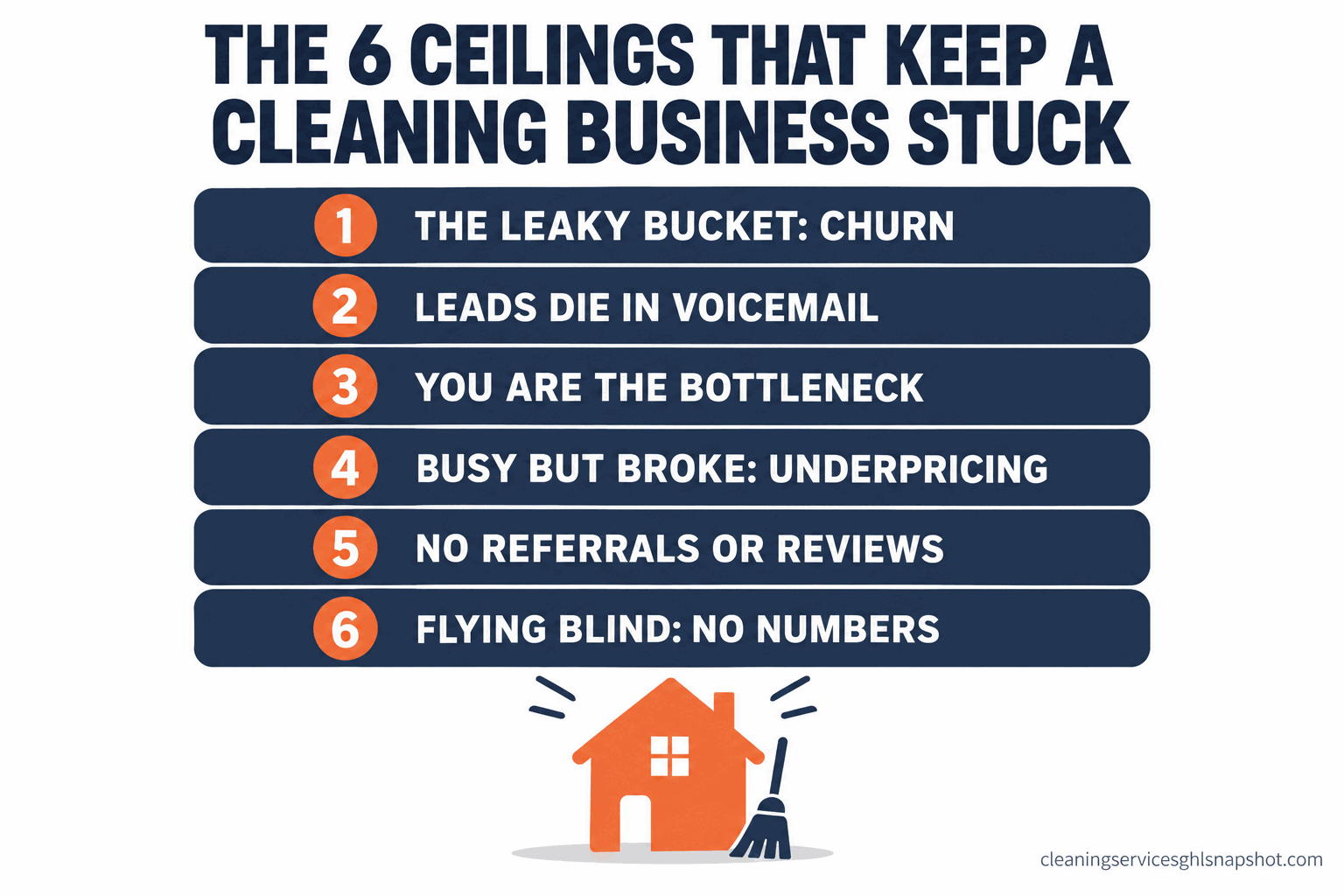
A cleaning business that stops growing is usually hitting one of six specific ceilings, and none of them is “not enough leads.” You are losing customers out the back as fast as you win them, or every lead dies in your voicemail while you are on a job, or you are the only person who can do the work, or you are priced so low that more jobs just means more exhaustion. This guide names all six, shows you how to tell which one is holding you down, and gives the fix for each, with the exact texts you can steal and how the priorities shift from solo to a 40-person janitorial crew.
Key Takeaways
- “More leads” is rarely the real problem. Most stuck cleaning businesses leak customers out the back, not starve for them at the front.
- The industry is built for small. About 357,000 US residential cleaning businesses share roughly $18.8 billion, about $52,000 each per year (IBISWorld).
- Retention is the cheapest growth lever. Winning a new customer costs 5 to 25 times more than keeping one, and a 5% lift in retention can raise profit 25% to 95% (Harvard Business Review).
- Six ceilings: churn, phone dependence, the owner bottleneck, underpricing, no referral engine, no numbers. Break the one biting hardest first.
Table of contents
- Why “get more leads” is usually the wrong fix
- Ceiling 1: The leaky bucket
- Ceiling 2: Every lead dies in your voicemail
- Ceiling 3: You are the bottleneck
- Ceiling 4: Busy but broke
- Ceiling 5: Linear, not compounding
- Ceiling 6: You are flying blind
- The same problem at three sizes
- The objections I hear from owners
- Frequently asked questions
- The bottom line
Why “get more leads” is usually the wrong fix
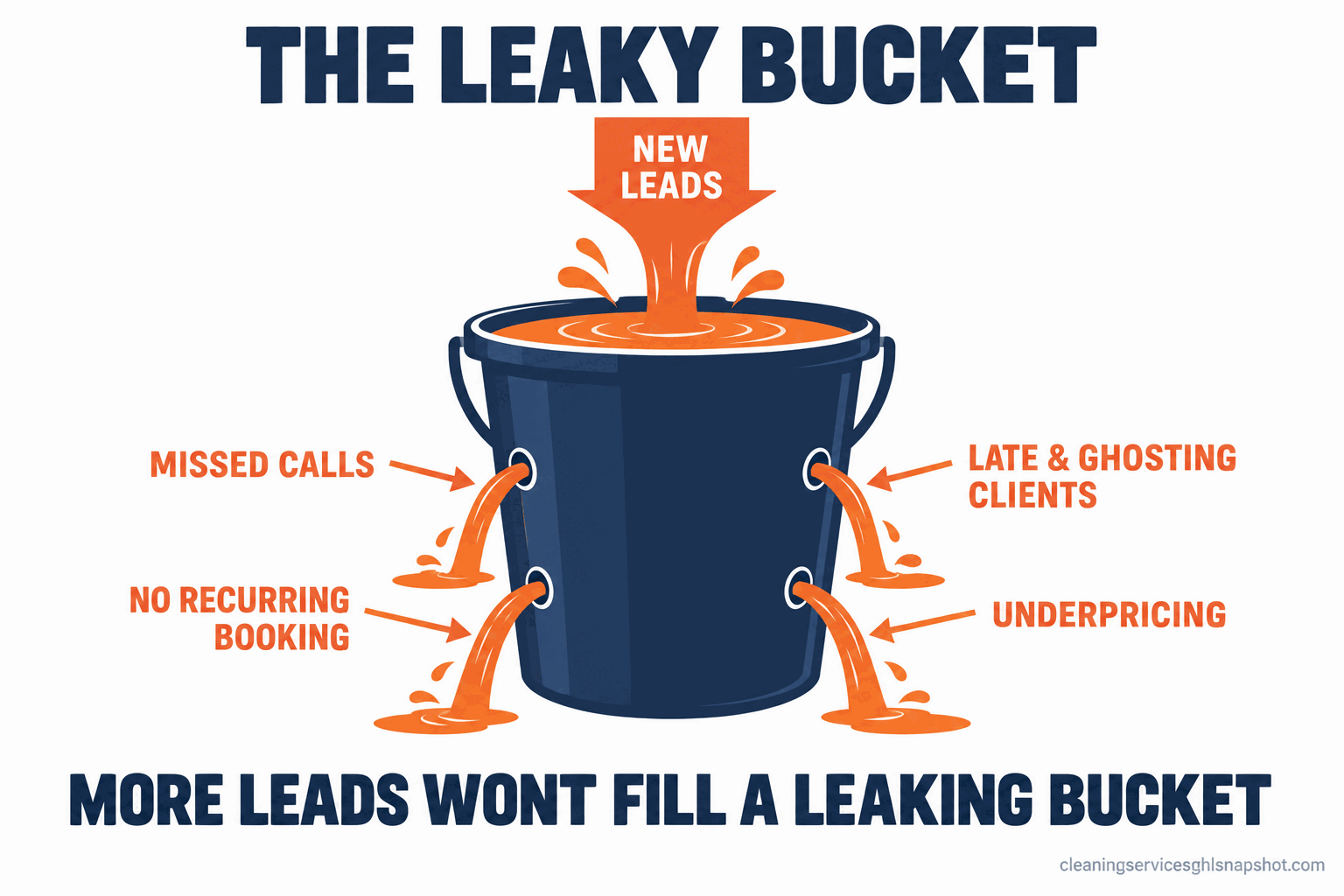
When an owner tells me the business is stuck, the first instinct is always marketing. Run ads. Post more. Buy leads. Most of the time that is pouring water into a bucket with a hole in the bottom. Add ten customers a month but lose ten to cancellations, no-shows, and quiet ghosting, and you run hard all month to end where you started. The marketing worked, but the business did not grow.
The industry itself is built to keep you small. Roughly 357,000 residential cleaning businesses in the US split about $18.8 billion, a little over $52,000 each (IBISWorld). Growing past that means fixing the specific thing capping you, so before you spend another dollar on leads, read the six below and be honest about which are true.
Ceiling 1: The leaky bucket
How it shows up: You win new clients every month, but a first clean rarely turns into a second, and a second rarely turns into a standing weekly or biweekly slot. Customers drift, nobody is counting, and the calendar just needs constant refilling.
This is the most common reason a cleaning business stalls, and the most expensive. Winning a new customer costs 5 to 25 times more than keeping one, and Bain’s Frederick Reichheld found that lifting retention just 5% can raise profit 25% to 95% (Harvard Business Review). A one-off clean is one payday; a recurring client is an annuity.
The fix: Build a bridge from the first clean to the standing slot, automatically, because you will forget by hand. The best moment is the hour right after the first clean, while the client is thrilled, not three weeks later when the shine has worn off. Playbooks: how to build recurring revenue and why cleaning clients ghost after one visit.
Here is the recurring-offer text I hand every operator. Send it the evening of the first clean:
Hi [Name], it was a pleasure getting your home spotless today! Most clients keep it this way with a standing every-other-week slot, and it is 15% less than a one-time clean. Want me to hold Tuesday mornings for you? Just reply YES and you are set.
And the win-back text for anyone who has gone quiet for 6 to 8 weeks:
Hi [Name], we have missed cleaning for you! Book this week and I will take $25 off your next visit. Want your old Tuesday slot or something new?
Ceiling 2: Every lead dies in your voicemail
How it shows up: The phone rings while you are elbow-deep in a bathroom. You cannot answer, you call back at 6pm, and they already booked the company that picked up.
This is pure lost revenue, and it is invisible, which makes it dangerous. You cannot miss what you never saw. A cleaner on a job cannot answer the phone, and the caller shopping for a price will not wait. They text three companies and hire whoever responds first. Call back after the job and you are congratulating them on their new cleaner.
The fix: Stop relying on yourself to answer in real time. An automatic missed-call text-back fires the second you miss a ring, so the lead gets a reply in ten seconds instead of ten hours, over text where a busy caller actually wants it, often the fastest payback in the business. Setup and numbers are in missed call text-back for cleaning businesses.
The text that catches the lead while you are still on the job:
Hi, this is [Company], sorry we missed your call! We were on a job. If you are after a quote, send your zip code, bedrooms and bathrooms, and I can get you a price right here.
Firing automatically, it turns calls you were quietly losing into booked cleans, and you set it up once.
Ceiling 3: You are the bottleneck
How it shows up: Every clean has to be done by you, or checked by you, or saved by you. You tried hiring once, it went badly, so now you do it all. The business cannot take on more work because there is only one of you.
This ceiling feels like success and is actually a cage. The most expensive, least scalable person, you, is doing the hands-on cleaning. The median wage for maids and housekeeping cleaners sits around $17 an hour across the roughly 860,000 of them in the US (U.S. Bureau of Labor Statistics), so the cleaning itself is not where an owner’s time is worth the most. But you cannot step back, because nothing is written down and nobody is trained.
The fix: Turn what is in your head into something you can hand off. Write the simplest checklist for a standard clean, room by room, and record yourself doing one house on your phone. That is your training program. Hire for attitude and train the process, and use a before-and-after photo check to verify quality without driving to every house. The goal is to make yourself replaceable on the cleaning so you are free for the growth.
Ceiling 4: Busy but broke
How it shows up: The calendar is slammed and the money is not there. You are the cheapest option in town, you win on price, and every new job adds work without much profit, but you are afraid to raise rates in case you lose everyone.
Underpricing is the quietest ceiling because it hides inside a full schedule. You feel productive, you are exhausted, and the margin is paper-thin. There is always someone willing to go lower, and more volume at a bad price just means you hit the limit of your hours sooner, with nothing left to hire your way out.
The fix: Raise prices on the work that is worth more and stop apologizing for it. Start with new clients, who have no old price to compare against, then move existing clients up with notice. Build clear tiers so clients self-select instead of haggling. A $30 bump across 40 cleans a month is $14,400 a year for the same workload. We break down how in cleaning business pricing tiers and the cost math behind a profitable price in what a clean costs you.
The script for telling an existing client about a rate increase, which almost never loses anyone when done with notice:
Hi [Name], a heads up that starting [date] your biweekly cleaning will be [new price], our first adjustment in [time]. Nothing about your service changes, we are keeping up with rising supply and labor costs. We value having you as a client and wanted to give plenty of notice. Any questions, just ask!
Ceiling 5: Linear, not compounding
How it shows up: Every new customer comes from you spending money or time. Turn off the ads and the pipeline goes dry. Your happiest clients are a dead end instead of a source of more clients.
A business that only grows by buying attention is running up a down escalator. The ones that break out have customers who bring them more customers, for free, on repeat. Word of mouth is still the most trusted form of advertising, with about 88% of people trusting recommendations from someone they know (Nielsen). Reviews are table stakes too: only about 4% of consumers never read them before choosing a local business (BrightLocal).
The fix: Make the ask automatic and well-timed. Right after a great clean, trigger a review request. A week later, a referral offer. You already did the hard part, so capture the word of mouth it earns while the client is delighted, not a month later. Playbooks: the referral program that runs itself and how to get more Google reviews.
The review-request text, fired the evening of a clean:
Hi [Name], so glad we could get your home sparkling today! Reviews are how a small business like ours survives. Would you take 30 seconds to leave us one here? [link] Thank you so much, it genuinely helps.
The referral offer, a week later:
Hi [Name]! Know a friend whose home could use the same treatment? Send them our way and you each get $25 off your next clean when they book. Just have them mention your name. 🏡
Ceiling 6: You are flying blind
How it shows up: You cannot answer basic questions about your own business. How many clients did you lose last month? What does it cost to land one? What is your recurring-attach rate? You run on gut feel and the checking-account balance, so you cannot tell which of the five ceilings above is holding you down.
This is the meta-ceiling, because it hides all the others. If you do not measure churn, you blame marketing for a retention problem and waste a year. If you do not know your cost per clean, you cannot tell whether a price is profitable. The first five fixes are guesses until you can see.
The fix: Track four numbers monthly, even on a napkin: new clients won, clients lost, what you spent to win them, and how many turned into recurring. That is enough to spotlight your real ceiling. A simple system that logs leads, bookings, and client status in one place makes it automatic. See why a cleaning business needs more than a spreadsheet.
The same problem at three sizes
The six ceilings are universal, but the one that matters most depends on the shape of your business.
Solo or two-person team. Your killers are ceiling 2 and ceiling 3. Every missed call dents the month, and you are the entire bottleneck. Start with the missed-call text-back, which recovers jobs immediately, then write down your process so you can eventually hire. One lost recurring client is a real chunk of income, so retention bites too.
Mid-size residential, 3 to 15 cleaners. Your ceilings are 1, 4, and 6. You have enough volume that churn and pricing swings move real money, and enough moving parts that gut feel fails. Get the recurring offer and win-back running, tighten pricing with real cost math, and track the four numbers.
Commercial and janitorial, 15 to 50-plus. Bid-based contracts, night crews, and long sales cycles mean ceiling 3 and ceiling 6 dominate. Growth is about systems and accountability: documented processes, verifiable quality checks, and clean reporting for a facilities manager. Retention is contract renewal here, and keeping a contract is far cheaper than bidding a new one.
The objections I hear from owners
“I don’t have a retention problem, I have a lead problem.” Count how many of last quarter’s new clients came back for a second clean. If it is under half, you have a bucket with a hole in it, and new leads drain out the same way. Fix retention first and every lead you buy is worth more.
“I can’t raise prices, my market is too cheap.” Someone in your market is charging more than you and staying busy. Raise on new clients first, where there is no old price to anchor against. It is rarely the exodus owners fear.
“Won’t all these automated texts annoy my clients?” Not when they are relevant and well-timed. A review ask after a great clean, a heads up about a standing slot, a genuine win-back offer: these read as good service, not spam. What annoys clients is being forgotten.
Frequently asked questions
Why isn't my cleaning business growing even though I'm always busy?
Being busy and growing are different things. A full calendar at a thin price, or a business that replaces churned clients as fast as it wins them, feels productive but stays flat. The usual cause is a leak, not a shortage of leads: clients who do not come back, calls missed on a job, or prices too low to profit. Fix that before spending more on marketing.
How do I know which ceiling is holding my cleaning business back?
Count four numbers for last quarter: new clients won, clients lost, what you spent to win them, and how many became recurring. If few new clients came back, it is retention. If you lose callers on jobs, it is lead capture. If you must do or check every clean, it is the owner bottleneck. If the calendar is full but the money is not, it is pricing. If you cannot answer at all, that is its own ceiling.
Isn't the real answer just to get more leads?
Rarely. More leads only help if you keep the customers you win. Acquiring a new customer costs 5 to 25 times more than keeping one (Harvard Business Review), so the cheapest growth almost always comes from plugging the leak, not widening the funnel. Buy leads after the bucket holds water, not before.
What is a good recurring-attach rate for a cleaning business?
A healthy residential operation turns a solid majority of first-time cleans into recurring weekly, biweekly, or monthly slots, because that is where the profit and stability live. If most of your work is one-off cleans, you rebuild your revenue from zero every month. The fastest fix is to ask for the standing slot the same day as the first clean.
Should I raise my cleaning prices if I'm worried about losing clients?
Yes, and the fear is usually bigger than the reality. Raise new-client pricing first, since they have no old rate to compare against, then move existing clients up with clear notice and a short, honest explanation. Most clients who value your work stay. The ones who leave over a small increase were price-shopping anyway.
The bottom line
Your cleaning business is probably not stuck because you need more leads. It is stuck because customers leak out the back, calls die in your voicemail, you are the only one who can do the work, you are priced too low to profit, your best clients are a dead end, or you cannot see which of those is true. Each ceiling has a fix that does not require a single extra job on the calendar.
Pick the one that made you wince and start there. Count last quarter’s second cleans, turn on the missed-call text-back, raise your new-client price by $30. The leads were almost always there, leaking out of a hole nobody was watching. If you would rather install the whole system at once, the Cleaning Snapshot ships every one of these automations pre-built, or book a walkthrough first. Growing past $52,000 a year is not luck. It is fixing the ceiling you are actually hitting.
About the author
Nadia Sarin is a Customer Retention & Reviews Lead in San Diego, CA. She is obsessed with the part of the cleaning business most owners ignore until it is too late: what happens after the first clean. She built the photo-triggered review loops and win-back sequences she writes about, and she has seen firsthand how a single well-timed text turns a one-off deep clean into an eighteen-month recurring customer. She translates retention theory into copy and timing you can deploy in GoHighLevel this afternoon.
Related posts
- How to Build Recurring Revenue in a Cleaning Business
- Why Cleaning Clients Ghost After One Visit
- Missed Call Text-Back for Cleaning Businesses
- Cleaning Business Pricing Tiers: Stop Leaving Money on the Table
- The Cleaning Referral Program That Runs Itself
Sources
- IBISWorld: Residential Cleaning Services in the US
- Harvard Business Review: The Value of Keeping the Right Customers
- U.S. Bureau of Labor Statistics: Maids and Housekeeping Cleaners (OEWS, May 2025)
- Nielsen: Trust in Advertising, US sell sheet (2021)
- BrightLocal: Local Consumer Review Survey 2025
- HomeAdvisor: House cleaning and maid service cost