
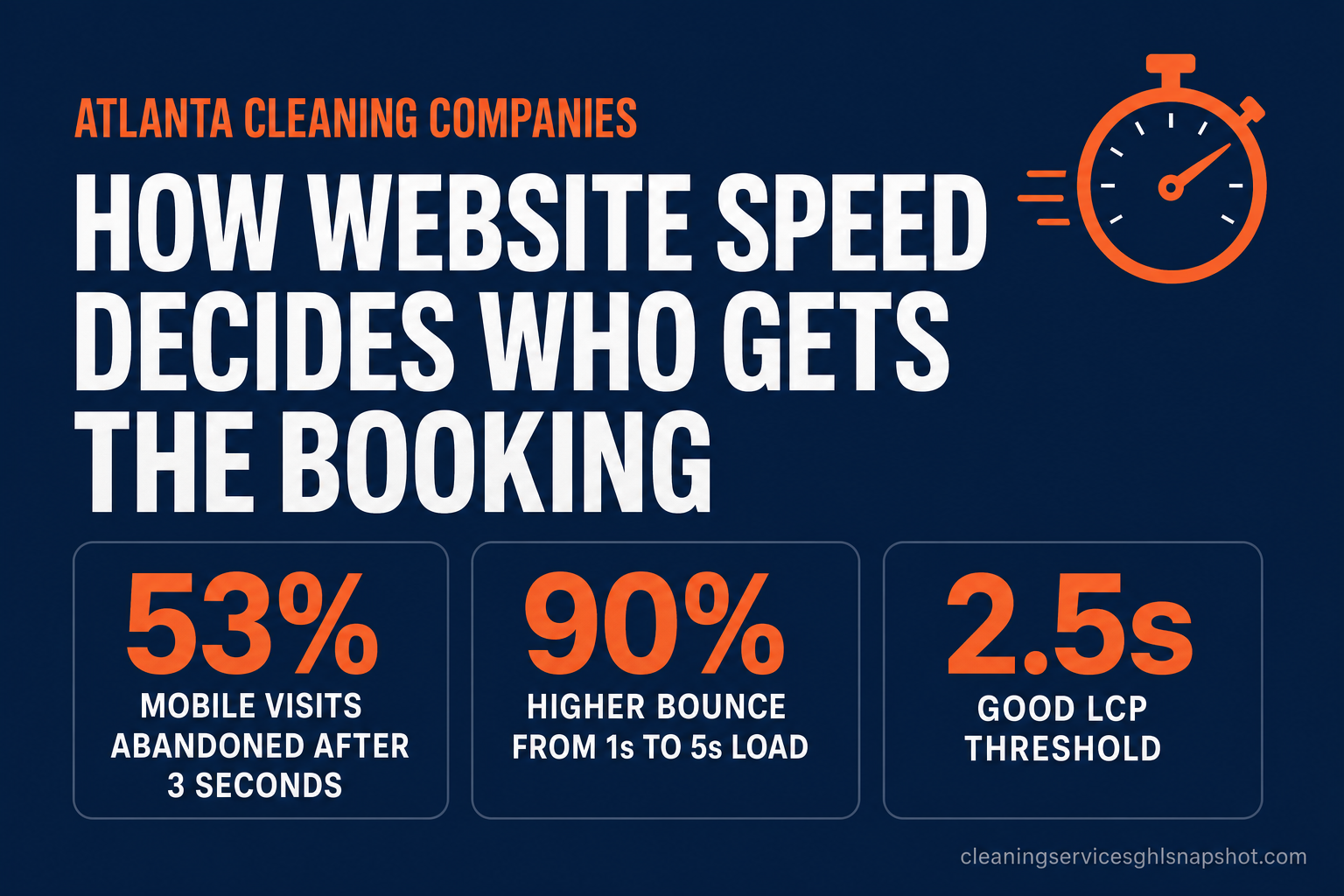
An Atlanta cleaning company’s website speed decides who gets the booking because a homeowner comparing cleaners on their phone will abandon a page that takes more than about three seconds to load — and most cleaning sites built on WordPress, Wix, or a page builder are far slower than that on mobile. Google’s own data shows the probability of a mobile visitor bouncing climbs 32% as load time goes from 1 to 3 seconds, and 90% from 1 to 5 seconds (Think with Google). In a metro adding tens of thousands of new households a year, the cleaner whose site loads instantly — and passes Core Web Vitals — is the one who wins the recurring customer.
This is written for cleaning operators across metro Atlanta — Buckhead, Midtown, Decatur, Sandy Springs, Marietta, Alpharetta, Roswell, and the surrounding counties — who are paying for traffic (ads, Google Business Profile, local SEO) but watching too little of it turn into booked cleans. Very often the leak isn’t the offer or the pricing. It’s the two or three seconds your site makes a homeowner wait before they ever see it. Every number below is sourced; nothing is invented.
Key Takeaways
- Speed is a conversion lever, not a vanity metric. As a mobile page’s load time grows from 1 to 3 seconds, the probability a visitor bounces jumps 32%; from 1 to 5 seconds it jumps 90% (Think with Google). Google also found 53% of mobile visits are abandoned if a page takes longer than three seconds (Google/SOASTA).
- Even fractions of a second move revenue. A 0.1-second improvement in mobile speed lifted retail conversions 8.4% and cut lead-generation bounce rates 8.3% across 37 brands (Deloitte, “Milliseconds Make Millions”).
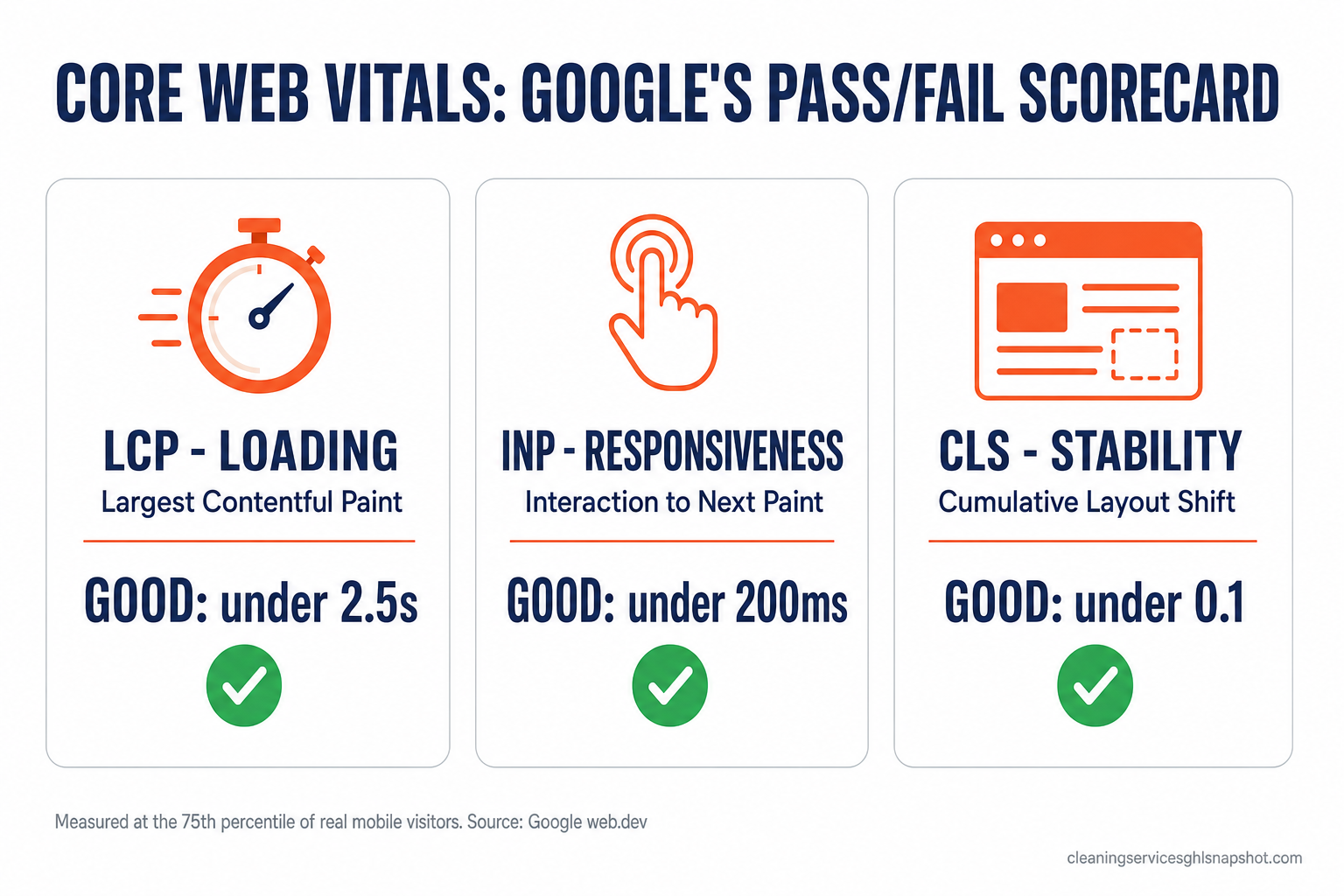
- Core Web Vitals are the scorecard. Google grades every page on LCP (≤ 2.5s), INP (≤ 200ms), and CLS (≤ 0.1) at the 75th percentile of real visitors (web.dev). In 2025 only 48% of mobile pages passed all three (HTTP Archive Web Almanac).
- Most cleaning sites fail on mobile — where the bookings are. WordPress plugins, Wix builders, and GHL-built pages ship heavy JavaScript that drags mobile load times, exactly where the majority of “house cleaning near me” searches happen.
- A fast Atlanta site is a business advantage. We build cleaning websites on the Astro framework with a guaranteed 90+ PageSpeed — static-first, edge-served, and built to pass Core Web Vitals — so the homeowner sees your page before they think about tapping back.
Table of contents
- What “website speed” actually means for a cleaning business
- The Atlanta problem: a fast-growing metro on slow websites
- What one slow second costs an Atlanta cleaning company
- Why most cleaning websites are slow
- Core Web Vitals, Google rankings, and local search
- How to make a cleaning website genuinely fast
- The Atlanta math: turning speed into booked cleans
- Frequently asked questions
What “website speed” actually means for a cleaning business
“Fast website” used to be a vague compliment. Google turned it into a measurable, ranked scorecard called Core Web Vitals — three metrics it collects from real Chrome users and factors into search rankings. For a cleaning business, they translate directly into whether a homeowner sticks around long enough to see your quote form:
- Largest Contentful Paint (LCP) — how long until the main content (your headline, hero image, “Get a Quote” button) actually appears. Good is 2.5 seconds or less.
- Interaction to Next Paint (INP) — how quickly the page responds when someone taps a button or opens your quote calculator. Good is 200 milliseconds or less.
- Cumulative Layout Shift (CLS) — how much the page jumps around while loading (the reason people tap the wrong thing). Good is 0.1 or less.
Google measures each at the 75th percentile of your real visitors — meaning three out of four people need a good experience, not just the one test you ran on office Wi-Fi (web.dev). That last part matters enormously for cleaning companies, because your buyers aren’t on office Wi-Fi. They’re on a phone, on cellular, on the couch at 9 PM. The number that counts is how your site performs there.
The Atlanta problem: a fast-growing metro on slow websites
Metro Atlanta is one of the country’s great growth stories — and a great growth story is a river of new cleaning customers. The 11-county region added roughly 62,700 residents in a single year (April 2023–April 2024), pushing the metro past 6.1 million people (Atlanta Regional Commission). The metro homeownership rate sits around 66% (Data USA / U.S. Census), and every one of those new owner-occupied households is a household that will, sooner or later, search for a cleaner.
Here’s the catch: nearly all of that searching happens on a phone, and phones are exactly where cleaning websites fall apart. A homeowner in Alpharetta who just moved into a four-bedroom doesn’t open a laptop to find a cleaner — they thumb “house cleaning near me,” tap the first few results, and give each one about two seconds to prove itself. If your site is still spinning while a competitor’s has already shown a price range and a “Book Now” button, the growth of Atlanta is working against you, not for you. The traffic arrives; it just doesn’t wait.
I’ve audited dozens of home-service sites, and the pattern is always the same: the owner is proud of how the site looks on their desktop, and it scores a 34 on mobile. The homeowner never sees the pretty desktop version. They see the 34.
What one slow second costs an Atlanta cleaning company
The link between speed and lost customers isn’t a hunch — it’s one of the most replicated findings in web analytics. Google’s mobile benchmark study found that as a page’s load time increases, the probability a visitor bounces climbs steeply and non-linearly:
Increase in probability a mobile visitor bounces as page load time grows. Source: Think with Google, “Mobile Page Speed: New Industry Benchmarks.”
Bounce is only half the story — the other half is conversion. Portent’s analysis of over 100 million page views across 20 sites found the highest conversion rates land between a 1- and 2-second load time, with e-commerce conversion falling from about 3.05% at one second to 0.67% at four seconds — an average drop of roughly 4.4% of conversions for every additional second between 0 and 5 seconds (Portent). A cleaning quote form is a conversion event just like a checkout, so the same physics apply to your bookings.
And you don’t need to shave whole seconds to see it in revenue. Deloitte’s “Milliseconds Make Millions” study — 30 million sessions across 37 brands — found that a mere 0.1-second improvement in mobile site speed lifted outcomes across every vertical:
Improvement from a single 0.1-second gain in mobile site speed, by vertical. Source: Deloitte, “Milliseconds Make Millions.”
For a cleaning business, “lead-gen bounce ↓ 8.3%” is the line to circle. Your site is a lead-generation page. Fewer bounces means more homeowners reaching your quote calculator, and more quotes means more of the recurring, weekly-and-bi-weekly customers that make a cleaning company actually profitable. Speed doesn’t just save a visit — it feeds the whole recurring-revenue engine.
Why most cleaning websites are slow
If speed is this valuable, why is nearly every cleaning site slow on mobile? Because of how they’re built. In 2025, only 48% of mobile pages passed all three Core Web Vitals (HTTP Archive Web Almanac) — meaning more than half the web fails the exact test your buyers put you through. The usual culprits:
- WordPress plugin bloat. A typical cleaning WordPress site stacks a page builder (Elementor/Divi), a slider, a form plugin, analytics, a chat script, and a dozen others — each shipping its own JavaScript and CSS. It adds up to megabytes the phone has to download and run before anything is usable.
- Wix / Squarespace overhead. Drag-and-drop builders are convenient but ship a heavy, generic runtime to every visitor whether your page needs it or not.
- Page-builder / funnel-tool pages. Sites built inside all-in-one marketing platforms (including GoHighLevel’s own page builder) render client-side and lean on third-party embeds, which is why they often score well on desktop and poorly on the mobile field data that Google actually ranks on.
Notice the pattern: all three are JavaScript-heavy and render in the browser, so the phone does the work while the homeowner waits.
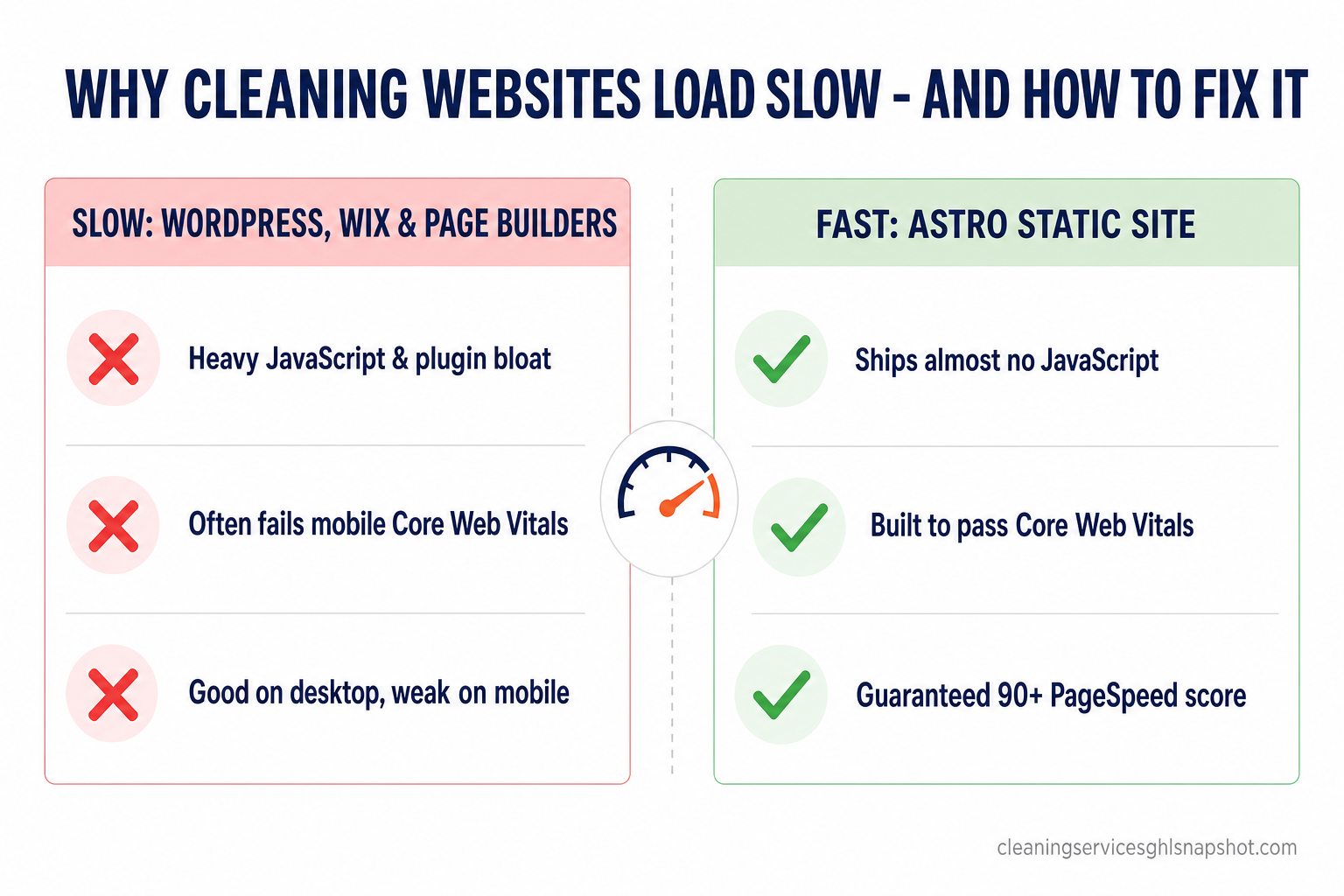
Here’s how the common approaches stack up for a cleaning business that lives or dies on mobile:
How cleaning-website platforms compare on speed
| Plan | WordPress + builder | Wix / GHL builder | Astro static site recommended |
|---|---|---|---|
| Price | Slow on mobile | Middling | 90+ PageSpeed |
| Feature 1 | Plugin & builder JS bloat | Heavy generic runtime shipped | Ships almost no JavaScript |
| Feature 2 | Often fails mobile Core Web Vitals | Good desktop, weak mobile field data | Built to pass Core Web Vitals |
| Feature 3 | Speed decays as plugins pile up | Limited control over what loads | Served from the edge, instantly |
| Feature 4 | Needs caching plugins to patch it | Third-party embeds add weight | Guaranteed 90+ (often 100) score |
| See our builds |
We go deeper on this trade-off in Astro vs. WordPress for cleaning websites, but the short version is simple: if your platform ships a lot of JavaScript, your mobile visitors wait, and waiting visitors leave.
Core Web Vitals, Google rankings, and local search
Speed isn’t only about the visitors who already found you — it also shapes how many find you at all. Google uses page experience, including Core Web Vitals, as a ranking signal, and it indexes the web mobile-first, meaning the mobile version of your site is the version that gets ranked. A cleaning site that’s slow on mobile is fighting two headwinds at once: fewer people see it in search, and more of the ones who do click will bounce before it loads.
For a local business, that compounds with everything else you’re doing to get found. When you invest in local SEO for your cleaning company or work to win more Google reviews, you’re spending to earn the click. A slow site quietly taxes every one of those clicks on the way in. And with AI answer engines increasingly summarizing “best cleaners near me” queries, a fast, well-structured, schema-rich site is also easier for those systems to read and cite — the same durability we cover in getting found in AI search.
How to make a cleaning website genuinely fast
Whether you fix your current site or start fresh, the levers are the same:
- Ship less JavaScript. This is the biggest one. The less code the phone has to download and execute, the faster your content appears. Static-first frameworks like Astro send almost none by default.
- Serve from the edge. Static pages delivered from a global CDN (like Cloudflare) reach an Atlanta phone in milliseconds instead of waiting on a distant origin server.
- Right-size images. Before/after photos are your best sales tool and your heaviest asset. Serve modern formats (WebP/AVIF), lazy-load below-the-fold images, and set explicit dimensions so nothing shifts (protecting your CLS).
- Reserve space for everything. Chat widgets, embedded reviews, and quote calculators should load without shoving content around — otherwise your CLS tanks and homeowners mis-tap.
- Measure the mobile field data. Track real-user Core Web Vitals, not a one-off lab score. The 75th-percentile mobile number is your true grade.
This is exactly the build we ship for cleaning companies. Our Get-a-Website service puts your site on the Astro framework with a guaranteed 90+ Google PageSpeed score (often a perfect 100) on mobile and desktop, up to 60 pages including location pages for your Atlanta service areas, an instant-quote calculator, an AI chat widget, review-collection automation, and managed Cloudflare hosting — $497 one-time plus $97/month, live in about 10 working days. It’s the fast foundation everything else in this article depends on.
The Atlanta math: turning speed into booked cleans
Put real numbers on it. Say your Atlanta cleaning site gets 1,500 mobile visits a month from ads, Google Business Profile, and organic search — a modest volume for a growing operator. Your site currently loads in about 5 seconds on mobile, which, per Google’s benchmark, means visitors are roughly 90% more likely to bounce than they’d be at one second.
Suppose that slow load costs you even a 1-percentage-point drop in the share of visitors who reach your quote form — a conservative read of the Portent and Deloitte data. On 1,500 visits, that’s 15 lost quote-starts a month. If one in three quote-starts books, and a booked cleaning becomes a recurring bi-weekly customer worth, say, $150 a clean × 26 cleans a year = $3,900 in first-year revenue — those 15 lost quote-starts represent roughly 5 recurring customers and ~$19,500 in annual revenue walking to a faster competitor. Every year. Because the page made them wait a few seconds.
You’re already paying to bring those visitors in. The website’s only job is to not lose them at the door. A fast site is the cheapest, highest-leverage fix in your whole funnel — and once it’s fast, everything downstream (online booking, the CRM, review automation) has more visitors to work with.
Frequently asked questions
What is a good website speed for a cleaning business in Atlanta?
Aim to pass Google's Core Web Vitals on mobile: Largest Contentful Paint under 2.5 seconds, Interaction to Next Paint under 200 milliseconds, and Cumulative Layout Shift under 0.1, measured at the 75th percentile of real visitors (web.dev). In practice, target a Google PageSpeed mobile score of 90+ and a load time under two to three seconds on a phone. That matters because 53% of mobile visits are abandoned when a page takes longer than three seconds to load (Google).
Does website speed really affect how many cleaning jobs I book?
Yes, directly. As mobile load time grows from 1 to 5 seconds, the probability a visitor bounces rises 90% (Think with Google), and conversion rates are highest between a 1- and 2-second load, falling about 4.4% for every added second (Portent). Your quote form is a conversion event, so a slow site means fewer quote-starts and fewer booked cleans from the same traffic.
Why is my current cleaning website slow on mobile but fine on desktop?
Because desktop usually runs on fast Wi-Fi and a powerful machine, while your buyers are on phones and cellular. WordPress plugins, Wix/Squarespace builders, and page-builder tools ship heavy JavaScript that a phone has to download and execute before the page is usable. Google ranks the mobile version of your site and measures real-user data, so the mobile field score is the one that counts — and in 2025 only 48% of mobile pages passed all three Core Web Vitals (HTTP Archive Web Almanac).
Can I just install a caching plugin to fix it?
Caching and image compression help at the margins, but they're patches on a heavy foundation. If the underlying site ships a megabyte of JavaScript from plugins and builders, no plugin fully undoes that. The reliable fix is a lighter foundation — a static-first framework like Astro that ships almost no JavaScript and serves from the edge, which is how we guarantee a 90+ mobile PageSpeed score.
How does website speed affect my Google ranking in Atlanta?
Google uses page experience, including Core Web Vitals, as a ranking signal and indexes the web mobile-first, so a slow mobile site can rank lower and also loses more of the visitors it does earn. That compounds your other local-search work — a slow site taxes every click you paid to earn through local SEO and reviews. Speed helps you get found and helps you keep the people who find you.
How fast can I get a fast cleaning website for my Atlanta business?
Our Get-a-Website service builds cleaning sites on the Astro framework with a guaranteed 90+ PageSpeed score, up to 60 pages including Atlanta location pages, an instant-quote calculator, an AI chat widget, and managed hosting for $497 one-time plus $97/month — typically live within about 10 working days of the onboarding call. Book a free speed walkthrough and we'll audit your current mobile score first.
Darnell Pierce runs a small GoHighLevel agency serving home-service operators, with cleaning companies making up most of his book. He writes about the parts of the business that quietly leak money — slow lead response, half-built funnels, and, yes, websites that take five seconds to load on a phone. Statistics cited here come from the linked third-party sources; Atlanta market figures are from the Atlanta Regional Commission, U.S. Census, and Data USA.
Related reading: Astro vs. WordPress for cleaning websites · Local SEO for cleaning businesses · Online booking for cleaning companies · Getting found in AI search · The AI chat widget that books after hours