
Short version: ZenMaid is excellent maid-service scheduling software, and most owners outgrow it for the same three reasons. The per-user fees stack as you hire, the texting your business runs on is billed on top of the plan, and the tool was built to organize a booked job, not to win new ones or chase lapsed ones. When those walls cost more than the software saves, the four alternatives worth a real look in 2026 are Jobber, Housecall Pro, BookingKoala and GoHighLevel. Jobber and Housecall Pro are heavier field-service platforms; BookingKoala is booking-first for online sales; GoHighLevel replaces the scheduler and the follow-up engine at once. Below is the current pricing on each, who it fits, how it breaks, and a switching plan that does not torch your calendar.
I run a small GoHighLevel agency, and cleaning companies are most of my book. The call I get most starts the same way: “ZenMaid has been fine, but we are at five crews now and something is off.” The software did not get worse. The business got bigger, and the parts ZenMaid was never built to do, the lead-chasing and recurring attach and review flywheel, became the parts that keep the schedule full. This is the honest map I wish those owners had before they went shopping.
Sources: employment and wage, BLS OEWS, May 2025 (median $17.07/hr, about $35,500/yr at full time); business count and market size, IBISWorld.
Key Takeaways
- You have not outgrown ZenMaid’s scheduling. You have outgrown its ceiling. The usual triggers are per-user fees that climb as you hire, texting billed on top of the plan, and no real lead-capture or follow-up engine.
- Jobber and Housecall Pro are the like-for-like upgrades: fuller field-service platforms with invoicing, dispatch and payments. They also charge per user, so the bill climbs with the crew.
- BookingKoala is the pick if most of your jobs are sold online and you want a booking-first storefront, starting at $27/mo.
- GoHighLevel is the different animal: it replaces the scheduler and the marketing follow-up in one flat seat-free price, but you run the usage-based texting and you (or a partner) set it up.
- The switch is a weekend, not a quarter, if you export your client list, rebuild recurring jobs, and send one honest “we moved” text before you flip the booking link.
Table of contents
- How do you know you have actually outgrown ZenMaid?
- What does ZenMaid really cost once you scale?
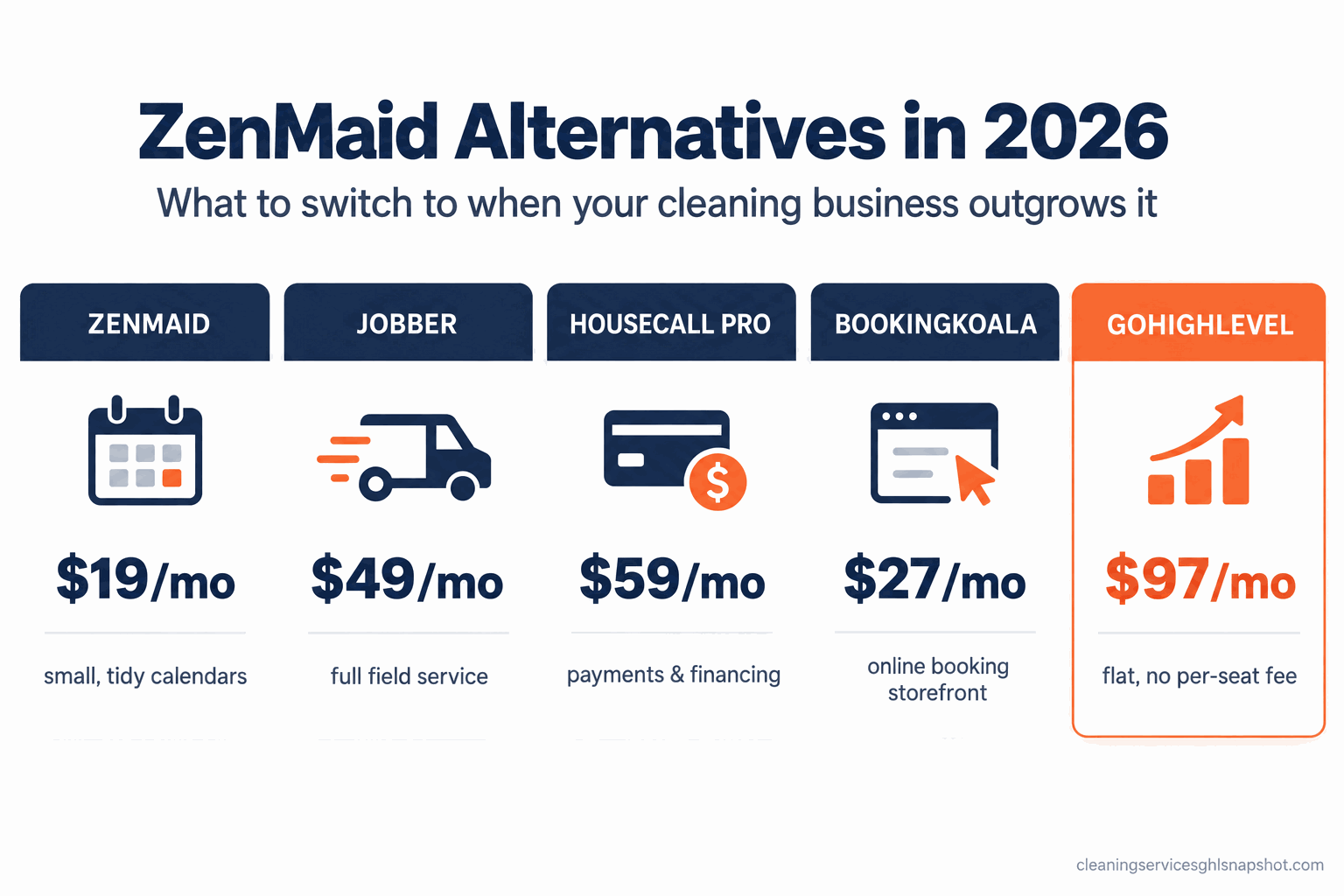
- The four alternatives at a glance
- Jobber: the full field-service upgrade
- Housecall Pro: strong payments, per-user bill
- BookingKoala: booking-first for online sellers
- GoHighLevel: the scheduler and the growth engine in one
- Which one fits your size?
- The texting rule nobody mentions when you switch
- Steal this: the no-drama migration plan
- Common objections to switching
- Frequently asked questions
How do you know you have actually outgrown ZenMaid?
ZenMaid is purpose-built maid-service software, and for a solo operator or two-crew shop it is hard to beat. The problem is not quality. It is scope, and it shows up as four specific walls.
The first wall is price per head. ZenMaid’s plans start at $19/mo for Starter and run to $39 and $49 for Pro and Pro Max, and each adds a per-user fee on top of the first seat. Fine at three people; at ten it is a line item you notice.
The second wall is texting. Reminders, on-my-way messages, and review asks all ride on SMS, and SMS is billed separately from the plan. The more your automation works, the more that meter runs, and it is not in the sticker price.
The third wall is the sales side. ZenMaid assumes the job is already booked. It is not built to capture a lead the instant it arrives, text a quote before a competitor calls back, or win back a client who ghosted. For a shop whose bottleneck has shifted from “manage the calendar” to “fill the calendar,” that gap is the whole game. If that is you, start with why cleaning clients ghost after one visit and the missed-call text-back setup.
The fourth wall is commercial work. If you bid janitorial contracts with night crews, you need proposals, contract records, and site-level reporting a maid scheduler was never designed for.
What does ZenMaid really cost once you scale?
Here is what the table hides. Your bill is the first seat, plus every added cleaner, plus the texting your workflows send. For a five-crew shop at roughly 10 users, per-user stacking turns a $39 plan into closer to $100 to $150 a month before SMS, and texting can add $50 to $150 more. That is not a knock on ZenMaid; it is how seat-plus-usage pricing works, and it is the math that makes a flat, seat-free platform look different as you grow.
Illustrative monthly software cost as a residential shop grows, before SMS usage. Seat-based tools climb with every added cleaner; a flat platform price does not. Modeled from published rates on the ZenMaid and GoHighLevel pricing pages; your number depends on headcount and texting volume.
So the question is never “what is cheaper this month,” but “what does this cost at the size I am trying to reach.”
The four alternatives at a glance
Four tools come up in almost every one of these conversations.
| Tool | Starts at | Billed per user? | Built for | Best when you want to |
|---|---|---|---|---|
| ZenMaid (today) | $19/mo | Yes | Residential maid scheduling | Keep a tidy calendar at small scale |
| Jobber | $29/mo annual ($49 month-to-month) | Yes | General field service | Add invoicing, dispatch and payments |
| Housecall Pro | $59/mo annual | Yes | Field service with strong payments | Run cards, financing and a pro app |
| BookingKoala | $27/mo | By provider count | Online booking storefronts | Sell most jobs through a website |
| GoHighLevel | $97/mo | No (flat) | CRM plus marketing automation | Replace the scheduler and the follow-up engine |
Prices are published starting tiers; confirm the live figure before you buy. Now the detail that decides it.
Jobber: the full field-service upgrade
Jobber is the natural step up if you want a heavier operations platform and you are fine paying per seat. Its 2026 plans are Core, Connect, Grow and Plus: $49, $199, $399 and $699 a month (month-to-month), or $29, $149, $299 and $529 on annual prepay, including 1, 5, 10 and 15 users respectively. Extra seats are $29 each a month.
You get quoting, scheduling, invoicing, a solid crew app, and card processing at 2.9% plus $0.30 per transaction. The marketing muscle is an add-on, though: Jobber’s Marketing Suite runs about $99 a month on top, plus an AI receptionist add-on, so the lead-chasing you might be shopping for is a separate line, not the base.
How Jobber breaks for cleaners. The bill climbs with the crew because it is still per user, and the growth features are paid add-ons, so a shop that needs both operations and aggressive follow-up can end up on Grow plus Marketing Suite past $400 a month fast. Jobber is worth it when operations are the main need and marketing is secondary. I compared the two heavyweights directly in Jobber vs Housecall Pro for cleaning businesses.
Housecall Pro: strong payments, per-user bill
Housecall Pro is the other big field-service name, and its edge is money movement: card processing, consumer financing, and instant payouts that residential operators like. Its 2026 annual tiers are Basic at $59/mo (one user), Essentials at $149/mo (up to five), and MAX at $299/mo (up to eight). Month-to-month runs roughly 20 to 25 percent higher, and extra users are about $35 a month each.
If clients pay by card at the door and you want financing on bigger jobs, it is a strong fit.
How Housecall Pro breaks for cleaners. It is still seat-priced, so the $35-per-user creep is the same scaling tax in a different shirt, and like Jobber its strength is field-service operations, not lead generation. It will not, on its own, text a web lead a quote in ninety seconds or run a win-back. For the head-to-head against the all-in-one approach, see GoHighLevel vs Housecall Pro for cleaning businesses.
BookingKoala: booking-first for online sellers
BookingKoala comes at the problem from the storefront. Customers book, reschedule, and pay through a branded website, and it is priced by how many providers you run rather than per admin seat. Published tiers are Starter at $27/mo for five providers, Growing at $57/mo for fifteen, and Premium at $197/mo for fifty, with a free trial and no card to start. If a large share of your jobs are sold online and you want customer logins and provider assignment, it does that well, and provider-based pricing can be kinder to a big team than per-seat models.
How BookingKoala breaks for cleaners. SMS notifications and some integrations are extra and are not itemized plainly, so the real cost needs a direct quote. And it is fundamentally a booking-and-operations tool: the CRM depth and marketing automation, the pipelines and multi-step win-back sequences, are thinner than a platform built for that. It is a better front door than a growth engine.
GoHighLevel: the scheduler and the growth engine in one
GoHighLevel is not trying to be a better ZenMaid. It is a CRM and marketing-automation platform that also schedules, so it covers the operations ZenMaid did and the lead-capture, follow-up, and reputation work ZenMaid never did. Its pricing is Starter at $97/mo, Unlimited at $297/mo, and Pro at $497/mo, and the first two are what a cleaning company uses. (Disclosure: that is our GoHighLevel partner link; we may earn a commission if you sign up through it, at no change to your price.)
The piece that matters for the scaling math: GoHighLevel does not charge per user. One flat price covers the whole team. SMS, email, and calls are usage-based and rebilled at cost on top, which for normal cleaning volume is modest and scales with activity, not headcount. So the tool gets cheaper per person as you hire, the opposite of the seat-based trap.
How GoHighLevel breaks for cleaners. It is powerful, so it is not a five-minute self-setup. A raw account is an empty platform; the value is in the pipelines, workflows, and message copy you build on top, and that is a project. So most cleaning operators either hire a GoHighLevel VA or specialist or start from a pre-built configuration. For the straight ZenMaid feature comparison, see GoHighLevel vs ZenMaid for cleaning businesses.
Which one fits your size?
The right answer changes with your scale. The same question gives three shops three picks.
The solo operator with one or two helpers
If your calendar is tidy and you mostly fear missing inquiries, you may not need to leave ZenMaid, or a jump to Jobber Core or Housecall Pro Basic is plenty. The per-user fee is small here and simplicity beats the ceiling. Spend your energy on the free wins: answer every call, text back every missed one, ask for a review after every clean.
The mid-size residential shop at five crews
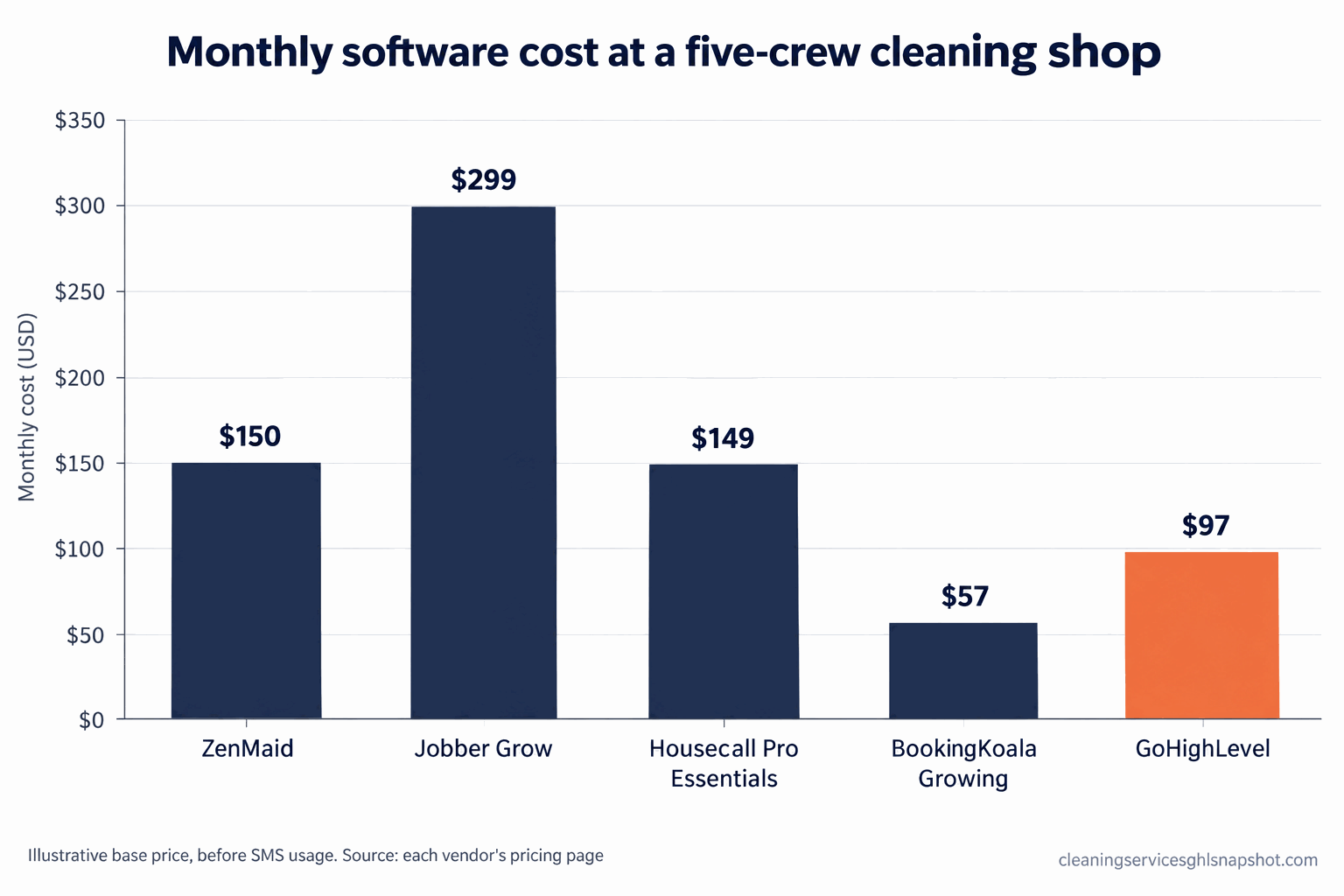
This is where the seat math turns. Ten users on a per-seat tool plus SMS starts to rival, or beat, a flat platform price, and the bottleneck has moved from scheduling to filling and keeping. This is the classic GoHighLevel crossover: you stop paying more to grow and get the recurring-attach and win-back engine in the same bill. Prefer pure field service? Jobber Grow or Housecall Pro Essentials are the like-for-like picks. Full breakdown: what cleaning software really costs in 2026.
The large janitorial contractor at 20-plus crew
Commercial changes the requirements: proposals, contract records, site-level reporting, and often proof of how you communicate. GoHighLevel’s flat price and CRM depth scale well here and Housecall Pro’s tooling is capable, while BookingKoala’s consumer-booking model fits least. The win at this scale is standardization: one pipeline and one set of templates instead of five people improvising in texts.
The texting rule nobody mentions when you switch
Here is the trap that bites operators who switch tools and finally turn on all the automated texting. In the US, business texting runs on a registration system called A2P 10DLC, and you must register your brand and campaign before high-volume automated SMS flows reliably. Skip it and your reminders and quotes get filtered or blocked, which is worse than not sending them. The registration is on you, not the tool, so build it into setup week and make sure every automated text honors consent and includes an opt-out. Full playbook in the TCPA and texting compliance guide; the FCC’s rules on unwanted texts are the authoritative reference.
Steal this: the no-drama migration plan
The fear that keeps people on a tool they have outgrown is the switch itself, and it is smaller than you think. Here is the sequence I run for cleaning clients, with copy you can lift.
1. Export everything from ZenMaid first. Pull your full client list (names, addresses, phone, email, recurring frequency) plus upcoming scheduled jobs before you cancel anything. Pro Max includes data export; on lower tiers, ask support.
2. Rebuild recurring jobs, not just contacts. Contacts import easily. The money is in the recurring schedule, so rebuild every weekly and biweekly job and check the next-visit dates against your old calendar.
3. Run both tools for one cycle. Keep ZenMaid live two to four weeks while the new system runs in parallel, so a mistake never leaves a client unscheduled.
4. Send one honest “we moved” text. Do not surprise people. Short, plain, and it doubles as a consent refresh:
“Hi [First name], it’s [Company]. We upgraded our scheduling and booking system to serve you better. Your next clean on [date] is all set, nothing changes on your end. You can reply STOP anytime to opt out of texts. Questions? Just reply here.”
5. Turn the new engine on, one flow at a time. Start with the two that pay immediately: a missed-call text-back and a review request after each clean. Review copy that works:
“Hi [First name], thanks for having [Company] out today. If the place looks great, would you leave us a quick review? It helps a ton: [review link]. If anything was off, reply here first and we’ll make it right.”
6. Cancel ZenMaid only when the parallel cycle is clean. Once a full recurring cycle has run in the new tool with no gaps, cancel.
That is the whole migration: a weekend of setup, a short overlap, two text templates. The platform-specific step-by-step is in how to migrate a cleaning business to GoHighLevel.
Common objections to switching
“I don’t want to relearn software and retrain my crew.” Fair, and it is the real cost of switching, bigger than the subscription. Shrink it by changing one thing at a time: keep the crew’s job list identical at first and only move the back-office pieces. Crews care about one thing, is my schedule on my phone and is it right. As long as that holds, the platform underneath is invisible.
“What if I already paid ZenMaid for the year?” Run the parallel cycle and time your switch to the renewal. The rushed migration is the only expensive one.
“Do I need to be technical to run GoHighLevel?” No, but someone has to do the build. You either learn it, hire a VA or specialist, or start from a pre-built setup so the pipelines already exist. It is not harder to use day to day than ZenMaid; it is harder to stand up from zero, a one-time cost.
Frequently asked questions
What is the best ZenMaid alternative in 2026?
There is no single best one; it depends on your bottleneck. If you want a fuller field-service platform, Jobber and Housecall Pro are the closest upgrades. If you sell most jobs online, BookingKoala fits. If your real problem is filling the schedule and keeping clients, GoHighLevel replaces the scheduler and adds the lead-capture and follow-up engine ZenMaid lacks.
Is ZenMaid being discontinued or getting worse?
No. ZenMaid remains solid maid-service scheduling software. Owners move not because it degraded but because they grew past what a scheduler is built to do: capturing leads, converting one-off cleans to recurring, and running review and win-back automation.
How much does ZenMaid really cost at five crews?
More than the sticker. Plans start at $19 to $49 a month, but each added cleaner carries a per-user fee and SMS is billed on top. A roughly 10-user residential shop commonly lands near $100 to $150 a month before texting. Full breakdown in our cleaning software cost guide.
Can I move my client list and recurring jobs out of ZenMaid?
Yes. Export clients and scheduled jobs before you cancel (data export is included on Pro Max; ask support on lower tiers). Rebuild recurring jobs, verify the next-visit dates, and run both systems in parallel for one full cycle first.
Do I have to register for A2P 10DLC when I switch texting tools?
Yes. US automated business texting requires A2P 10DLC brand and campaign registration regardless of which platform sends it. Register during setup week and keep opt-out and consent intact. Details in our TCPA and texting guide.
Should a solo cleaner leave ZenMaid at all?
Usually not yet. At one or two crews the per-user fees are small and simplicity wins. The crossover is typically around five crews, when seat-based costs rise and the bottleneck shifts from managing the calendar to filling it.
Related reading: GoHighLevel vs ZenMaid, head to head · What cleaning software really costs in 2026 · Jobber vs Housecall Pro · How to migrate to GoHighLevel