
It is the second week of January and your phone has gone quiet. In April you were turning work away and apologizing for a three-week wait. Now you are staring at a Tuesday with two crews and four jobs, doing the math on payroll, and wondering if you overhired in the spring. Same business, same crews, same city. The only thing that changed is the month.
Here is what most owners miss: that quiet January was not bad luck. Your schedule has a shape, and it is roughly the same every year. Residential cleaning spikes in spring, rides a move-out wave through summer, gets a short pre-holiday run in the fall, and dips hard after New Year. Know the shape and you can staff for it, market ahead of it, and bank recurring revenue before the slow stretch instead of panicking inside it. This is the month-by-month version: what happens in each window, what to do, the campaigns you can steal, and how the year differs for a solo operator, a mid-size team, or a janitorial shop.
Key Takeaways
- The slow season is predictable, not random. Demand follows a yearly curve: a spring deep-clean surge (80% of US adults plan one, per the American Cleaning Institute), a summer move-out wave (60 to 70% of US moves hit the warm months), a short fall run, and a January-to-February dip.
- You beat the dip in the season before it. Survive January by converting spring and summer one-offs into recurring plans from March to August, not by discounting in December.
- Keeping a customer is far cheaper than finding one. Winning a new client costs five to 25 times more than keeping one, which is why the recurring book you build in the busy season carries you through the slow one.
- Staff and market to the curve. Hire for the surge without over-committing payroll, and fire each seasonal campaign four to six weeks before its window opens.
Table of contents
- Why your cleaning calendar has a shape
- The cleaning demand year at a glance
- Spring (March to May): the deep-clean surge
- Summer (June to August): the move-out wave
- Fall (September to November): the pre-holiday run
- Winter (December to February): the slow season everyone fears
- The seasonal campaigns you can steal
- The same year at three sizes
- Hiring for the surge without the 1099 trap
- The objections I hear from owners
- Frequently asked questions
- The bottom line
Why your cleaning calendar has a shape
Demand for home cleaning is tied to the calendar. People deep-clean in spring because the weather turns and the light shows the grime. The American Cleaning Institute’s 2025 survey found 80% of US adults plan an annual deep clean. People move in summer: Movers.com estimates roughly 60 to 70% of US moves happen during the warm months, and every move is a move-out clean, a move-in clean, or both. The holidays bring a short pre-Thanksgiving run of “company is coming” cleans. Then January goes quiet, because nobody is hosting, nobody is moving, and the spring deep-clean crowd is coasting.
None of that is a secret, but most owners run the business as if every month should look like April. The median cleaner earns $17.07 an hour per the Bureau of Labor Statistics, and you pay that wage in January whether the house is booked or not. The fix is to treat the year as four windows with four jobs, and to do each window’s work in the window before it.
The cleaning demand year at a glance
Think of your year as four windows, each with one dominant job:
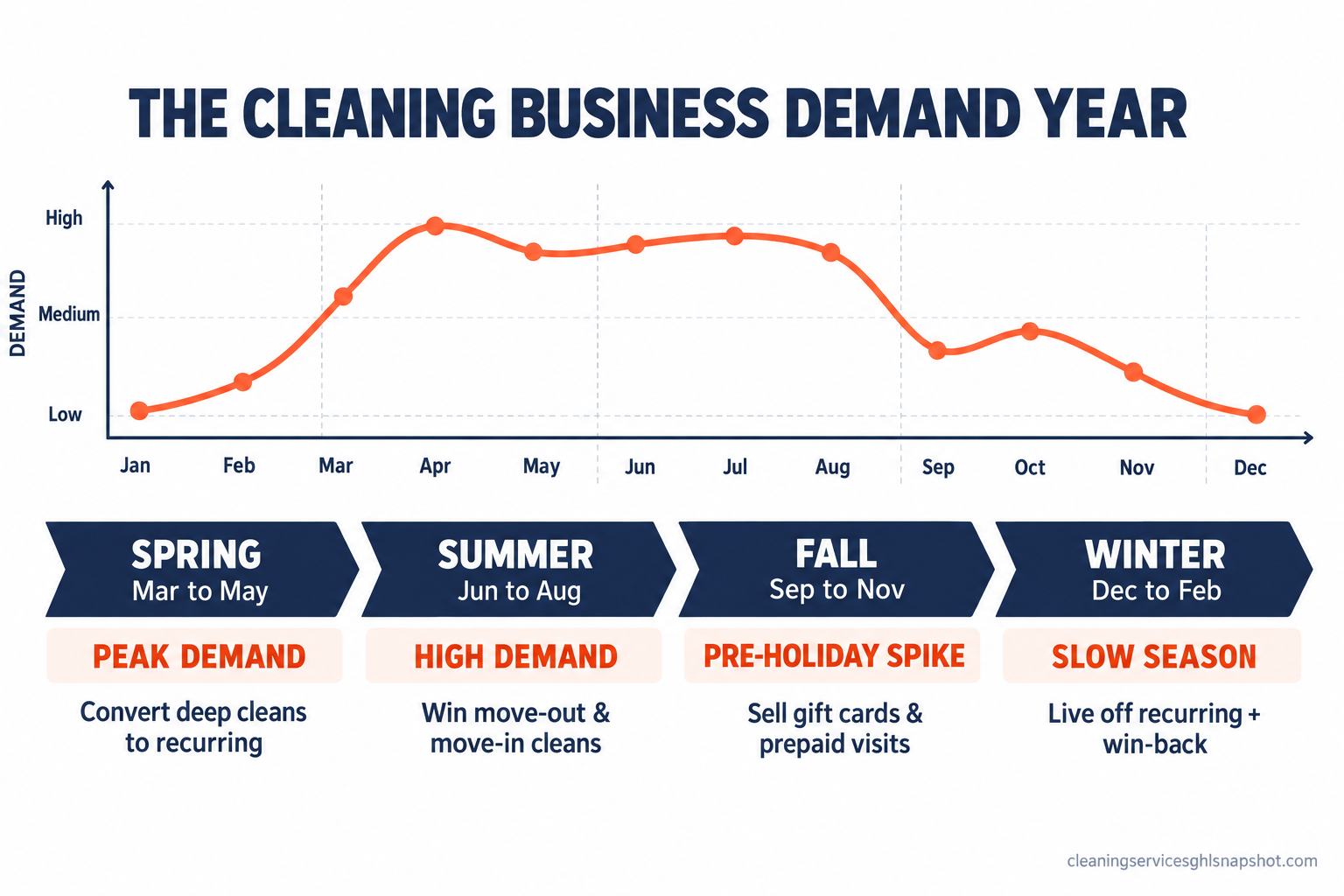
- Spring (Mar to May): peak demand. Convert deep cleans into recurring plans.
- Summer (Jun to Aug): high demand. Win move-out, move-in, and short-term rental work.
- Fall (Sep to Nov): pre-holiday spike. Book the Thanksgiving rush early, sell gift cards and prepaid visits.
- Winter (Dec to Feb): low demand. Live off the recurring book, run win-back, lean into commercial work.
The most useful thing to understand is how concentrated moving work is, because it tells you when to staff up for one-time jobs and when that demand evaporates.
Approximate share of US moves that fall in the summer peak. Chart uses the midpoint of the reported 60 to 70% range. Source: Movers.com, 2026.
Spring (March to May): the deep-clean surge
This is your busiest, most profitable window, and it is where most of your yearly recurring customers get born. With 80% of households planning a deep clean, your phone rings on its own. The mistake is treating all that work as one-time money.
What to do. Start marketing in late February, not mid-March. Spring buyers search early and book the first company that answers. Put your “spring deep clean” offer live, quote every inbound lead fast, and set your intake to ask one question on every booking: “Want us back every two weeks at a lower per-visit rate?” That single question is how a $350 one-time deep clean becomes a $200-every-other-week customer who is still on your books next January.
Where spring breaks. Two failures cost you the most here. The first is booking spring as one-offs: a pile of disconnected deep cleans gives you a great April and a dead January, so every one should leave with a recurring offer attached and a follow-up scheduled (the rebooking sequence is here). The second is slow quotes. Spring shoppers contact three companies and hire whoever quotes first, not whoever is cheapest, so if you quote by phone tag over two days you hand the job to the competitor who texted a price in ten minutes. A fast quote-and-follow-up system is worth more in spring than any other month.
Summer (June to August): the move-out wave
Spring is about deep cleans. Summer is about moves. With most US moves landing in the warm months, your lead mix shifts to move-out cleans, move-in cleans, and short-term rental turnovers.
What to do. Build a dedicated “move-out clean” offer that is easy to book under time pressure, because movers book last-minute. Partner with two or three local real estate agents and property managers: an agent who trusts your move-out clean is a referral engine that costs you nothing and runs all summer. If you do Airbnb and vacation-rental work, summer is your volume stretch, and surviving the back-to-back turn schedule takes a tight checklist-and-dispatch system, which we laid out in the Airbnb turnover playbook.
Where summer breaks. Two things. First, do not treat a move-out like a recurring customer: the house is sold and they are gone, so the recurring gold is the move-in client who just bought a house, has money, and is open to “let us keep it this clean every two weeks.” Ask them for the plan, not the move-out customer who no longer lives there. Second, expect the vacation hole: your recurring clients travel in July and August, so a wave of “skip this visit, we are away” pauses hits right when move work is spiky. Use a pause-and-resume flow so a skipped visit does not quietly become a cancellation, and backfill the open slots with move work.
Fall (September to November): the pre-holiday run
Fall starts slow, then spikes hard in the two weeks before Thanksgiving, when “the family is coming” becomes a one-time-clean emergency. Early fall is also the best time to shore up recurring, because the kids are back in school and routines reset.
What to do. Run two plays. First, a “host-ready” deep-clean push timed to land four weeks before Thanksgiving, booked tight so you can fit the last-minute requests. Second, sell gift cards and prepaid recurring plans in November, because a cleaning gift card is both a December gift and a January booking you have already been paid for. Prepaid winter visits are the cleanest way there is to drag revenue from your busy season into your slow one.
Where fall breaks. Two failures. First, no holiday cutoff: keep saying yes to one-time cleans right up to Thanksgiving week and you blow up your recurring clients’ regular visits and burn out your crew in the worst stretch, so set a cutoff and protect the recurring book first. Second, ignoring the quiet first half: September and October feel soft and owners get twitchy, but this is the window for the unglamorous work, including a referral program seeded in October that pays out in the spring surge, when a warm referral is worth triple a cold lead.
Winter (December to February): the slow season everyone fears
December is split: the first three weeks carry the tail of the holiday rush, then it falls off a cliff. January and February are the real slow season. Nobody is hosting, nobody is moving, and the deep-clean crowd is coasting. This is where undisciplined operators discount to fill the calendar and train their market to wait for a sale.
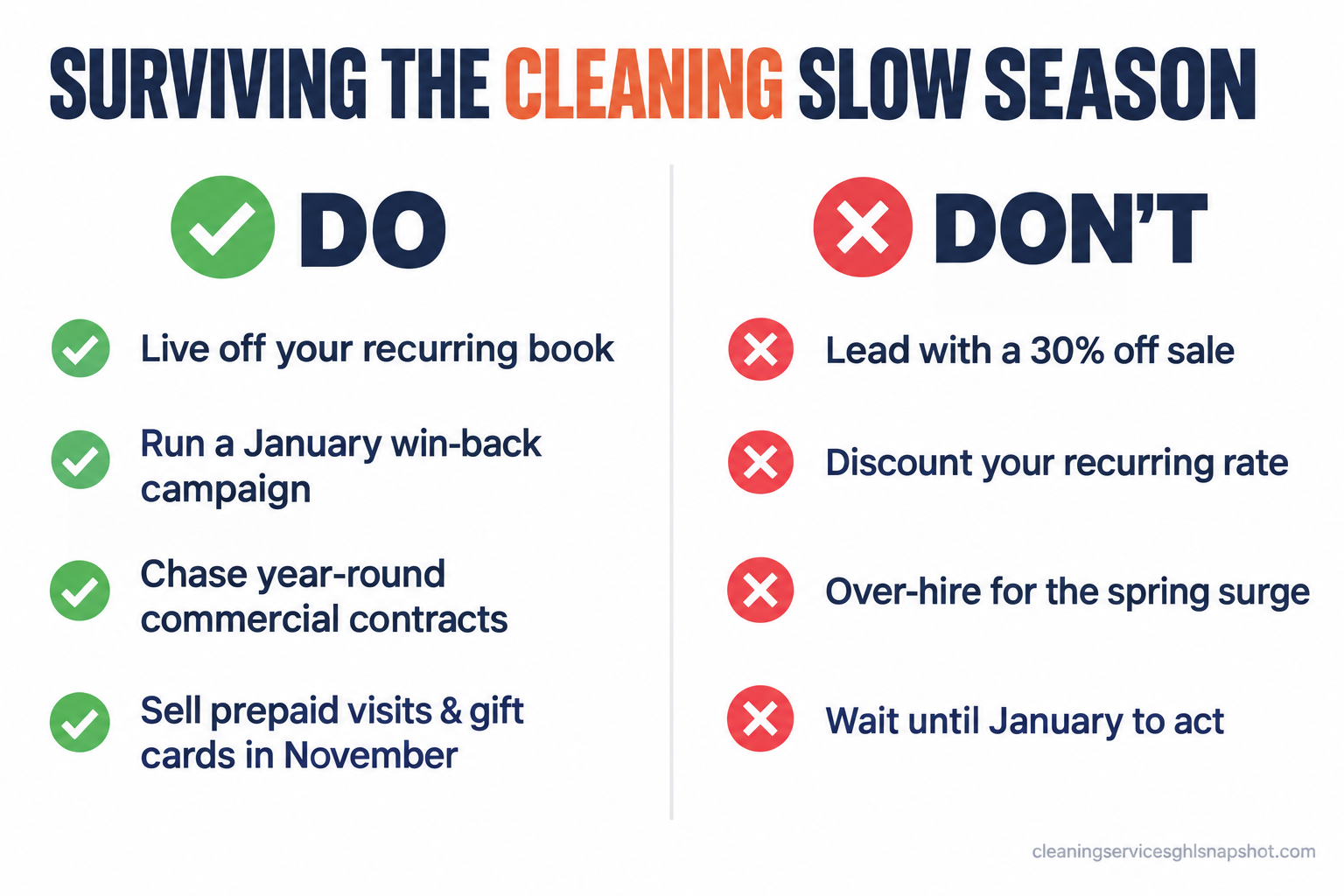
Do not lead with discounts. The winter dip is a demand problem, and cutting price does not create demand that is not there. It just lowers your margin on work you would have won anyway. The operators who survive winter comfortably do it with three things built before December: a recurring book, a win-back engine, and commercial work.
Live off the recurring book. This is the whole reason spring and summer matter. If 30 to 40% of your revenue is recurring every-two-week plans, January is slower but not scary, because that money shows up no matter the season. You build the book in the surge and stand behind it in the dip. Keeping those customers is also the cheapest growth you have: winning a new client costs five to 25 times more than keeping an existing one, which is why one retained recurring plan beats three winter discount leads.
Relative cost of acquiring a new customer versus retaining one. Chart uses the low end of the reported 5 to 25x range. Source: Harvard Business Review, 2014.
Run win-back in January. Your list from the last two years is full of people who did one deep clean and drifted. January is when you text them, because they just looked at a messy post-holiday house. A good win-back campaign reactivates lapsed customers for the cost of a few texts, and January is its best month. The same discipline keeps first-timers from vanishing at all, which we covered in why cleaning clients ghost after one visit.
Lean into commercial and janitorial. Offices, medical suites, gyms, and retail do not care that it is January. Commercial contracts run on a fixed nightly or weekly schedule all year, so they are counter-seasonal to residential. A few steady commercial accounts flatten the winter curve, and winter is the right time to chase them, because you finally have the crew hours to service them.
The seasonal campaigns you can steal
Here is the copy. Swap in your name and numbers, and schedule each one four to six weeks before its window opens. Keep every SMS compliant: you need prior consent to text, and every message needs a clear opt-out. If 10DLC and consent language are new to you, read our TCPA guide for cleaners before you send.
Late-February spring deep-clean launch (SMS to your list):
Hi [First Name], it’s [Company]. Spring deep-clean season is booking up fast and our best slots go first. Want us to get [City]’s cleaning crew into your home before the rush? Reply SPRING for a 2-min quote. Reply STOP to opt out.
Spring recurring-attach (said at the end of every first deep clean, then texted next day):
Thanks for having us today, [First Name]. Homes stay easiest when we come back every 2 weeks, and recurring clients pay [$X] less per visit than a one-time clean. Want me to hold your [day/time] spot every other [weekday]? Reply YES and you’re set.
Summer move-out push (to local agents and past clients):
Hi [First Name], moving season is here. We do move-out and move-in deep cleans that pass final walkthroughs, and we can usually fit a job within 48 hours. Know anyone closing this summer? Send them our way: [link].
Fall gift-card and prepaid plug (November, to recurring and past clients):
[First Name], a [Company] gift card is the one holiday gift nobody returns. Buy now and we’ll handle the mess all season. Prepay 6 recurring visits and the 6th is on us: [link].
January win-back (to clients who went quiet 60+ days):
Happy New Year, [First Name]. Post-holiday houses are rough, I know. We saved your details from last time, so rebooking takes 30 seconds. Want your first clean of the year on the calendar? Reply BOOK. Reply STOP to opt out.
January commercial prospecting (cold, to local offices and property managers):
Hi [First Name], I’m [Name] with [Company]. We handle nightly and weekly cleaning for offices in [City] and have crew availability starting [month]. Could I send a quick quote for your space? No pressure, just a number.
The same year at three sizes
The curve is the same for everyone, but what you do about it changes with your size.
Solo operator or one crew. You cannot hire for the surge, so your lever is the schedule, not headcount. Book spring tight, push every client into recurring, and set a hard capacity ceiling so you do not burn out in April and bail in May. In winter you have time, so January is when you do your own commercial prospecting and win-back. A solo operator with 20 solid every-two-week clients has a survivable January. One with 40 one-time cleans a year does not.
Mid-size, 3 to 15 crews (residential). You can flex a little for the surge, but the payroll you add in April is payroll you carry in January. Hire two seasonal cleaners for spring and summer on clear terms, and build your recurring base big enough that your core crews stay busy in winter without them. This is the size where a dead January genuinely threatens the business. Your spring recurring-attach rate is the number that decides your winter, so track it like revenue.
Large residential or janitorial (15 to 50+). If you are heavily janitorial, you barely have a slow season, because commercial contracts run year-round. Your risk is the opposite: a summer labor crunch on night crews when move and event work spikes. If you are large residential, your edge is a real counter-seasonal strategy, deliberately building a commercial book to fill the winter trough. At this size the playbook is a planning document, not a reaction to a quiet Tuesday.
Hiring for the surge without the 1099 trap
Every spring, owners staff up fast, and the fastest-looking way is to label the new people 1099 contractors. In most of the country that is a legal risk, and in some states it is close to automatic trouble. California’s ABC test presumes a worker is an employee, and cleaning companies almost always fail the “outside the usual course of business” prong, because cleaning is your usual course of business. Misclassification penalties there run into thousands of dollars per violation.
The risk is highest exactly when you are moving fastest, so a spring hiring spree done with 1099 paperwork is a spring hiring spree done wrong. If you flex headcount for the surge, flex it with properly classified part-time or seasonal W-2 employees, or a legitimate staffing partner. We walked through the full decision in 1099 vs W-2 for cleaning businesses, and it is worth reading before you hire a single spring cleaner. Getting it wrong does not show up in April. It shows up as a bill much later.
The cost side ties back to the curve too. If a cleaner is a permanent employee, you carry their wage through the slow months. Knowing your true cost per clean, including what you pay in January when the house is not booked, is what tells you how big a recurring base you need to stay profitable year-round.
The objections I hear from owners
“My area does not really have a slow season.” Some do not, almost always because the owner built a counter-seasonal book without naming it: a stack of commercial accounts, or a market like Phoenix where snowbird and move-prep demand peaks in fall and winter instead of spring. If your winter is genuinely fine, you have already done the work in this article. If you are not sure, pull last year’s revenue by month and look at the shape. The curve is usually there, hiding under the averages.
“I do not have time to run six campaigns a year.” You do not have time to run them manually, which is the whole point. You write each sequence once, set it to trigger on a date or a customer action, and it runs without you touching it during the surge. The owner firing these by hand is the one who skips them in April because the crews are short. Automating them is what makes seasonal marketing actually happen.
“Won’t customers find the seasonal texts annoying?” Not if they are timed to something the customer wants. A spring deep-clean reminder in February, a win-back text to someone staring at a post-holiday mess in January: that is a useful nudge, not spam. It gets annoying when you text people who never opted in, or send the same promo every two weeks. Get consent, keep the cadence sane, and honor every opt-out.
“I already use Jobber or Housecall Pro for scheduling.” Good, but scheduling software only schedules the work you already have. It does not fire a February spring campaign to your dormant list, ask for the recurring rebook at the right moment, or run a January win-back on its own. That marketing-and-follow-up layer is what most cleaning stacks are missing, and it is the part that fills the slow months.
Frequently asked questions
When is the slow season for a cleaning business?
For most US residential cleaners it is January and February. December is split: a busy pre-holiday stretch, then a sharp drop. The quiet runs until the spring surge picks up in March. Commercial and janitorial work is far less seasonal, since those contracts run year-round.
How do I keep my cleaning schedule full in winter?
Build the defenses before winter: convert spring and summer one-time cleans into recurring every-two-week plans, sell prepaid and gift-card visits in November, and add a few year-round commercial accounts. Then in January, run win-back to lapsed customers and prospect commercial clients. Do not lead with discounts, which do not create demand and train your best clients to wait for a sale.
When is the busiest season for house cleaning?
Spring, roughly March through May. The American Cleaning Institute's 2025 survey found 80% of US adults plan an annual deep clean, and that demand lands in those weeks. Summer is a strong second window driven by moves, since 60 to 70% of US moves happen in the warm months.
Should I discount to fill my calendar in the slow months?
Rarely, and never your recurring rate. A discount does not create new demand, it just shrinks your margin on work you would have won anyway, and running the same January sale two years running teaches customers to wait for it. If you must move slow inventory, discount a specific slow slot or a one-time add-on.
How far ahead should I start marketing for each season?
Four to six weeks before the window opens: the spring campaign in late February, the move-out push in May, gift-card plays in November, and win-back in the first week of January. Seasonal buyers hire whoever answers first, so being live before the rush matters more than the offer.
What is the single most important number to track across the year?
Your recurring-attach rate: the share of one-time cleans you convert into recurring plans. It decides whether your January is survivable or scary. A healthy residential shop converts 25 to 40% of one-time deep cleans into recurring customers.
The bottom line
Go back to that quiet January from the top. The owner sweating payroll in week two did not have a bad month. They had a predictable month they did not prepare for. The schedule has a shape: spring surges, summer moves, fall hosts, winter rests. Once you can see the curve, the slow season stops being a threat and becomes a line on a plan.
You do not fill January in January. You fill it in the spring, by asking every deep-clean customer to come back every two weeks, and in the fall, by selling prepaid visits that land after the holidays. Build the recurring book, set the seasonal campaigns to run on their own, add a little counter-seasonal commercial work, and the dip flattens into something you can plan a business around. The owners who do this are not working harder in the slow months. They did the work in the right season, and now they coast through the quiet one too.
Ready to stop reacting to the calendar and start running ahead of it? See what is built into the Cleaning Snapshot, or book a walkthrough and we will map the whole year to your market.