
To build a house cleaning website in Los Angeles that actually books jobs, you need five things working together: a page that loads in under a second on a phone, an instant quote estimator above the fold, a separate page for every LA neighborhood you serve, a Google Business Profile wired to real reviews, and content structured so Google and AI assistants can quote you. A brochure site that just lists services and a phone number won’t do it — 84% of consumers searched for a local business online in the last three months (BrightLocal, 2025), and in a market of 9.76 million people (U.S. Census Bureau, 2024) they are comparing three cleaners on their phone before they ever call. This is the step-by-step playbook, built for the LA market and its competition.
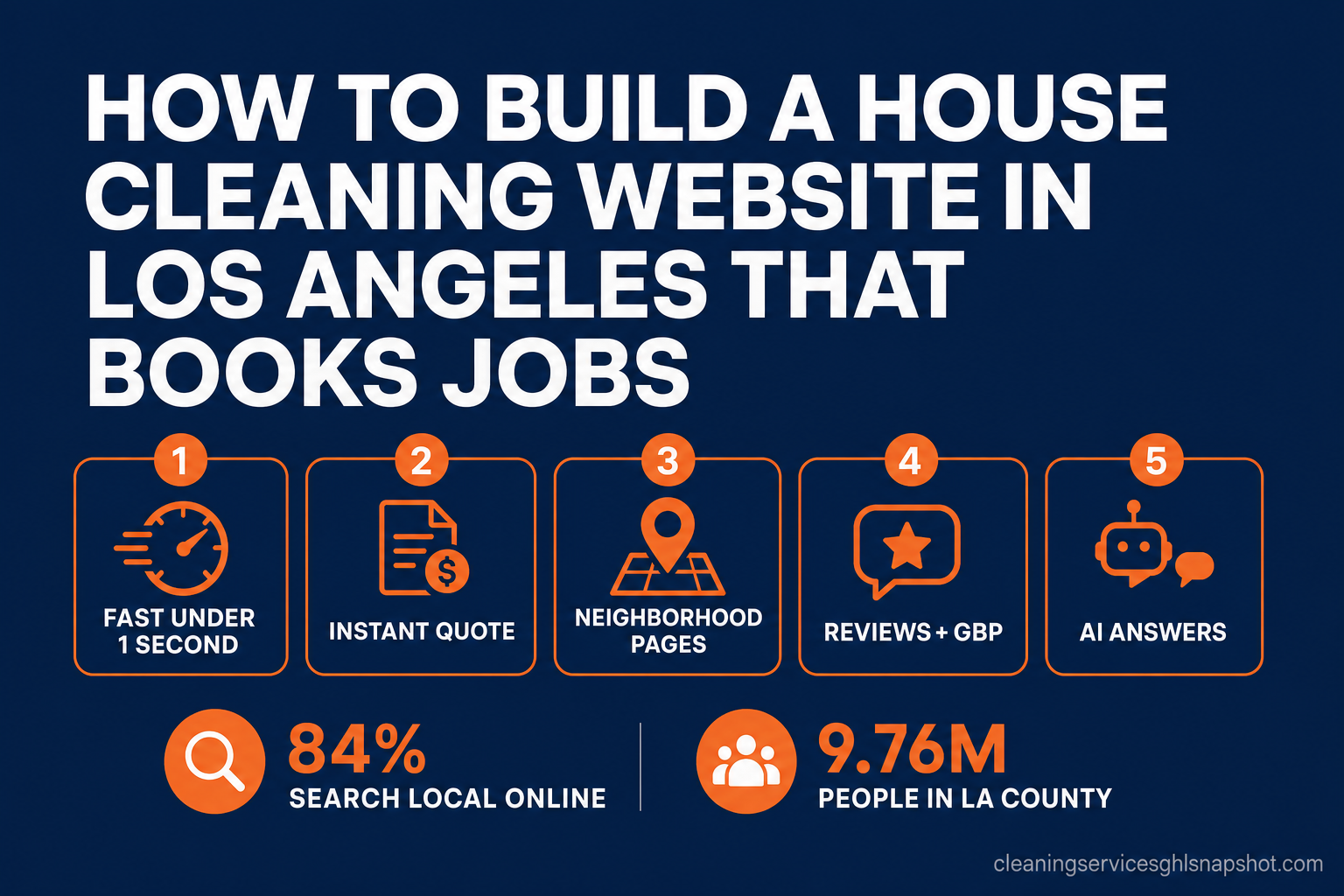
This guide is written for cleaning operators working across LA County — the Westside and Santa Monica, the San Fernando Valley, Pasadena and the San Gabriel Valley, Long Beach, and Downtown — who are paying for leads (Google Business Profile, referrals, local SEO) but losing too many at the same point: the website that homeowner lands on. Every number below is sourced; nothing is invented, and where a figure predates 2024 the year is stated in-text so you can judge it.
Key Takeaways
- Being online is table stakes; being bookable is the edge. 84% of consumers searched for a local business online in the last three months, and 80% do it at least weekly (BrightLocal, 2025). An LA cleaning site has to convert that search into a booked clean, not just display a phone number.
- Speed decides who gets the tap. Google’s benchmark found the probability a mobile visitor bounces rises 90% as load time goes from 1 to 5 seconds (Think with Google, 2017), and 53% abandon a page that takes over 3 seconds (Google, 2016). Build to Core Web Vitals: LCP under 2.5 seconds (Google Search Central, 2024).
- Neighborhood pages win the LA map pack. 42% of local searchers click inside the local 3-pack (Backlinko, 2024). A page per city you actually drive to — Santa Monica, Pasadena, Sherman Oaks — is still the biggest local lever a cleaner has.
- AI is now a real discovery channel. 45% of consumers use AI tools to find local services, up from 6% a year earlier (BrightLocal, 2026), and when an AI Overview appears only 8% of searches lead to a traditional click (Pew Research, 2025). Structure content so assistants can quote you.
- You can skip the build. We build cleaning sites on the Astro framework with a guaranteed 90+ PageSpeed, location pages included — from $97/month plus a one-time $499 build fee, charged only after you’re live.
Table of contents
- Why a Los Angeles cleaning business needs more than a brochure page
- Step 1: Build for speed first, everything else second
- Step 2: Put an instant quote estimator above the fold
- Step 3: Build a page for every LA neighborhood you serve
- Step 4: Wire the site to your Google Business Profile and reviews
- Step 5: Structure every page so AI can quote you
- Step 6: Make it mobile-first and obviously trustworthy
- Step 7: Push every form into your CRM and recover no-shows
- Build it yourself or have it done for you?
- Frequently asked questions
Why a Los Angeles cleaning business needs more than a brochure page
Los Angeles is one of the largest and most competitive residential-cleaning markets in the country. LA County holds 9,757,179 people and roughly 3.67 million housing units (U.S. Census Bureau, 2024) — an enormous pool of homes that need cleaning, and an equally enormous field of cleaners chasing them. Nationally there are about 1.26 million janitorial-services businesses, up 2.4% year over year (IBISWorld, 2026), and LA carries more than its share. You are not the only “house cleaning near me” result on that homeowner’s screen.
That’s the context that makes the website matter. A homeowner in Sherman Oaks or Silver Lake doesn’t call the cleaner with the best van wrap — they call the one whose page opened first, answered their question, and let them get a price without picking up the phone. Your website is where the lead you already paid for either converts or leaks away.
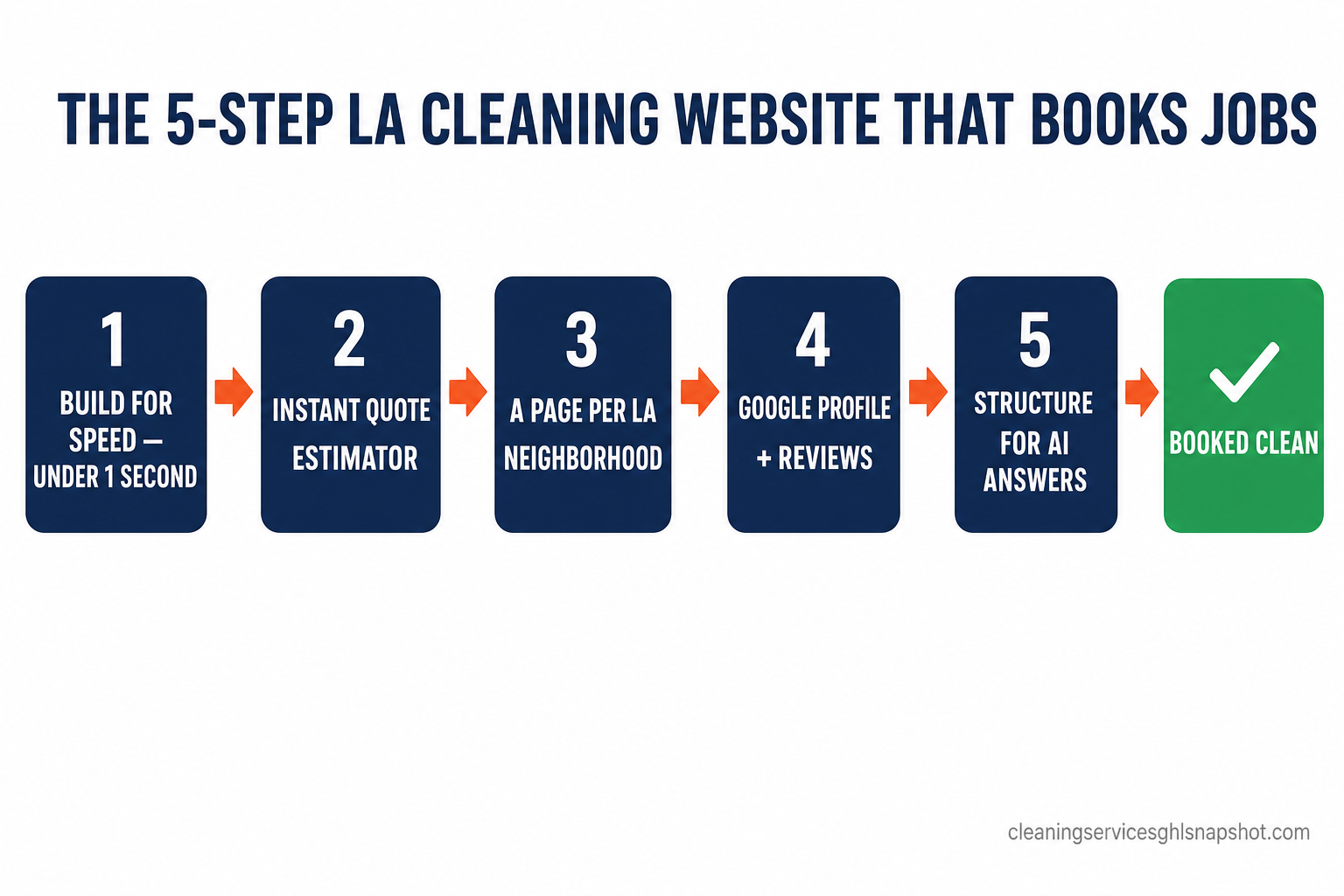
The rest of this guide is the fix, in the order that matters. Do them in sequence: speed makes the page get seen, the estimator makes it convert, location pages make it found, and the CRM connection makes the lead land somewhere you’ll actually work it.
Step 1: Build for speed first, everything else second
Speed isn’t a nice-to-have; it’s the gate every other feature sits behind. If the page doesn’t paint fast on a mid-range phone on LA cellular, none of your copy, reviews, or estimator ever gets seen. Google’s own neural-network benchmark quantified how fast the leak is: as a mobile page’s load time climbs from 1 to 3 seconds the probability of a bounce rises 32%, from 1 to 5 seconds it rises 90%, and from 1 to 10 seconds it rises 123% (Think with Google, 2017). Separately, Google found 53% of mobile visits are abandoned if a page takes longer than three seconds to load (Google, 2016).
Increase in mobile bounce probability as page load time grows. Source: Think with Google, Mobile Page Speed Benchmarks, 2017.
The concrete bar to build to is Core Web Vitals: a “good” Largest Contentful Paint is under 2.5 seconds at the 75th percentile of real visitors, and as of March 2024 Interaction to Next Paint (INP) replaced FID as the responsiveness metric (Google Search Central, 2024). The reason most cleaning sites miss it is the platform: a WordPress theme plus booking, slider, form, and SEO plugins — or a drag-and-drop Wix/GHL page — ships heavy JavaScript that drags mobile load times exactly where the bookings are.
The durable fix is to build static-first. A site built on the Astro framework serves mostly plain HTML from the edge with almost no JavaScript, so it opens in a blink and clears Core Web Vitals with room to spare. We go deeper on the platform trade-offs in Astro vs WordPress for cleaning websites and on the vitals themselves in what Core Web Vitals cost you in bookings — but the headline is simple: pick the fast foundation before you decorate it.
Step 2: Put an instant quote estimator above the fold
The single biggest conversion upgrade for a cleaning site is letting the homeowner get a price without calling. The number every homeowner is trying to work out before they’ll pick up the phone is what will this cost at my house — bedrooms, bathrooms, square footage, weekly or bi-weekly or one-time, standard or deep or move-out. Answer that on the page and you turn an anonymous visitor into a pre-qualified lead with the job details already filled in.
This matters more in LA than almost anywhere because the searcher is high-intent and impatient. Even in Google’s older research, 76% of people who run a local search on their smartphone visit a related business within a day, and 28% of those searches end in a purchase (Think with Google, 2016). That homeowner wants to move now. Make them wait for a callback and, as we covered in instant quote vs callback, they book whoever quoted first.
Step 3: Build a page for every LA neighborhood you serve
“House cleaning near me” is a neighborhood query, not a citywide one. A homeowner in Pasadena searches differently from one in Long Beach, and Google decides who to show partly on whether your site has a real, specific page for that place. 42% of local-query searchers click a result inside the Google local 3-pack, and the top three organic-in-pack positions draw roughly 17%, 15.4%, and 15.1% of clicks (Backlinko, 2024). Individually written location pages are still the single biggest lever a local cleaning company has to get into that pack.
The mistake is one thin “Areas We Serve” page listing thirty neighborhoods. That doesn’t rank. What ranks is a genuine page per place you actually drive to — Santa Monica, Sherman Oaks, Pasadena, Silver Lake, Downtown LA, Long Beach — each with real copy about that area, the services you run there, local landmarks or building types (Westside condos, Valley single-family homes, DTLA lofts), and its own title, meta, and schema. Here’s why the individual-page approach compounds:
Share of local-query clicks captured by the Google local pack and its top positions. Source: Backlinko Local SEO Stats, 2024.
Tie those pages to your local SEO fundamentals — consistent name, address, and phone, and the same service definitions Google uses — and the library of pages does the work of surfacing you across the whole county instead of just your home ZIP.
Step 4: Wire the site to your Google Business Profile and reviews
For a local cleaning company, the Google Business Profile is very often the first thing a homeowner sees — before your website, in the map pack. The website’s job is to reinforce it, not compete with it. That means the same NAP details, the same service list, links to your profile, and reviews pulled onto the site so the trust you’ve earned on Google shows up the moment someone lands on your page.
Reviews are the fuel. We cover the mechanics in how to get more Google reviews for a cleaning business, and the reason it’s worth the effort is that reviews and profile completeness are among the strongest signals for the local pack you’re trying to enter in Step 3. In a market as crowded as LA, the cleaner with 140 recent five-star reviews and a fresh, photo-rich profile wins the click over the one with nine reviews from 2021 — every time.
Step 5: Structure every page so AI can quote you
The way people find a cleaner is shifting, fast. 45% of consumers now use AI tools to find local services — up from just 6% a year earlier — and 64% of AI users trust tools like ChatGPT as much as reviews (BrightLocal, 2026). At the same time, Google’s AI Overviews are quietly eating clicks: when an AI Overview appears, only 8% of searches lead to a click on a traditional result, versus 15% without one, and users click a link inside the overview just 1% of the time (Pew Research, 2025).
Percent of searches that lead to a click, with and without a Google AI Overview. Source: Pew Research Center, 2025.
The takeaway isn’t to panic about lost clicks — it’s to become the thing the assistant quotes. That means answer-first writing (lead each page with the direct answer), question-shaped headings, self-contained passages an AI can lift cleanly, and machine-readable structure: correct schema on every page, a clean sitemap and robots.txt, and an llms.txt file so AI crawlers index you cleanly. We break the approach down in how to show up in AI search for a cleaning business. Build the site this way and when a Los Angeles homeowner asks an assistant “who should I hire to deep-clean my apartment in Koreatown,” your business is in the answer.
Step 6: Make it mobile-first and obviously trustworthy
Cleaning is sold on the impression of careful, thorough, and trustworthy — this is a stranger deciding who to let into their home while they’re out. Your website makes that judgment before anyone reads a word. Stanford’s web-credibility research found 75% of users judge a company’s credibility based on its website design, and studies put 94% of first impressions down to design (Stanford Web Credibility research, cited in a 2015 review). A dated, cramped site quietly says the opposite of “careful and thorough.”
Mobile-first isn’t optional either, because that’s where the searches are. Design for the thumb: a tap-to-call button and the quote estimator visible without scrolling, text large enough to read one-handed, buttons big enough to hit, and no layout shift as the page settles. Everything you built for speed in Step 1 pays off here — a fast, stable, current-looking page reads the way a good clean looks, and it’s what makes a homeowner or a Westside property manager pick you over the six-plugin site that loaded a beat too late.
Step 7: Push every form into your CRM and recover no-shows
A booking that lands in a second inbox nobody checks is a lost booking. The last step is plumbing: every quote request and booking form pushes straight into the CRM your office already watches — by direct API, Zapier, or Make — so leads land where someone will actually work them, and the automated follow-up starts immediately.
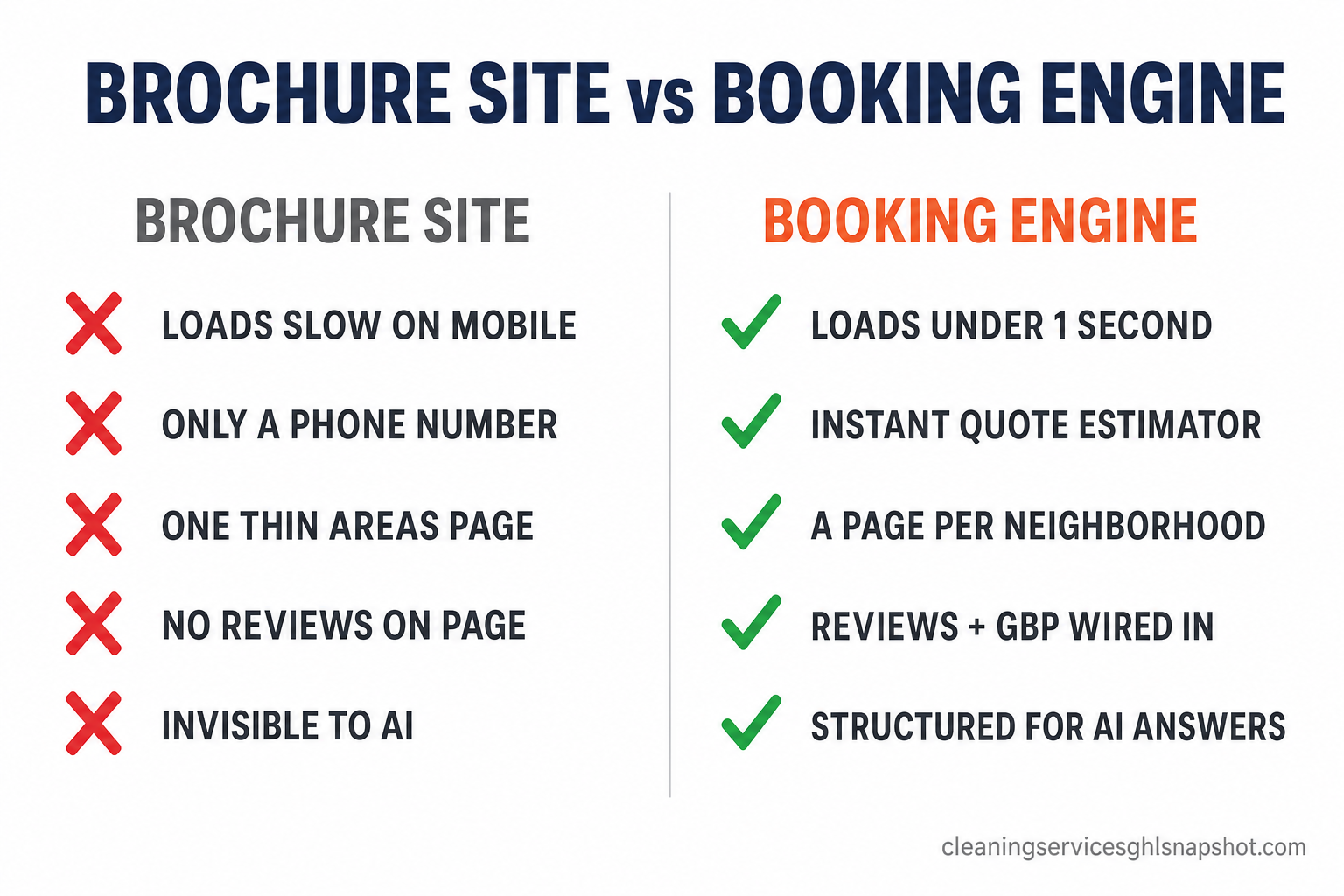
That connection is what turns a website from a billboard into a booking engine. The estimator from Step 2 creates the lead; the CRM catches it, texts a confirmation, sends reminders, and recovers the no-show if the homeowner ghosts the first slot. If you’re running GoHighLevel, this is the same wiring behind the prebuilt website and appointment automation in the snapshot — the site and the CRM are one system, not two tools you bolt together and hope sync.
Build it yourself or have it done for you?
Every step above is doable yourself if you have the time and the technical patience — pick a fast framework, write the location pages, wire the schema, connect the CRM, and keep it all fast as you add to it. Plenty of operators do. The honest trade-off is time: a cleaning owner’s hours are better spent quoting jobs and running crews than fighting Core Web Vitals and rewriting neighborhood pages.
That’s the gap we built Get a Website to close. We build cleaning sites on Astro with a guaranteed 90+ PageSpeed, individually written location pages for every suburb on your route sheet, the quote estimator, schema and llms.txt shipped from day one, and every form pushed into your CRM — fully managed, so you never log in. It’s $97/month plus a one-time $499 build fee, charged only after your site is live and you’re happy with it. Compare it against building it yourself, and against the snapshot bundle, on the pricing page.
Frequently asked questions
How much does a house cleaning website cost in Los Angeles?
A DIY builder like Wix or Squarespace runs roughly $15–$50/month, but you build and maintain it yourself. A custom freelance or agency build in LA typically runs $2,000–$8,000+ up front. A done-for-you managed option like Get a Website is $97/month plus a one-time $499 build fee that's only charged after the site is live — location pages, quote estimator, hosting, and CRM wiring included.
How fast should my cleaning website load?
Aim for a Largest Contentful Paint under 2.5 seconds on mobile, the 'good' Core Web Vitals threshold (Google Search Central, 2024). Google found 53% of mobile visits are abandoned when a page takes longer than 3 seconds to load. Static-first frameworks like Astro make hitting that bar routine; plugin-heavy WordPress and page-builder sites tend to miss it on mobile.
Do I really need a separate page for each LA neighborhood?
Yes, if you want to rank for 'house cleaning near me' across the county. 42% of local-query searchers click inside the Google local pack (Backlinko, 2024), and individual, genuinely written location pages — Santa Monica, Pasadena, Long Beach, Sherman Oaks — are the strongest lever to get there. One thin 'areas we serve' list doesn't do it.
How do I get my cleaning business to show up in AI search and ChatGPT?
Write answer-first content with question-shaped headings and self-contained passages an assistant can quote, and ship correct schema, a clean sitemap, and an llms.txt file. It matters because 45% of consumers now use AI tools to find local services, up from 6% a year earlier (BrightLocal, 2026). See our AI search guide for the full approach.
Can I just use my GoHighLevel or Wix site instead?
You can, and it's better than nothing — but page-builder and GHL-built sites tend to be slower on mobile and harder to structure for location SEO and AI. If most of your quote traffic is mobile (it is), the speed and structure gap costs you bookings. A static-first build closes it; see Astro vs WordPress for cleaning websites for the detail.
Darnell Pierce runs a small GoHighLevel agency serving home-service operators, with cleaning companies making up the bulk of his book. He covers the agency side of the business: what to white-label, what to charge, and how to build a cleaning website and onboarding flow that books jobs without breaking the client’s existing calendar.
Related posts
- Astro vs WordPress for Cleaning Business Websites: Speed, SEO & Bookings Compared
- Cleaning Website Speed in Atlanta: How Core Web Vitals Decide Who Gets the Booking
- How to Show Up in AI Search for a Cleaning Business (San Diego)
- Local SEO for Cleaning Businesses: The Complete Playbook
- How to Get More Google Reviews for Your Cleaning Business (Seattle)